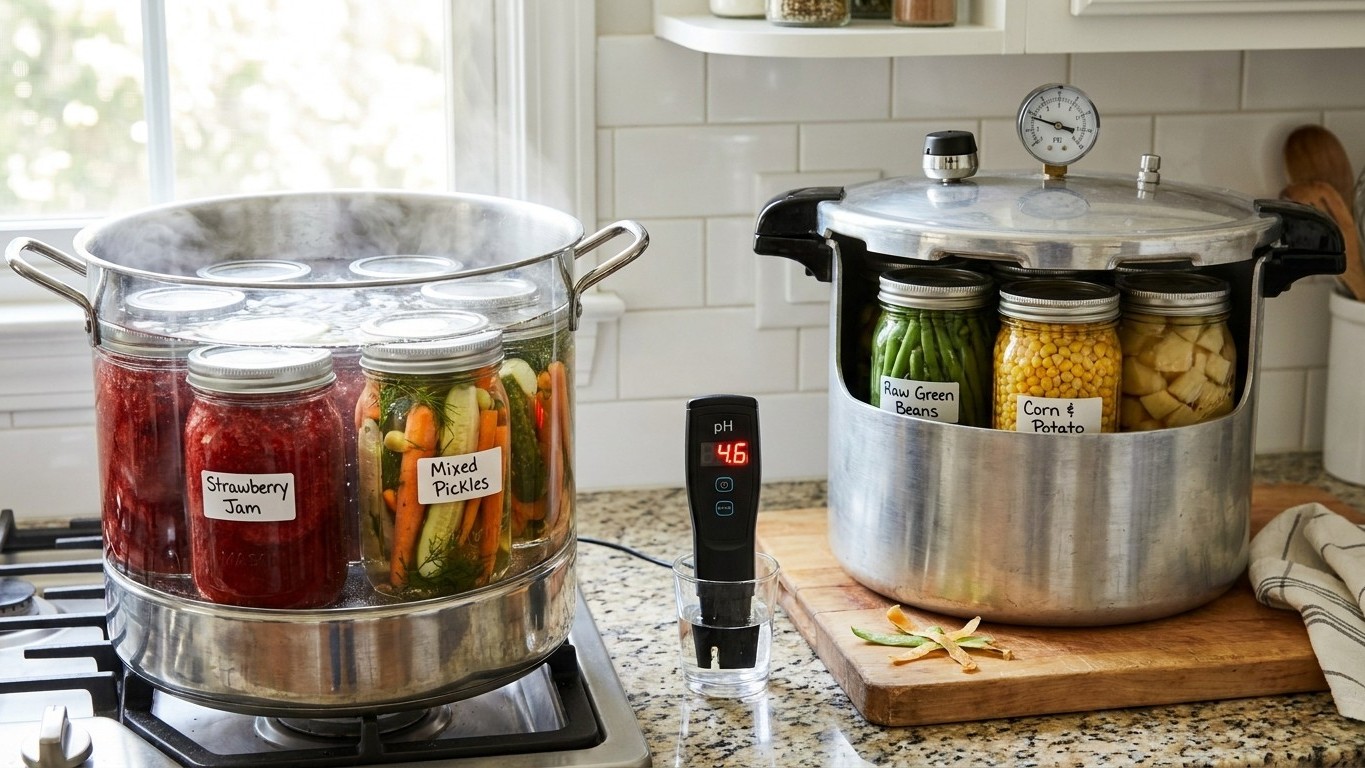

The dividing line is a number: pH 4.6. Foods above it are low-acid and require a pressure canner reaching 240 to 250°F. Foods at or below it are acid and can go in a boiling-water canner, which tops out at 212°F at sea level. This figure, tracked by the National Center for Home Food Preservation at the University of Georgia, decides which equipment sits on your stove and which method you’re allowed to use.
Acid or Low-Acid: The One Question That Decides Everything

Before you pull out a single jar, answer this: is the food you’re canning above or below pH 4.6? That number is the entire reason two different canning methods exist. It’s not a rule of thumb, but a chemical threshold that determines whether heat alone can make a jar safe, or whether it needs help from pressure.
Foods that sit above pH 4.6 are classified as low-acid. That group includes red meats, seafood, poultry, milk, and nearly every fresh vegetable you’d think to can, from green beans to corn to potatoes. These foods need a pressure canner because only the higher temperature it produces, 240 to 250°F, can destroy the bacterial spores that survive in a low-acid, oxygen-poor environment.
Foods at or below pH 4.6 fall into the acid category. Fruits, pickles, sauerkraut, jams, jellies, marmalades, and fruit butters belong here. Their natural acidity does the work that pressure would otherwise have to do, which means a boiling-water canner, reaching 212°F at sea level, is enough to make them shelf-stable.
Why this isn’t always obvious
Here’s where a lot of home canners get tripped up. Some tomatoes are now known to have pH values that creep slightly above 4.6, right at the edge of the acid zone. Figs behave the same way. Both are close enough to the line that they can’t be trusted to fall reliably on the safe side, which is why tested recipes call for acidifying them, usually with bottled lemon juice or citric acid, before they go into a boiling-water bath.
Nothing about the color, smell, or texture of a tomato tells you where it lands relative to 4.6. The only way to know is to rely on measured data and tested guidance rather than intuition or what worked for a neighbor’s garden variety three counties over.
So the question in the title isn’t rhetorical. It’s the first decision every canning session requires, and it has to be made correctly before anything else, because it determines the equipment, the method, and ultimately whether the food inside the jar is safe to eat months later.
What actually decides it
The pH 4.6 threshold isn’t an arbitrary number picked for convenience. It marks the point below which Clostridium botulinum, the bacterium responsible for botulism, can’t grow. Above that pH, in a low-oxygen, low-acid environment, the bacterium can produce a toxin that has no taste and no smell. You cannot detect it by opening the jar and checking. That’s the entire reason the acid/low-acid split exists.
Clostridium botulinum needs three specific conditions present at the same time to grow and produce toxin. Remove any one of them and the risk collapses. A sealed jar of unprocessed low-acid vegetables happens to supply all three without anyone intending it to:
- A moist, low-acid food. This is removed by acidity, either the food’s natural pH being at or below 4.6, or by adding acid through a tested recipe. Dry conditions also work against the bacterium, which is part of why canning liquid and headspace matter so much in tested procedures.
- A temperature between 40 and 120°F. This is removed by heat high enough to destroy spores, which for low-acid foods means the 240 to 250°F a pressure canner can reach. Boiling water alone, at 212°F, never gets hot enough to do this job for low-acid foods.
- Less than 2 percent oxygen. This condition is actually created, not removed, by the canning process itself. A sealed jar is a low-oxygen environment by design, which is exactly why the other two conditions have to be eliminated deliberately.
The seal that makes home canning possible, the one that keeps food shelf-stable for months, is also the seal that creates one of the three conditions the bacterium needs. You can’t avoid making a low-oxygen environment; that’s the point of canning. So the entire safety structure of the low-acid method rests on eliminating the other two conditions with certainty, either through acidity or through sustained high heat.
This is also why altitude changes the math without changing the chemistry. Water boils at a lower temperature as elevation rises, and a lower boiling temperature kills less. According to the USDA Complete Guide to Home Canning, this is compensated for by increasing the process time or the canner pressure, not by changing the method itself. The three conditions stay the same everywhere. What changes is how much heat and how long it takes to reliably remove them at your specific elevation.
Once you understand the mechanism this way, classifying an unfamiliar food gets simpler. Ask whether it’s moist, whether it sits above or below pH 4.6, and whether a sealed jar of it would create a low-oxygen pocket. If the answer points to low-acid, it needs pressure. If it’s genuinely acid, or acidified to a tested level, boiling water is enough.
How to do it
Once you know whether a food is acid or low-acid, the process itself follows a fixed order. The steps below apply broadly, but the specific times, pressures, and headspace measurements always come from a tested recipe for that exact food, never from general knowledge.
- Confirm the acid classification. Determine whether the food is acid, low-acid, or a borderline case like tomatoes or figs that requires acidification before anything else happens.
- Select the correct canner. Choose a boiling-water canner for acid foods or a pressure canner for low-acid foods, based on the classification from step one, not on habit or what’s already on the stove.
- Prepare the food according to a tested recipe. This includes any required acidification, cutting, blanching, or raw-pack versus hot-pack decisions specified by the recipe source.
- Fill the jars, leaving the headspace the recipe specifies. Headspace amounts vary by food and jar size, and the correct figure comes from the recipe, not from memory.
- Remove air bubbles and wipe the jar rims. A clean rim is what allows the lid to seal properly in the next steps.
- Apply lids and bands according to the manufacturer’s instructions. This step happens before the jars go into the canner, not after.
- Process the jars for the time and, if applicable, the pressure stated in the tested recipe. This is the step where altitude adjustments apply, and where the specific figures always come from the recipe source rather than general guidance.
- Cool the jars undisturbed and check the seals. This happens after processing ends, once the canner has depressurized or the boiling bath has been removed from heat according to the recipe’s cooling instructions.
Every one of these steps depends on the acid/low-acid decision made at the very start. Skip that decision, or get it wrong, and no amount of careful jar-filling or rim-wiping downstream will fix it.
What goes wrong
Most canning failures trace back to a mismatch between the food’s actual acidity and the method used to process it. Here’s what tends to show up, and what to do once it’s already happened.
- A low-acid food was processed in a boiling-water canner. If you realize this before the jars are opened and eaten, don’t taste the contents to check. Discard the food, since boiling water alone can’t reach the temperature needed to destroy spores in a low-acid environment, and there’s no way to visually confirm safety.
- Tomatoes or figs were canned without acidification. Because these foods sit close to the pH 4.6 line, unacidified jars can’t be assumed safe even if the recipe was otherwise followed correctly. Treat them the same as a low-acid food processed with the wrong method.
- A jar failed to seal. This isn’t a low-acid versus acid issue specifically, but an unsealed jar means the low-oxygen condition C. botulinum needs was never fully established, or was broken afterward. Refrigerate and use the food promptly, or reprocess according to a tested recipe’s instructions for that food.
- The process time didn’t account for elevation. Since water boils at a lower temperature at higher elevation, a processing time meant for sea level won’t deliver the same heat exposure. If this is discovered after the fact, the jars should be treated as unsafely processed and not consumed based on appearance or smell alone.
- A recipe was adjusted or scaled without checking against a tested source. Changing ingredient ratios, jar sizes, or acidity levels from a tested recipe means the original processing time no longer applies. Jars canned this way fall into the same category as an untested recipe entirely.
In every one of these cases, the common thread is the same: once a jar’s safety is in question, there’s no test you can perform at home, including taste, that tells you whether it’s safe. The only reliable path is comparing what actually happened against a tested recipe’s exact requirements.
Where the exact times come from
A tested time belongs to a tested recipe for a specific food, prepared a specific way, in a specific jar size. There’s no general number that applies safely across the board, because the variables that affect heat penetration, like density, acidity, and piece size, change from one food to the next.
For the exact figures your food requires, go to the National Center for Home Food Preservation and look up that specific food’s page. The USDA Complete Guide to Home Canning is the other authoritative source for these figures, and both are built on lab testing rather than tradition or estimation.
The reason this caution matters comes down to one fact: botulinum toxin has no taste and no smell. A jar that looks, smells, and tastes completely normal can still be dangerous if the time or pressure used to process it fell short of what the food actually required. There’s no way to catch that mistake after the fact by inspecting the jar. The only safeguard is using the correct figure before the jar is ever sealed.
Common questions
Can I tell if a food is acid or low-acid just by tasting it?
No. Taste doesn’t reliably indicate pH, and some low-acid foods can taste tangy or fresh without being anywhere near acid enough for boiling-water processing. Classification has to come from measured pH data, not from how the food tastes raw or cooked.
Why do tomatoes need extra attention if they’re usually considered a fruit?
Some tomato varieties have pH values slightly above 4.6, close enough to the safety threshold that they can’t be assumed acid without acidification. Adding bottled lemon juice or citric acid according to a tested recipe brings them reliably below the line.
Does a pressure canner work for acid foods too?
Yes, a pressure canner can process acid foods safely, though tested recipes for jams, jellies, and pickles typically call for boiling-water processing since it’s sufficient and often faster for that category.
If my kitchen is at a higher elevation, does that change whether a food is acid or low-acid?
No. Elevation doesn’t change a food’s pH or its classification. What changes is the processing time or pressure needed, since water boils at a lower temperature at higher elevation and that lower temperature kills less unless compensated for.