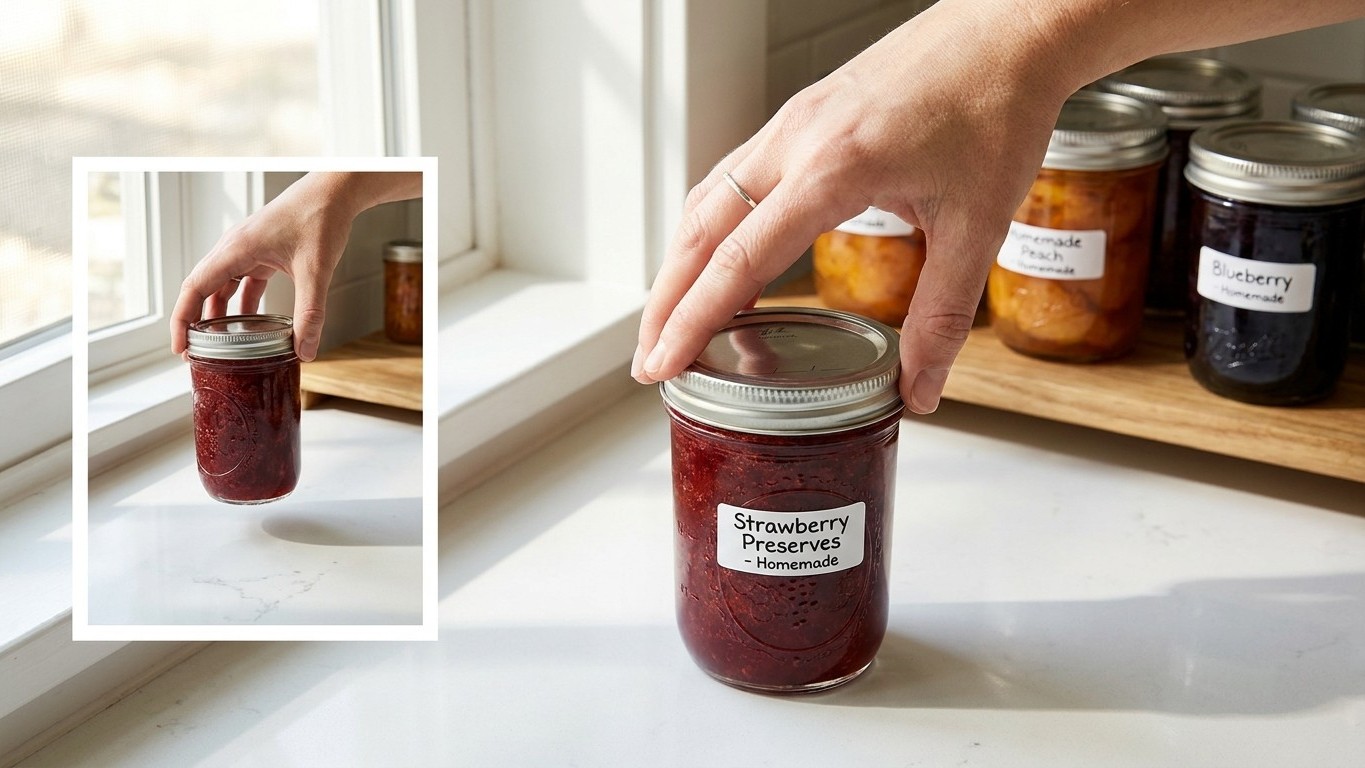

A sealed jar lid sits flat and slightly concave, and it doesn’t move when you press the center. If it pops up and down under your finger, or flexes at all, the seal didn’t take. At that point you have three options: refrigerate the jar and eat the contents within a few days, reprocess it with a new lid within 24 hours, or freeze it instead, and the choice depends on the food and how much time has passed.
The short answer

Testing a seal comes down to physical evidence, not guesswork. Once a jar has cooled for the full 12 to 24 hours recommended after processing, remove the screw band and check the lid three ways: look at it (it should curve slightly downward in the center, not bulge up), press it (no give, no click), and lift the jar by the lid alone with the band off. If the lid holds the weight of the jar, the vacuum is real. If it doesn’t, the jar never sealed, or it sealed and then lost the seal, and either way, the food inside is no longer shelf-stable.
The National Center for Home Food Preservation, run out of the University of Georgia, treats this three-part check as the standard way home canners confirm a seal, and it’s worth following exactly because it removes the guesswork that gets people into trouble. A jar can look sealed from across the kitchen and still fail the lift test. The lid concavity is the most reliable single sign, since it’s created by the vacuum pulling the metal down as the jar cools, but checking all three together catches the edge cases where one sign alone would mislead you.
What you do next depends on how much time has passed since processing and what’s inside. A failed seal caught within 24 hours can usually be reprocessed with a fresh lid, following the same recipe’s full process time again, or transferred to the refrigerator for near-term use. A failed seal discovered days or weeks later, sitting at room temperature the whole time, is a different situation entirely, that jar goes in the trash, unopened, because you can’t know what happened inside it during the time it sat unsealed at room temperature.
None of this is about taste or smell. A jar that’s gone wrong in a dangerous way can look, smell, and taste completely normal, which is exactly why the physical seal check matters more than your senses do.
What actually decides it
Everything about canning safety traces back to one number: pH 4.6. Foods above that threshold are classified as low-acid, and foods at or below it are classified as acid. That single line determines which canning method a food requires, because it determines whether a spore-forming bacterium called Clostridium botulinum can grow inside a sealed jar.
Low-acid foods include red meats, seafood, poultry, milk, and nearly all fresh vegetables. Acid foods include fruits, pickles, sauerkraut, jams, jellies, marmalades, and fruit butters. Some tomatoes and figs sit right at the edge, with pH values that can run slightly above 4.6 depending on variety and growing conditions, which is why both are acidified with lemon juice or citric acid before canning rather than trusted to be naturally safe.
Clostridium botulinum doesn’t need much to thrive. It needs three conditions together, and a sealed jar of unprocessed low-acid vegetables happens to supply all three at once:
- A moist, low-acid food. This is removed by acidifying the food, or bypassed entirely by using a pressure canner that reaches temperatures a boiling-water bath can’t.
- A temperature between 40 and 120 F. This is removed by refrigeration below 40 F or by destroying the spores at the higher heat a pressure canner provides, since boiling water alone doesn’t get hot enough to kill them.
- Less than 2 percent oxygen. This is exactly what a proper seal creates on purpose, and it’s why the vacuum you’re testing for is also the condition that makes low-acid food dangerous if it hasn’t been processed at pressure-canner temperatures.
That last point is the one that trips people up. The seal you want, the vacuum that keeps food shelf-stable, is the same seal that creates ideal growing conditions for botulinum spores if the food was low-acid and never reached a high enough temperature to kill them. A boiling-water canner tops out at 212 F at sea level. A pressure canner reaches 240 to 250 F. That 30-to-40-degree gap is the difference between killing spores and simply sealing them in with food they can grow in undisturbed.
Once you know a food’s pH, you can classify almost anything you’d realistically can at home, even something you’ve never canned before, just by asking whether it’s a fruit or a vegetable, and whether it’s been acidified.
How to do it
Testing and reacting to a seal follows a fixed order, and skipping ahead is how mistakes happen.
- Let the jars sit undisturbed for 12 to 24 hours after removing them from the canner, since a seal isn’t final until the jar has fully cooled.
- Remove the screw band from each jar. The band isn’t part of the seal, it just holds the lid in place during processing, and leaving it on hides problems.
- Look at the lid’s center. It should be flat or curved slightly downward, not domed upward.
- Press the center of the lid with a finger. It should not move, click, or flex at all.
- Lift the jar by the edges of the lid alone, with no band and no hand underneath. A sealed lid holds the full weight of the jar without popping off.
- Label and store any jar that passes all three checks, without the band if you prefer, since the band isn’t needed for storage and can trap moisture against the lid.
- Set aside any jar that fails, and decide within the next step whether to refrigerate, reprocess, or freeze it, based on how long it’s been since the original process time came from the recipe.
- Reprocess a freshly failed jar with a new lid, following the process time given in that specific recipe again from the start, only if it’s still within the same day.
The process time itself, and the canner pressure if the recipe calls for one, always comes from the tested recipe you’re following, at the step where the jars go into the canner. That number changes by food, jar size, and altitude, which is exactly why it isn’t given here.
What goes wrong
- The lid flexes or clicks under a finger press. The jar never sealed. If it’s within 24 hours of the original processing, reprocess with a new lid using the recipe’s full process time again, or move the jar straight to the refrigerator and plan to eat the contents soon.
- The lid pops off when lifted, even though it looked sealed. Treat this exactly like a failed seal caught early, refrigerate or reprocess, don’t assume the food is fine just because the jar sat quietly on the shelf for a while.
- A sealed jar is found weeks or months later with a bulging lid, spurting liquid when opened, or an off odor. Discard the jar and its contents without tasting anything. Wrap the sealed, unopened jar in a bag before throwing it out if you suspect contamination, since spores can be present without any visible sign at all.
- A jar sealed properly but the liquid level dropped noticeably during storage. This usually points to a slow, small leak rather than a failed seal outright. Refrigerate and use the food soon rather than trusting long-term storage.
- You canned a low-acid vegetable in a boiling-water bath by mistake, and it sealed perfectly. A good seal says nothing about whether the food inside reached a safe temperature. If the processing method didn’t match the food’s classification above or below pH 4.6, discard the jar regardless of how the seal looks, because the seal was never the issue.
- You’re not sure how long a jar has been sitting, and you can’t recall if it sealed correctly at the time. When in doubt, don’t taste it to find out. Discard it. Botulinum toxin has no taste and no smell, so a jar that seems fine tells you nothing about what’s inside.
Where the exact times come from
A processing time, a canner pressure, or a jar-size recommendation only means something attached to a specific tested recipe. A time that’s safe for pint jars of green beans isn’t safe for quarts, and a time developed at sea level isn’t safe at 5,000 feet, since water boils at a lower temperature as elevation rises and a lower boiling temperature kills less. The canner has to compensate with a longer time or higher pressure, and that compensation has to be tested, not estimated.
For the exact time and pressure your food and jar size require, go to the National Center for Home Food Preservation page for that specific food. Using a time you half-remember, or one you found for a similar-sounding recipe, is exactly how low-acid food ends up under-processed. The danger isn’t theoretical: botulinum toxin has no taste and no smell, so an under-processed jar can pass every seal test and still not be safe to eat.
Common questions
Can I re-tighten the band and try the seal again later?
No. Retightening a band doesn’t create a vacuum, and it can mask a lid that’s already failed. Once a jar has cooled, the seal is what it is; the band has no role in fixing it.
Does a sealed jar guarantee the food inside is safe?
No. A seal only confirms the jar reached and held a vacuum. It says nothing about whether a low-acid food was processed long enough, or at high enough pressure, to destroy botulinum spores. The seal and the process time are two separate safety checks.
How long should I wait before checking a seal?
Let jars sit undisturbed for 12 to 24 hours after they come out of the canner. Checking too early, while the jar is still cooling, can give a false reading in either direction.
What if only the liquid looks cloudy, but the seal and lid look fine?
Cloudy liquid alone isn’t a reliable sign of anything specific, but it’s not something to explain away either. If you have any doubt about a jar, whether from a cloudy look, a strange odor, or a lid that seems off, the safest move is to discard it without tasting it.