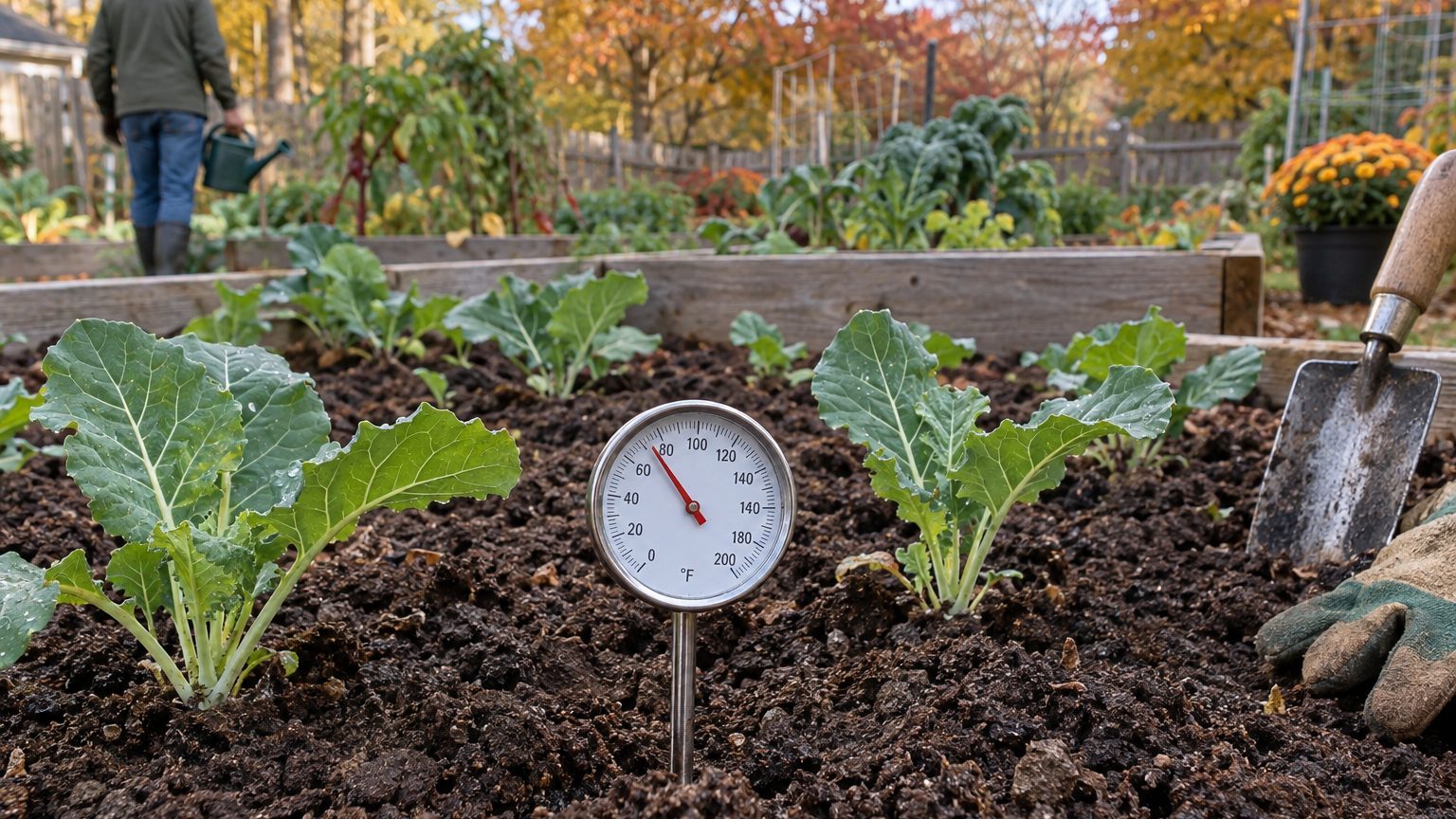

Collards go into Louisiana ground twice a year in most parishes: a spring crop that beats the summer heat, and a fall crop that can keep producing straight through a mild winter. The frost calendar that guides gardeners farther north barely applies along the Gulf Coast, where the ground rarely freezes at all. What decides planting dates here is soil temperature and how much heat the plant can outrun before summer arrives.
When the soil is warm enough in Louisiana

The frost date question has an answer, but it’s a slippery one in this state. NOAA’s 1991-2020 Climate Normals put the last spring freeze at the reference station in a window of January 18 to February 8, based on 32°F freeze probabilities in the 30-70% band. That’s the number most planting charts will hand you. But a frost date is a probability, not a promise, and in south Louisiana it’s a particularly soft one: a 32°F freeze shows up in only 86.8 percent of years at this station, which means roughly one winter in seven brings no freeze at all. Some years the “last frost” simply never happens.
Why frost isn’t the real trigger
Collard seed germinates and grows on soil temperature, not on the calendar square where a frost risk drops below a threshold. Soil lags behind air temperature by a couple of weeks, so even once the freeze window closes, the ground needs time to catch up before seedlings take off with any vigor. In practice, that means treating the frost date as the earliest possible marker, not the target date itself, and watching the bed rather than the almanac.
North Louisiana is a different story. Freezes there are far more reliable than along the coast, so the frost window matters more as a hard planning line, and gardeners in the northern parishes should lean on it more literally than someone gardening near the Gulf.
Collards are brassicas, in the same family as cabbage, kale, and mustard, and they pick up the same soil-borne diseases and pests. A bed that grew any of those crops last season isn’t a clean start for collards, whatever it looks like on the surface. Louisiana’s warm, humid soil keeps those pathogens active longer than a drier climate would, which makes rotating collards out of any recent brassica bed worth doing every season, not just when trouble shows up. For the full rotation logic, the crop rotation guide on this site lays out which families to alternate and for how long. And for the actual varieties worth planting, this page intentionally names none: the types trialled and recommended for Louisiana conditions are listed by the LSU AgCenter, and that list is the one worth trusting over anything printed on a seed rack.
How long the season lasts here
Do the subtraction with both frost dates from the Normals and something unusual falls out. The last spring frost runs January 18 to February 8, and the first fall frost runs December 17 to January 8, of essentially the same winter stretch. Counting from the latest possible spring frost date to the earliest possible fall frost date gives a frost-free stretch of roughly 312 days, and in a milder year, when the earlier spring date and later fall date both apply, that stretch pushes past 350 days. Either way, the frost-free season in Louisiana runs close to the full calendar, which is not something a gardener in Ohio or Minnesota gets to plan around.
What a long window actually buys you
A season that long allows something a six-month growing window never does: a real second sowing, timed independently of the first, rather than a rushed catch-crop squeezed into whatever’s left of summer. Gardeners here can put in a spring planting well ahead of the heat, let it finish or bolt out as temperatures climb, then start a fall planting on its own schedule without worrying about racing an early freeze. That’s the succession approach worth mapping out on the succession sowing guide on this site, since the timing that works for a 312-day window looks nothing like the timing that works where frost shuts things down by October.
The catch is that frost-free doesn’t mean growth-friendly. A long window without a heat limit would make Louisiana a year-round collard state. It isn’t, and the reason has nothing to do with frost at all.
Heat and water in Louisiana

This is where the frost calendar stops being useful and the summer climate takes over. Louisiana summers run hot and humid for a long stretch, with high temperatures pushing well past 90°F on a routine basis and heavy, frequent rain typical of the Gulf Coast keeping humidity high even between storms. Collards tolerate heat better than lettuce or spinach, but sustained heat like this slows leaf production, toughens texture, and opens the door to the fungal and bacterial problems that thrive in warm, wet air. A cool, damp summer would bring slow ripening and mildew; a hot, wet one brings a different set of headaches, mostly around disease pressure and leaves that turn bitter and coarse under stress.
Why winter, not summer, decides the plan
The number that actually splits Louisiana into two different collard climates is the coldest month’s mean daily minimum, which sits at 46.1°F at the New Orleans reference station. That’s mild enough that collards along the coast never really stop growing; they become a standing crop, picked leaf by leaf from November into March, with no hard freeze forcing an end date. Move north, into parishes where winter minimums run colder and freezes are far more dependable, and collards behave more like an ordinary autumn crop: planted for fall, harvested hard, and finished off by the season’s first real freeze.
| Region | Winter pattern | Collard growing pattern |
|---|---|---|
| South Louisiana (Gulf Coast, New Orleans reference) | Mild, coldest month averages 46.1°F minimum, freezes inconsistent | Standing crop, harvested leaf by leaf Nov-March |
| North Louisiana | Colder, freezes more reliable each winter | Autumn crop, ends at the first hard freeze |
The hardiness zone map backs this split up at a glance: Louisiana spans USDA Zones 8a to 10a, a wide range built on one variable, the average annual extreme minimum temperature. That range is exactly why a single planting calendar for “Louisiana” doesn’t hold up, and why the coldest-month figure for your own parish matters more than the state average ever will.
Which collards suit Louisiana
None of this points to a single best variety, and it shouldn’t. What the state’s climate does point to is a type of plant to look for, and that’s a more useful answer than a name on a seed packet anyway.
Reading the climate into a plant type
Where the effective season is long but interrupted by brutal heat, as it is across most of the state, disease resistance becomes the first filter, since humidity and warmth together push fungal and bacterial leaf problems harder than they would in a drier climate. After that, look for types bred with some tolerance to bolting and heat stress, since that’s what determines whether a spring planting survives into early summer instead of turning bitter and running to seed. In north Louisiana, where the growing window narrows and a hard freeze reliably ends the season, earliness moves up the list too, since a slower-maturing type simply may not finish before the cold arrives.
Spacing and airflow matter as much as the plant’s genetics. Wide-set rows with mulch at the root reduce the still, damp air around lower leaves that fungal diseases depend on, and that single practice does more for a humid-climate collard bed than any variety choice will.
What this page won’t do is hand over a cultivar name, because the varieties actually trialled for Louisiana conditions, and shown to perform in local heat and humidity, are the ones tracked by the state’s land-grant extension service. The LSU AgCenter publishes exactly that list, parish by parish in some cases, and it’s built on local trial data this page simply doesn’t have. That’s a better starting point than any generic recommendation, including this one.