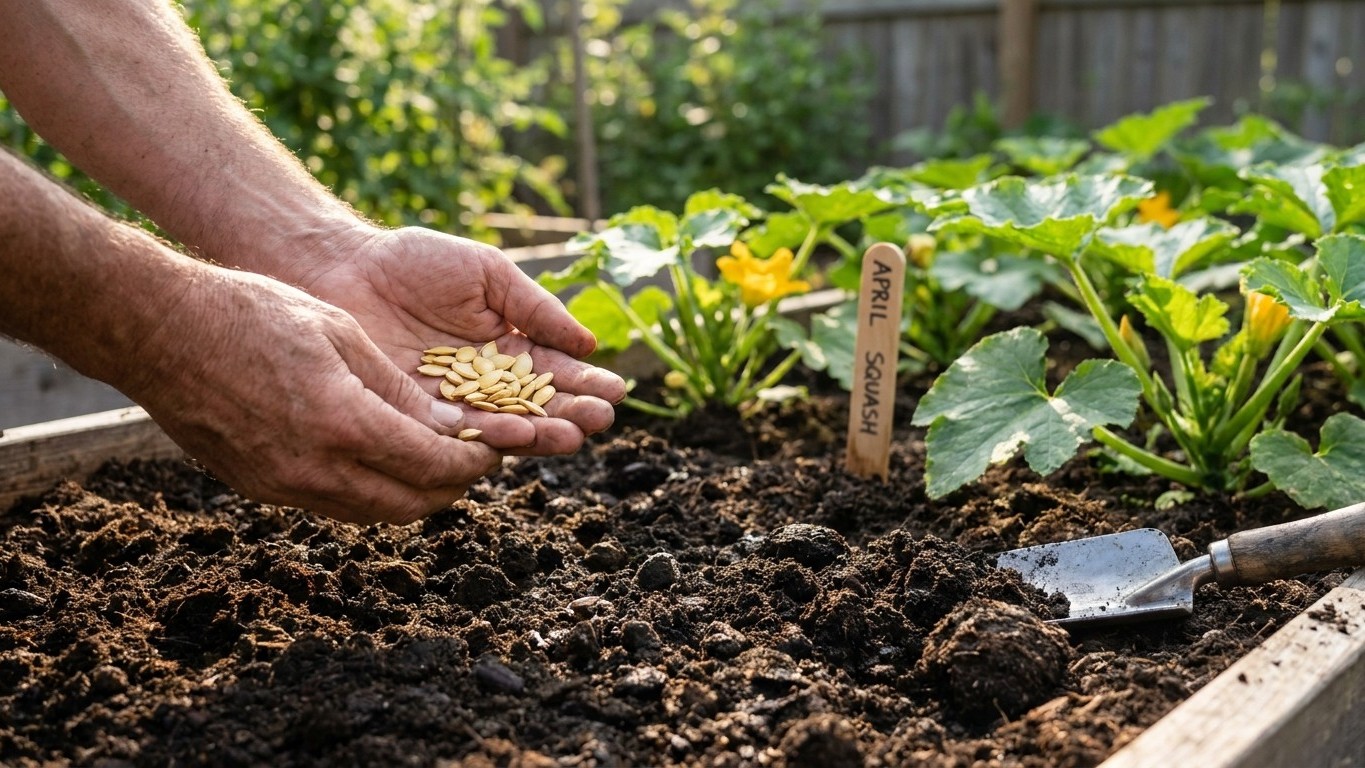

Summer squash goes into Louisiana soil twice a year, not once. The spring window opens once the last-frost risk clears in mid-to-late February for the New Orleans area, and a second sowing in August beats the state’s late first fall frost with room to spare. Heat, not cold, is what actually limits the calendar here.
The short answer for Louisiana
NOAA’s 1991-2020 Climate Normals put the last spring 32-degree freeze at the reference station between January 18 and February 8, and the first fall freeze between December 17 and January 8. Those dates mark the window where a 32-degree freeze has a 30 to 70 percent chance of occurring, not a guarantee. That distinction matters more in Louisiana than almost anywhere else in the Southeast, because the same data shows a 32-degree freeze happens in only 86.8 percent of years at this station. Roughly one winter in seven skips a hard freeze entirely, and the fall side of the window slides past New Year’s Day in some years.
So the frost calendar here isn’t really the obstacle. Once the last-frost window closes in early February, soil in the New Orleans area is usually workable and warm enough for direct-sown squash seed by mid-to-late February. Seeds rot in cold, wet ground below the mid-60s, so growers further from the coast wait for the soil itself to warm rather than the calendar date alone.
The real ceiling on spring planting is how fast the heat builds afterward. The reference station averages 70.7 days a year at or above 90 degrees, and those days start clustering by late spring. Summer squash sets fruit poorly once daytime highs sit consistently in the mid-90s with humid nights, so the spring crop is really a race: get flowers pollinating before the heat load shuts pollen viability down.
The second sowing, in August, works because the fall frost date is so late. With the first freeze not expected until mid-December at the earliest, and sometimes not until January, a squash crop sown in August has close to four months of frost-free growing before cold becomes a factor at all. What ends the fall crop early most years isn’t frost. It’s disease pressure building through the humid tail end of summer.
What will not work here
Planting through the middle of summer and expecting a steady harvest is the most common mistake. With 70.7 days a year above 90 degrees concentrated in June, July and August, blossoms drop before they set fruit, and squash vine borer moths lay eggs at their heaviest rate in exactly this stretch. A planting that looked fine in May can collapse by July, not from lack of water but from heat stress on the flowers themselves.
Watering on a fixed weekly schedule fails for the opposite reason many gardeners expect. Summer rainfall here isn’t scarce, it averages about 21.3 inches across June, July and August, with July the driest month at 6.79 inches. The problem is how that rain arrives. Much of it falls as short, hard thunderstorms that run off rather than soak in, especially once soil has baked under 90-degree afternoons. A single storm can dump an inch and still leave the root zone dry two days later. A rain gauge, not a calendar reminder, is what actually tells a Louisiana gardener whether the ground needs water.
Tight spacing is another failure point that owes nothing to heat and everything to humidity. Gulf Coast air holds moisture long after a rain event ends, and squash planted close together keeps leaves wet into the afternoon. That’s the setup for powdery and downy mildew, both of which spread fast in Louisiana gardens once the canopy closes. Wider spacing than a seed packet printed for a drier state, and pruning older leaves once the plant is established, matters more here than in most of the country.
Finally, treating the long frost-free stretch as an invitation to plant anytime between February and October is a mistake built into the very data that makes Louisiana’s frost dates unusual. A late-June sowing has to survive the peak of the 90-degree stretch with no head start, and most don’t make it to harvest before heat and borers take the plant down.
What changes across Louisiana
Louisiana spans USDA hardiness zones 8a to 10a, a system built on a single measurement, the average annual extreme minimum temperature. That three-zone spread means there is no single planting date that fits the whole state, only a range anchored to the coastal reference station used above.
| Region | Typical zone | Freeze reliability | Effect on squash calendar |
|---|---|---|---|
| North Louisiana | 8a | Freezes most winters, sometimes hard | Later, firmer spring start; fall crop needs to finish sooner |
| Central Louisiana | 8b-9a | Freezes most years, often mild | Spring start close to the state normal; moderate fall window |
| Coastal / South Louisiana | 9b-10a | Freeze-free in roughly 1 year in 7 | Earliest spring start; fall crop can push later; heat is the binding constraint |
A gardener near Shreveport is working a colder, more reliable freeze pattern than one near Houma or New Orleans, even though both are technically in Louisiana and both read this same state page. The north tends to push spring sowing later and closes the fall window sooner, since a real freeze is more of a sure thing there. The south can often start earlier and stretch the fall crop closer to the calendar’s actual limit, but pays for it with more days above 90 degrees stacked against pollination.
This page can’t tell an individual reader which of those zones applies to their own yard, since microclimate, elevation and distance from the coast all shift the line. The USDA Plant Hardiness Zone Map is the tool built for that, and it’s worth checking against a specific address rather than a parish name, since zone boundaries don’t follow parish lines.
Where to check this for your own county
The state-level numbers above come from one reference station and one hardiness map. A parish extension office works from trial data grown in local soil, under local disease pressure, which is a different and more reliable kind of evidence for a specific garden.
The LSU AgCenter is Louisiana’s land-grant extension service, and it’s the right next stop after this page. Two things are worth looking for there. First, a parish-specific vegetable planting calendar, which will translate the frost-probability windows cited above into working sowing dates for that particular corner of the state, north, central or coastal. Second, variety trial results or recommended cultivar lists, since squash varieties that hold up against vine borer or mildew pressure in one region don’t always perform the same thirty miles away.
A county or parish recommendation from LSU AgCenter beats anything on this page, plainly. This is the state-level answer, built from a single reference station’s frost data and a statewide hardiness range. It’s useful for understanding why Louisiana behaves differently from, say, a inland northern state, but it isn’t a substitute for a number generated from a garden in the same parish, with the same clay or sand, facing the same local mildew strain.
Checking this against your own garden
Every date above is a normal, built from thirty years of station data. A single garden in a single year runs on its own soil, its own drainage, its own microclimate, and that observation outranks any calendar figure once the season actually starts.
Soil warmth by feel is the first check. Cold, damp soil that still feels cool to the back of a hand in mid-morning isn’t ready for squash seed no matter what the calendar says, and seed sown into it usually rots before it sprouts. Warm, slightly dry-at-the-surface soil that’s comfortable to the touch is the better signal than any specific date.
The first flush of male flowers is the second. Squash plants typically produce a wave of male blooms before the female flowers that actually set fruit appear, so an early rush of yellow blossoms with no fruit forming isn’t a failure, it’s a normal stage. What’s worth watching for instead is whether female flowers, the ones with a small swollen bulge behind the petals, are opening and getting visited by bees; if they’re opening and dropping without swelling into fruit, heat stress or a lack of pollinator activity is the likely cause, not the planting date.
The first true leaves, the ones that look like actual squash foliage rather than the rounded seed leaves that appear first, mark how fast that particular plot is running relative to the state normal. A garden that reaches true leaves noticeably faster or slower than expected is telling its owner something real about that yard’s own microclimate, information no regional calendar can capture.