
Melons can be grown in Maine, but only if a gardener treats soil temperature, not the calendar, as the real starting gun. Coastal Portland offers the mildest window in the state; inland and northern counties run weeks behind on both ends of the season, which changes almost every decision that follows, from sowing date to variety type.
When the soil is warm enough in Maine
At the reference station in Portland (NOAA station USW00014764), the last spring frost falls somewhere between April 22 and May 1, based on NOAA’s 1991-2020 Climate Normals. That’s a 30-70% freeze probability band, not a fixed date, meaning even within that window there’s real year-to-year variation. And Portland is the mild end of Maine: inland valleys and the northern half of the state see frost risk linger substantially later into spring.
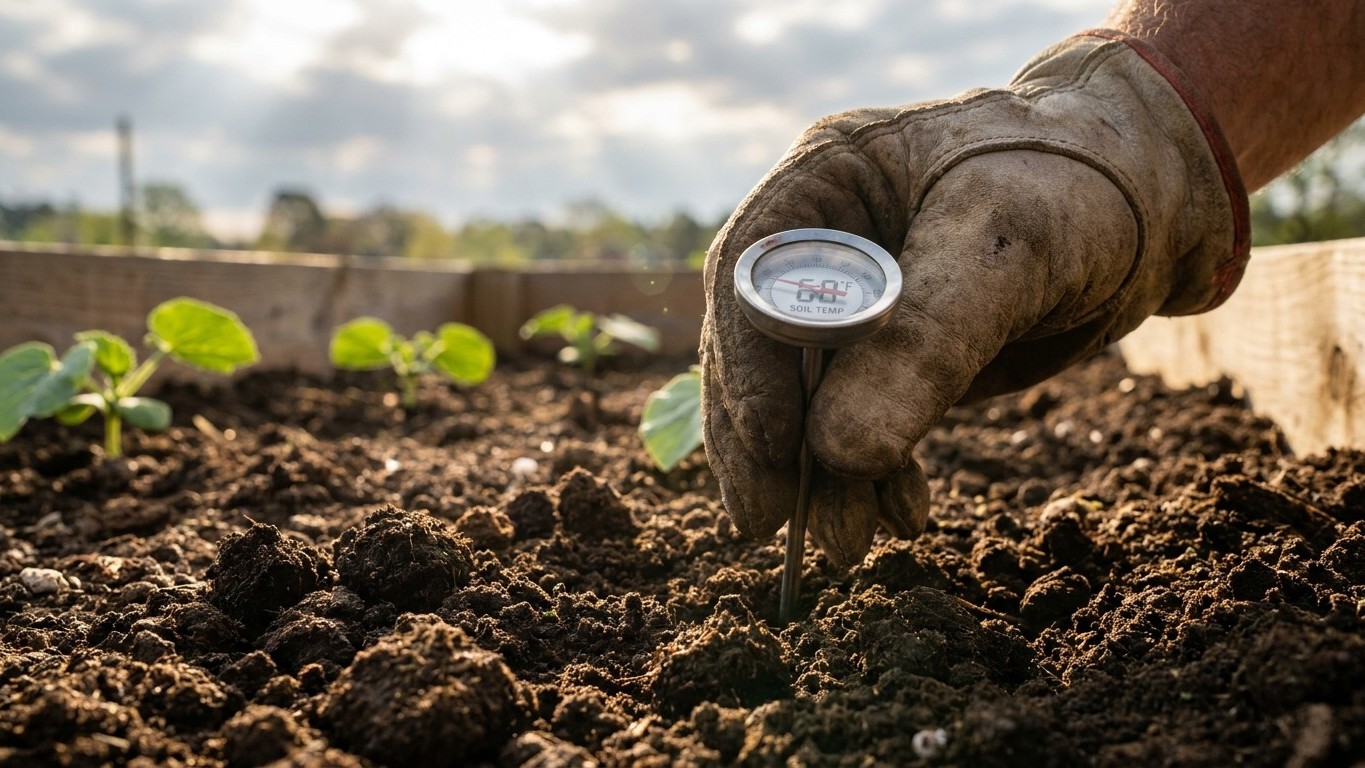
Here’s the part that trips people up. That frost date is a proxy, not the actual signal melons respond to. Melon seeds germinate poorly, and transplants sulk, in soil below roughly 65 degrees Fahrenheit at a few inches’ depth. Air can feel warm on a bright April afternoon while the ground underneath is still cold from winter, especially in clay-heavy soils that hold onto cold longer than sandy ones. So the frost date marks when it’s safe to be outside without a jacket; it doesn’t mark when the soil has actually caught up.
In practice, that means waiting past the stated frost window before direct-sowing melon seed outdoors, and using black plastic mulch or clear row cover to push soil temperature up faster if an earlier start matters. Starting seed indoors three to four weeks ahead, then transplanting once soil has genuinely warmed, is the more common approach across the state, particularly given how short the frost-free stretch already is at the cooler end of Maine.
Why frost probability isn’t a guarantee
A 30-70% band means frost is a coin flip at the edges of that window, not a settled matter. A gardener who plants on April 22 in an inland town is taking a real risk that has nothing to do with Portland’s numbers. This is exactly the kind of local variation that a county extension office tracks year to year, and it’s worth checking their current guidance before committing seed to the ground.
Variety choice matters here too, but not in the way seed catalogs sometimes suggest. Rather than chasing a specific cultivar name, it makes more sense to think in terms of type, such as early-maturing cantaloupe-type melons versus longer-season honeydew types, and then confirm which types have actually performed well in University of Maine Cooperative Extension trials for the reader’s specific county. Extension trial data reflects real Maine seasons; a seed catalog description written for a national audience often doesn’t.
How long the season lasts here
Subtracting the two frost dates gives a growing window that moves depending on where in the state a garden sits. Using the earliest possible last spring frost (April 22) and the latest possible first fall frost (October 21), the frost-free stretch runs up to about 182 days. Using the later spring date (May 1) paired with the earlier fall date (October 9), the same calculation shrinks to roughly 161 days. So depending on location and year, Maine’s melon-growing window falls somewhere between about 23 and 26 weeks.
That range matters more than it looks like it should. A window near the 182-day end gives enough runway to consider a second sowing of a fast-maturing type after an early harvest, particularly along the milder coastal strip. A window closer to 161 days, which is more realistic for inland and northern counties, makes the first sowing the only one that counts. There’s no margin for a failed transplant batch or a cold snap that sets plants back three weeks.
This is also where the transplant-versus-direct-seed decision gets sharper. In a shorter window, a gardener needs transplants that establish quickly without transplant shock, since every week lost to root recovery is a week that can’t be made up later in the season. Checking root development before setting plants out, rather than transplanting on a fixed calendar date, becomes a more important habit in the shorter-season parts of the state than it would be somewhere with a six-month cushion.
For the actual timing of a second sowing, and how to judge whether the remaining season can finish a crop, the site’s succession sowing guide walks through the math in more detail than frost dates alone can settle.
Heat and water in Maine
Melons don’t just need frost-free days, they need accumulated heat, and this is where Maine’s numbers matter more than its frost dates do. At the Portland reference station, the average is just 3.8 days a year at or above 90 degrees Fahrenheit, per NOAA’s 1991-2020 Climate Normals. That’s a low heat-load number by national standards. It doesn’t describe every summer afternoon in the state, since it’s a count at one reference station, but it’s a fair signal that sustained heat, the kind that pushes sugar development in melon fruit, is scarce here rather than abundant.
What that means in practice is that a Maine melon crop lives or dies more on technique than on the sowing date. Black plastic mulch to warm the root zone, row cover to trap heat early in the season, and siting the bed against a south-facing wall or fence all do real work in a state where 90-degree days are the exception rather than the rule. Trying to grow melons the way a grower in a genuinely hot climate would, betting on ambient heat to do the ripening, doesn’t translate well to Portland’s numbers.
Rainfall tells a different story. Summer rain across June, July and August averages about 11.2 inches at the same reference station, out of 48.1 inches for the year. July, the driest of the three summer months, still averages 3.43 inches; June comes in at 4.15 inches and August at 3.57. That’s meaningfully wetter than the near-desert summers some melon-growing regions deal with.
That combination, low heat load plus fairly reliable summer rain, flips the usual melon-growing script. In a hot, dry territory, irrigation decides fruit size and the final couple of weeks before harvest decide sugar content. In Maine, the bigger risks are cool, damp stretches that slow ripening and create the humid conditions that favor powdery mildew and other foliar disease. Airflow between plants, morning watering rather than evening, and avoiding wetting the foliage matter more here than any irrigation schedule.
| Factor | Maine figure | What it drives |
|---|---|---|
| Days above 90°F (annual average) | 3.8 (Portland) | Low heat accumulation; ripening and sugar development are the limiting factor |
| Summer rainfall (Jun-Aug) | ~11.2 inches | Reduces irrigation need but raises disease pressure in humid stretches |
| Driest summer month | July, 3.43 inches | Still a wet month by dry-climate standards |
Which melons suit Maine
Given a short-to-moderate season and a low heat load, the earliest-maturing melon types are the ones with a realistic shot at ripening fully before fall frost arrives, wherever a garden sits within the state’s 3b-6a hardiness range (USDA Plant Hardiness Zone Map, 2023, based on 1991-2020 normals). That range spans a wide swing in winter minimum temperatures across Maine, though hardiness zone speaks to overwintering cold, not summer ripening; it’s cited here because it’s the standard shorthand for describing how much the state’s climate varies from coast to interior.
Type matters more than brand name in this state for a simple reason: an early-maturing cantaloupe-type melon bred for shorter seasons has a real chance of ripening before the first fall frost in an inland county, while a long-season honeydew type bred for a hot climate may still be sizing fruit when frost arrives. Given the summer rainfall numbers above, disease resistance, particularly to powdery mildew, is a second criterion worth weighing seriously, since Maine’s damp summer stretches create exactly the conditions that mildew favors.
This page isn’t going to name a specific cultivar, and that’s a deliberate choice rather than an oversight. Seed catalogs list dozens of melon varieties, and only a fraction of them have actually been trialled under Maine conditions. University of Maine Cooperative Extension (extension.umaine.edu) runs and tracks those local trials, county by county, and their current variety recommendations reflect real performance in real Maine summers rather than a seed company’s national marketing copy. A variety that thrives in Virginia’s summer heat may simply run out of season here.
The more useful homework, then, is contacting the county extension office, describing the specific soil and site conditions, plastic mulch or row cover plans, and season length available in that town, and asking which melon types have actually performed in local trials that year. That answer changes from one growing season to the next as new varieties get tested, which is exactly why a static article can’t responsibly hand out a name and call it settled.