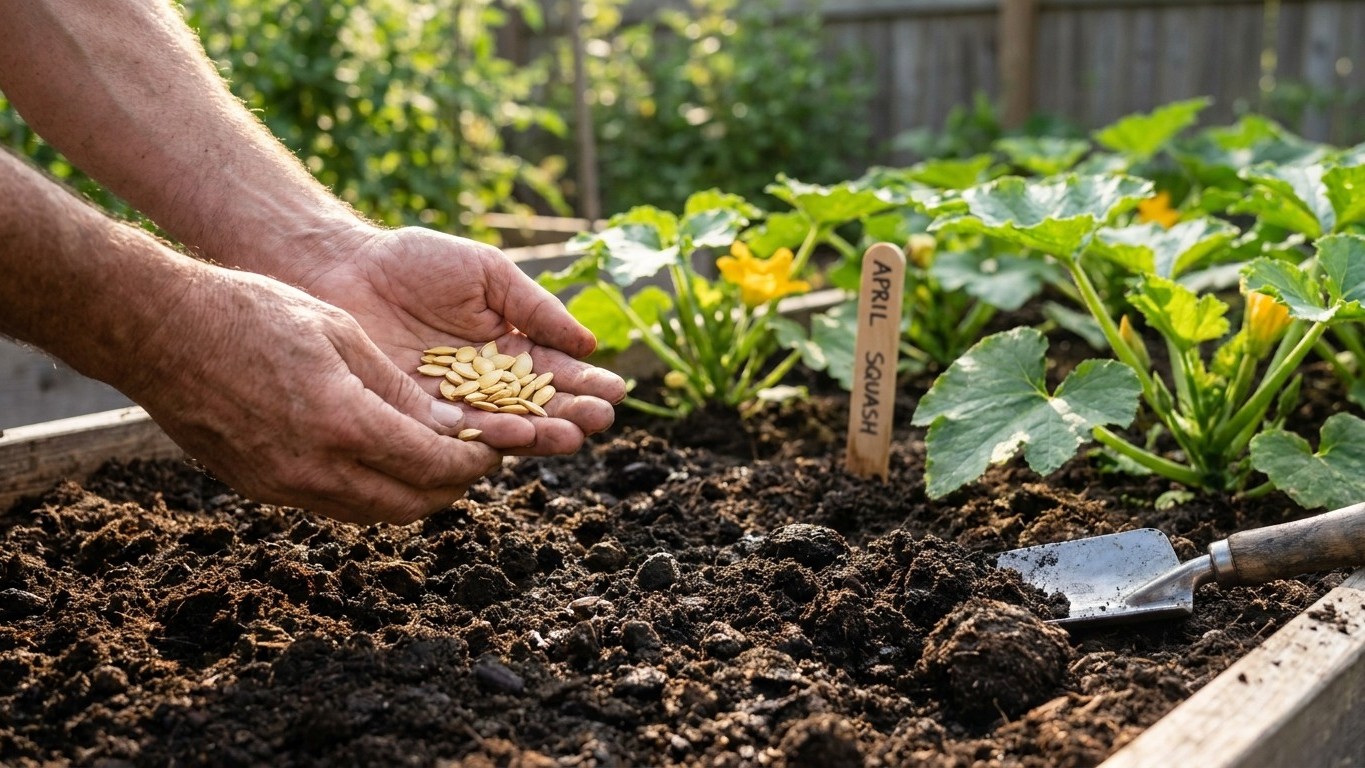

In coastal Portland’s climate zone, summer squash goes into the ground outdoors between roughly May 1 and early June, once the 30-70% frost-risk window from NOAA’s Climate Normals has passed. That’s the state’s mild edge. Inland and northern Maine gardeners need to push that date back and pick faster varieties, because the same calendar simply doesn’t apply once you leave the coast.
The short answer for Maine
NOAA’s 1991-2020 Climate Normals put the last spring frost at the Portland reference station somewhere between April 22 and May 1, and the first fall frost between October 9 and October 21. Those aren’t fixed dates. They mark a 30-70% probability band for a 32°F freeze, which means that even on April 22, there’s still meaningful odds of a killing frost, and the same is true on the other end of the range in October. Summer squash seed rots in cold, wet soil and the seedlings die outright below freezing, so gardeners in the Portland area are generally safe direct-sowing outdoors from around May 1 onward, accepting that anything sown before that date is a gamble against a documented, non-trivial frost risk.
Working backward from the fall side of the calendar sharpens the picture. Using the earliest fall frost date, October 9, as the conservative cutoff, and May 1 as the safer spring start, Portland’s frost-free window runs about 161 days. Using the more generous ends of both bands, April 22 to October 21, it stretches to 182 days. Summer squash varieties typically need 45 to 65 days from seed to first harvest, so even the shorter 161-day window leaves comfortable room. That comfort is exactly why the short answer holds for coastal Maine: there’s enough season length to absorb a slightly early or slightly late planting without losing the crop.
The nuance is in that word “probability.” A grower who sows on April 25 isn’t breaking a rule, they’re accepting odds that sit inside a 30-70% frost chance rather than waiting until the odds drop closer to zero. Some gardeners split the difference by starting seed indoors two to three weeks before the safer outdoor date and transplanting once night temperatures stay reliably above 50°F, which sidesteps the coldest part of the window without pushing harvest later than necessary. Either way, this page’s window is built from the Portland reference station’s own probability bands, not from a rule of thumb borrowed from a warmer or colder state.
What will not work here
The Portland-area normals show only 3.8 days a year reaching 90°F or higher. That’s a low heat load compared to much of the country, and it changes what actually threatens a summer squash planting here. This is not a climate where the plants are likely to bake and stall in a July heat dome. It is a climate where cool, slow-to-warm soil in spring is the real limiting factor, so pushing seed into the ground in mid-April on the theory that “it’s warm enough” tends to backfire: the soil is still cold, germination is slow and uneven, and any of the seedlings that do emerge sit vulnerable right through that 30-70% frost-risk band.
Rainfall works against a different assumption. Summer here averages about 11.2 inches across June, July and August, with July, the driest month, still bringing 3.43 inches. That’s not a dry-summer climate where weekly watering routines fail from underwatering. It’s damp enough, especially combined with the near-total absence of scorching heat, that powdery mildew and other fungal issues on squash leaves are a bigger practical risk than drought stress. Tight spacing that might be fine in a hotter, drier state becomes a liability in Maine’s humid summer air, because leaves stay wet longer and airflow between plants matters more for keeping mildew off the foliage.
Slow varieties run out of runway
The hardiness zone range for Maine, 3b to 6a on the USDA map, spans some of the shortest growing seasons in the continental United States at its cold end. A summer squash variety bred for a 70-day maturity, planted on schedule for coastal Portland, might still finish fine there. The same variety planted on the same calendar date in a zone 3b pocket inland risks running past the first fall frost before it ever reaches full production, simply because the frost-free window in the coldest parts of the state is dramatically shorter than the 161 to 182 days available near the coast.
What changes across Maine
A hardiness zone spread of 3b to 6a is not a rounding error, it’s close to a three-zone difference within a single state’s borders. The USDA Plant Hardiness Zone Map builds that number from one variable only, the average annual extreme minimum winter temperature, but it’s a useful proxy for how much colder, and how much shorter-seasoned, the northern and interior parts of Maine run compared to the coast. Portland sits at the mild end of that range. Northern Maine, at the 3b end, deals with a fundamentally different growing season, one where the frost-free window can close weeks earlier in fall and open weeks later in spring than anything the Portland normals describe.
What that means in practice for a gardener working from this page: the May 1 to early-June sowing window belongs to the coast. Move inland, gain elevation, or head north, and both ends of the frost calendar shift against you, later start in spring, earlier finish in fall, which squeezes the usable growing days from the coastal 161-182 range down toward something considerably shorter. A grower in one of the colder zones should default to the faster end of any variety’s days-to-maturity range and treat the coastal sowing dates as a floor to build backward from, not a target to match.
There’s no way to give a single statewide sowing date that’s honest about this spread. Saying “plant in early May” is defensible for Portland and potentially reckless for a garden two hours inland at higher elevation. This page can only describe the range and the mechanism behind it; it can’t tell an individual reader which zone their own plot falls into, because that depends on local topography, elevation and microclimate factors the statewide map can’t resolve.
Where to check this for your own county
The state-level numbers on this page come from one reference station and a statewide hardiness zone range that spans 3b to 6a. That’s useful for understanding the mechanism, but it’s not a substitute for a county-level recommendation. The University of Maine Cooperative Extension is the source built to close that gap, and it’s the next stop for anyone who wants a planting date sharper than “sometime around the first week of May, give or take three weeks depending on where in the state you are.”
Two things are worth looking for specifically once there. First, a local planting calendar, if the county or regional office publishes one, since it will already have baked in the frost-date shift for that specific area rather than relying on the Portland reference station this page uses. Second, any list of summer squash varieties trialled by the extension service in that county or a nearby one. Variety performance is local: a squash that shrugs off humidity and finishes reliably within the coastal window may perform differently, or simply run out of season, further inland or north, and extension trial data is where that kind of ground-truthed information tends to live.
A county recommendation beats a state one, plainly. This page describes what’s true across Maine as a whole and where that statewide picture breaks down, which is a different job than telling a reader in Aroostook County or in Cumberland County exactly what date to circle on their calendar. That narrower answer, if it exists in published form, is more likely to come from the extension office than from any general guide.
Checking this against your own garden
None of the dates above beat what’s happening in the actual soil a reader is planting into. Three things are worth watching directly, and each tells a different part of the story about a specific plot’s microclimate.
Soil warmth by feel is the first and most direct check. Summer squash seed wants soil that’s no longer cold to the touch, ideally warmed through rather than just thawed at the surface; a bed that still feels chilly a few inches down, even after the calendar says it’s time, is signaling that this particular spot, maybe shaded, maybe low-lying and slow to drain, is running behind the regional average.
The first flush of male flowers is the second signal, and it’s an early one: male flowers typically appear before the female flowers that actually set fruit, so their arrival is a sign the plant has moved past establishment and into active growth, not yet a harvest signal but a useful marker that things are on track.
The first true leaves, the second set that follows the rounded seed leaves, confirm the plant has settled in past germination. If those are slow to appear even weeks after a warm stretch, that’s a better read on this specific garden’s pace than any statewide frost date, and it’s the kind of on-the-ground observation that no regional normal can replace.