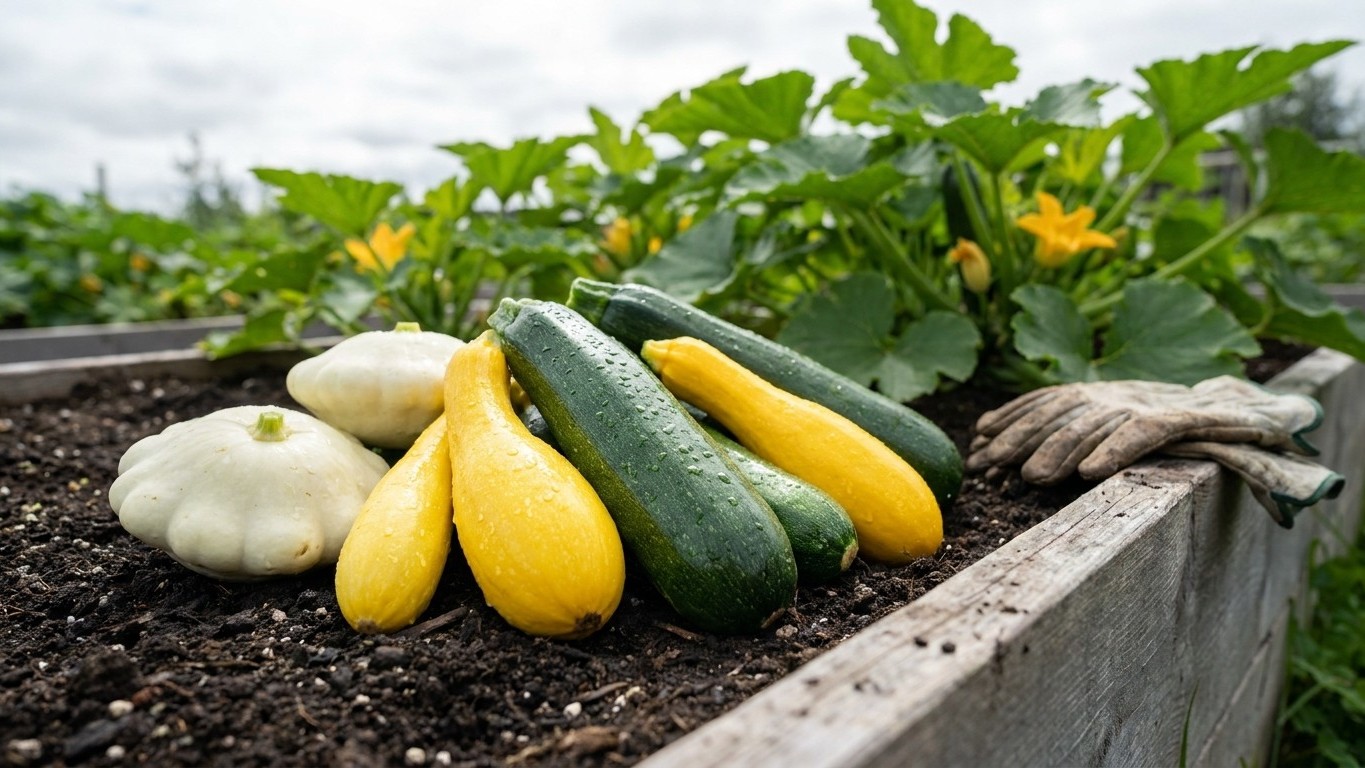

Short-season, fast-maturing bush varieties are the ones that actually finish here. Winnipeg’s climate normals put the frost-free window at roughly 122 days on average, and with zero days a year reaching 90°F, Manitoba gardeners need summer squash that sets fruit in cool nights and races to harvest before the calendar runs out, not varieties bred for long, hot summers further south.
The short answer for Manitoba
Bush zucchini and yellow crookneck types that mature in 45 to 55 days from transplant are the safe bet across this province. The reasoning starts with the numbers Environment and Climate Change Canada publishes for the Winnipeg Richardson International Airport station: an average last spring frost of May 23 and an average first fall frost of September 22. That is a mean gap of about 122 days, but a mean frost date is not a safe date. In half the years on record, frost at each end arrives later than the average, which means the workable season some years is shorter than 122 days, not longer. A squash that needs 65 or 70 days to first harvest is spending its entire safety margin, and then some, on a season that might not deliver it.
Pair that with the zero days a year above 90°F recorded at the reference station. Summer squash does not need scorching heat, but it does need consistent warmth to keep pollinators active and flowers setting fruit steadily. Varieties selected for Deep South or desert growing conditions, which often tolerate or even expect heat stress, are not the ones bred for Manitoba’s cooler, shorter summer. The types that perform here are the early, compact, bush-habit varieties: yellow straightneck and crookneck squash, green and yellow zucchini, and pattypan types sold as “early” or “bush” on the seed packet. These stay compact rather than sprawling, which matters when the growing window is tight and every week of soil warmth counts.
Timing follows directly from the frost data. Because the average last frost is May 23, and because that date runs late in half the years, most Manitoba gardeners start squash indoors three to four weeks ahead and transplant out once the soil has warmed, rather than direct-seeding at the average frost date and hoping. Black plastic mulch or row cover in the first weeks after transplant adds soil heat that this climate does not supply on its own. The type of squash to grow, and the way it is started, both trace back to the same fact: a season centered on 122 days, bounded by frost dates that are themselves only 50/50 bets.
What will not work here
Vining winter-squash-style summer squash and any variety advertised as needing 70-plus days to maturity is the first thing to cross off the list. Run the math against the mean frost window: 122 days between the average last and first frost sounds generous until a late spring frost or an early fall one eats two or three weeks off either end, which happens in roughly half of all years given how these averages are calculated. A 70-day variety planted at the average last-frost date has almost no buffer left if fall arrives even slightly early, and Manitoba’s fall frost date is itself only an average, not a guarantee that runs later.
Direct-seeding into cold, unworked soil is the second common failure. With zero days a year above 90°F at the reference station, this is not a climate that heats garden soil quickly in spring. Squash seed sown into soil that has not warmed sits and rots rather than germinating, which effectively burns days off an already tight season before a single true leaf appears. Gardeners who start seed indoors and transplant, or who warm the bed with plastic mulch first, are working with the season length the frost data actually allows; gardeners who direct-seed on the average frost date and wait are gambling with a shorter one.
Watering on a fixed weekly schedule
Manitoba’s summer rainfall runs about 9.7 inches across June, July and August, with August the driest month at roughly 3.03 inches. That is not a drought climate, but it is not a reliably wet one either, and the monthly totals shift enough that a fixed once-a-week watering habit either overshoots in a wet June or undershoots in a dry August. Combined with sandy garden soil, which drains that same rain within a day, a rigid watering calendar built around the seasonal average rather than the actual bed will stress squash plants precisely when they are setting fruit. The rainfall number only means something once it is checked against the soil type and the week’s actual weather, not treated as a standing schedule.
Heat-dependent pollination is the last trap. Some squash varieties, and squash in general during cool, overcast stretches, set fruit poorly without warm daytime temperatures to keep bees active. A season with no days reaching 90°F is not a season that compensates for that with excess heat elsewhere; it is a season where warmth is the limiting factor from the first flower onward.
What changes across Manitoba
The 3b hardiness zone figure quoted for this province is specific to the Winnipeg Richardson International Airport reference station, using the Canadian system built on seven climate variables, not the single-variable USDA scale used elsewhere on this site. It describes conditions around Winnipeg and nowhere else with certainty. Manitoba is a large province running from the U.S. border up toward Hudson Bay, and a single zone rating for one southern city cannot describe a province that stretches that far north. There is no single answer for “what zone is Manitoba,” and this page does not have the zone figures for other Manitoba municipalities to offer instead.
What that means in practice: a gardener working land north of Winnipeg, or at any distance from the reference station, should expect a shorter frost-free window than the 122-day average quoted here, not the same one. Colder zones generally mean a later average last frost in spring and an earlier average first frost in fall, which compresses the growing season from both directions at once. For summer squash, that argument points the same direction as the season-length caution above but pushes it further: shift transplant dates later relative to the local last frost, lean even harder on the shortest-maturity bush varieties, and treat any 65-plus day variety as a poor fit rather than a marginal one.
None of this can be resolved from a provincial page, because the zone figure here belongs to one station, not to the whole territory. A reader gardening any real distance from Winnipeg is better served checking the Canadian Plant Hardiness map for their own municipality’s rating than assuming the Winnipeg number applies to their yard.
Where to check this for your own county
Manitoba Agriculture, the province’s extension service, is reachable for anyone gardening outside the immediate Winnipeg area, and honestly for Winnipeg-area gardeners too, because everything on this page is built from one reference station’s climate normals, not from trial results grown in any specific county or municipality.
What to look for once there: a local or regional planting calendar, if one is published for the growing area closest to the reader’s own garden, and any variety trial results specific to summer squash grown under Manitoba conditions. Provincial extension services periodically test which zucchini, crookneck and pattypan varieties actually perform in local trial plots, and that kind of result, grown and measured in the ground rather than estimated from climate normals, outranks anything calculated from a frost-date average.
A county or regional recommendation beats a provincial one every time, for a simple reason: this page reasons from a single weather station’s averages applied across an entire province, while a local extension recommendation is built from what was actually planted and actually harvested nearby. This page is the provincial-level starting point, useful for narrowing down variety type and rough timing, not the final word on either. Treat the Manitoba Agriculture site as the place where that starting point gets corrected for wherever the reader actually gardens.
Checking this against your own garden
Every date on this page is an average pulled from one airport weather station, and the reader’s own garden will settle the question more reliably than any of them. Three things are worth watching directly, no thermometer or gauge required.
- Soil warmth by feel: squash seed and transplants sulk in cold soil regardless of the calendar date. If a handful of soil at planting depth still feels cold and damp rather than merely cool, the ground has not caught up to spring yet, no matter what the average last-frost date says.
- The first flush of male flowers: squash plants typically produce male blossoms before female ones. A strong early run of male flowers with few or no female flowers following is often a sign of temperatures still too cool for full fruit set, which matters most in a climate averaging zero days above 90°F.
- The first true leaves: the pair of leaves that follows the initial seedling leaves shows how vigorously the plant is actually growing in the specific bed it’s in. Slow, pale true leaves point to a colder or wetter microclimate than the provincial average suggests; quick, dark green ones mean that particular spot is running warmer than the reference station’s numbers.
None of these observations require equipment, and all three outrank the frost-date averages cited earlier in this page, because they describe the actual bed the plant is growing in rather than a mean calculated from decades of airport data miles away.