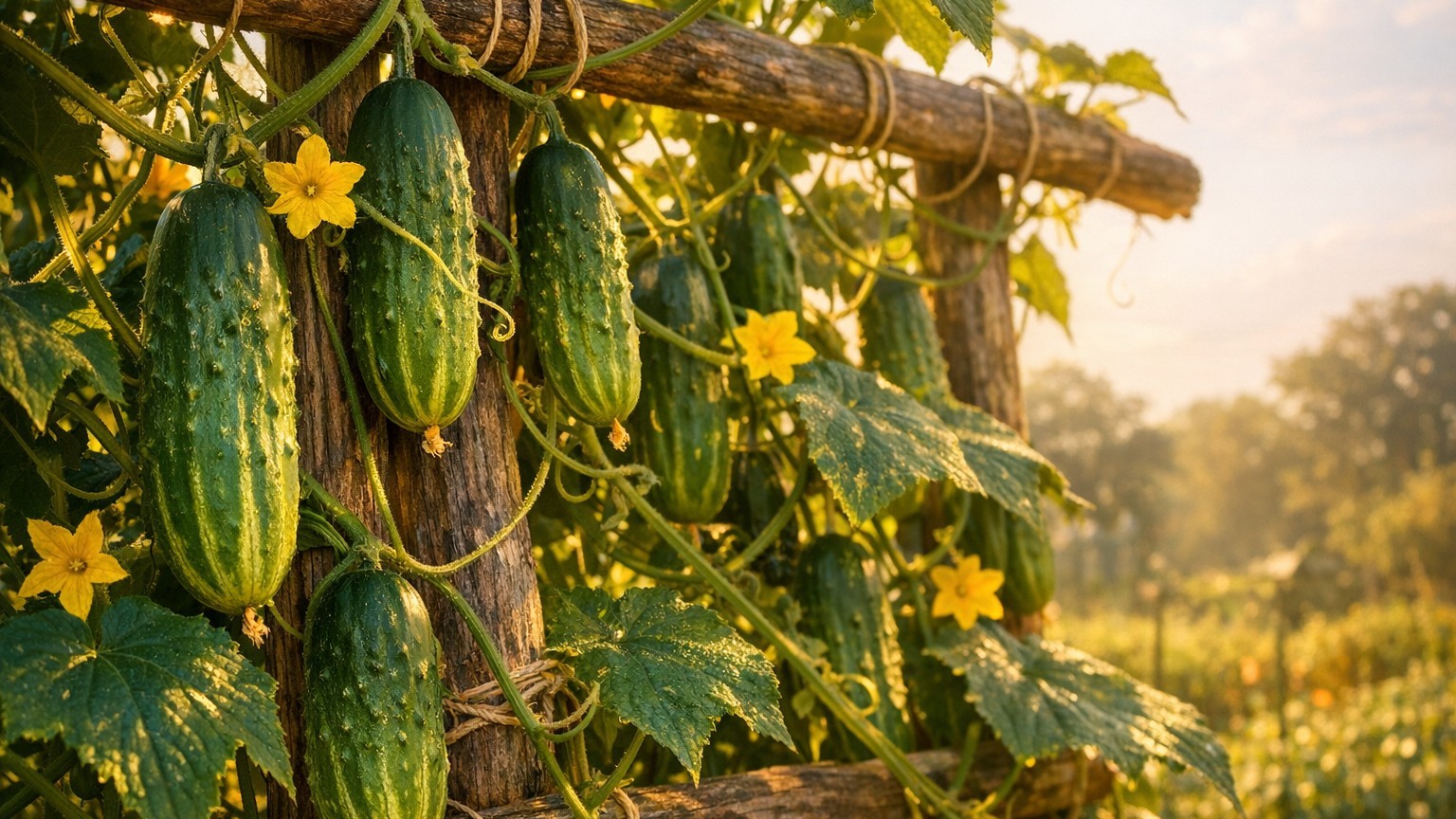

Maryland gardeners get a frost-free window long enough to grow almost any cucumber type from seed to harvest, so the real decision isn’t about days-to-maturity. It’s about which type shrugs off heat and humidity best. That means favoring disease-resistant, trellised, parthenocarpic or monoecious types over anything meant to sprawl unsupported on damp ground through a Mid-Atlantic summer.
The short answer for Maryland
The frost-free season here runs from roughly April 3-16 (last spring frost) to October 26-November 5 (first fall frost), which works out to somewhere around 195 to 215 days depending on where in the state you garden. That’s a generous window. A cucumber vine typically needs 50 to 70 days from seed to first harvest, so Maryland’s season isn’t the bottleneck. You have room for an early planting, a mid-summer succession, and often a fall crop squeezed in before frost returns in late October.
What does matter is the heat and the wet air. Baltimore’s reference station logs an average of 24.6 days a year at 90°F or hotter, and summer rainfall runs about 12.6 inches across June, July and August, arriving mostly as thunderstorms rather than steady soaking rain. That combination, heat plus humid air plus intense but irregular rain, is exactly the recipe for powdery mildew, downy mildew and bacterial wilt spread by cucumber beetles. So the type decision in Maryland comes down to airflow and resistance, not calendar math.
Pickling types (bushier, more compact, often bred for concentrated fruit set) work well if you want a canning crop finished before the worst of the summer humidity peaks in July and August. Slicing types on a trellis do better here than ones left to sprawl, because vertical growth keeps leaves drier and cuts down on soil-splashed fungal spores. Parthenocarpic types, which set fruit without pollination, are worth considering for anyone growing under row cover to dodge early cucumber beetle pressure, since they don’t need bees to reach in.
Burpless and Asian-style long slicers, usually trellised by design, also suit Maryland’s rainfall pattern because the fruit hangs clear of wet soil. Whichever type you land on, the single biggest lever a Maryland gardener has isn’t the variety name. It’s whether the plant is trellised and given room for air to move. Your state extension service maintains lists of varieties actually trialled in Maryland conditions, and that’s where a specific cultivar name should come from, not a general guide like this one.
What will not work here

Unsupported vining types left to sprawl across bare or mulched soil are the most common failure in Maryland gardens, and the reason traces straight back to the rainfall numbers. June averages 3.98 inches, July 4.48, August 4.09, and almost all of it lands as short, heavy downpours rather than gentle steady rain. Water splashes soil-borne fungal spores onto the lowest leaves, and with 24.6 days a year above 90°F keeping the air warm and humid at ground level, powdery and downy mildew move fast once they start. A sprawling plant with dense foliage sitting close to wet soil is close to a worst-case setup here.
Tight spacing compounds the problem. Cucumbers packed close together to save space might work in a dry climate, but in Maryland’s humid summers that density blocks airflow between plants, and airflow is what dries leaves off after a thunderstorm. A garden where mildew shows up by mid-July is very often a spacing and support problem more than a variety problem.
Watering on a fixed weekly schedule also tends to fail here, particularly on sandy soils common on the Eastern Shore. With nearly 25 days a year hitting 90°F or hotter, evaporation demand spikes well above what a single weekly watering can replace, and cucumbers that dry out between waterings often respond with bitter fruit or stalled growth. On sandy ground, that same rain from a thunderstorm can drain through within a day, leaving the plant thirsty again well before the next scheduled watering. Clay soils hold moisture longer, which helps between storms but can also mean root rot risk if drainage is poor and a plant sits waterlogged after a heavy rain event.
Finally, skipping a fall succession planting is less a failure than a missed opportunity, given how late Maryland’s first frost lands. A second sowing timed roughly 55 to 65 days ahead of the October 26-November 5 window can still produce a real harvest, and gardeners who plant once in spring and call it done are leaving weeks of usable season on the table.
What changes across Maryland
Maryland’s hardiness zone range, 5b to 8a under the USDA system, spans a wider gap than the state’s modest size suggests. That range is built on one measurement, the average annual extreme minimum winter temperature, but it hints at how differently the growing conditions play out from one end of the state to the other. There is no single Maryland answer here. Western Maryland, up in Garrett and Allegany counties, sits at the cold end of that range, with elevation pushing both the last spring frost later and the first fall frost earlier than the statewide dates given above. A gardener up there is working with a shorter effective window than the April-to-November span quoted for the reference station, which means faster-maturing types and less room for a late fall succession.
The Eastern Shore runs the opposite direction. Milder winters and a longer frost-free stretch push the season wider at both ends, and that extra length plus the region’s flat, often sandy terrain shifts the pressure toward heat and drought management rather than season length. A trellised, disease-resistant type still matters there, but watering discipline on fast-draining sandy soil becomes the bigger daily concern than it might be on the heavier clay soils found further inland.
Central Maryland, around Baltimore and the DC suburbs, sits in the middle of that spread and is also where the temperature and rainfall figures cited on this page were actually measured. That’s worth knowing, because it means the numbers above describe that corridor than they describe the mountains or the shore. Anyone gardening outside central Maryland should treat the dates and figures here as a starting frame, not a local forecast, and check the spread against their own part of the state before locking in a planting date.
Where to check this for your own county
The University of Maryland Extension service, at extension.umd.edu, is the source that can narrow this down to an actual county rather than a statewide average. This page has given you the state-level picture, drawn from a single reference weather station and a statewide hardiness zone range that spans nearly three full zones. A county recommendation from extension staff who work with local growers will beat that every time, because it accounts for the exact microclimate, soil type and frost pattern of the county you’re actually gardening in.
Two things are worth looking for specifically once there. First, a local planting calendar, if the county or regional office publishes one, will give sowing windows adjusted for local frost dates rather than the statewide range used here, which matters most if you garden in Western Maryland or right along the Chesapeake shoreline where local conditions diverge furthest from the Baltimore reference point. Second, look for any list of cucumber varieties that have actually been trialled through Maryland’s extension research stations or master gardener demonstration plots. That’s the appropriate place to get a specific cultivar name, since those recommendations come from plants grown and observed in Maryland soil and Maryland humidity, not from general categories.
Extension offices also typically track disease and pest pressure specific to a growing season, including outbreaks of cucumber beetle or downy mildew moving through a region, information that a static guide like this one simply can’t provide in real time. If mildew or beetle pressure has been heavy in your county recently, that’s exactly the kind of detail worth asking a local extension agent about before you finalize which type to plant.
Checking this against your own garden
None of the dates or figures above replace what your own soil and plants tell you directly, and three simple observations will usually tell you more than any calendar. Soil warmth by feel is the first and most reliable. Cucumber seed germinates poorly in cold soil, so if the ground still feels cool and damp rather than warmed through when you press a hand into it a few inches down, it’s telling you to wait regardless of what the calendar date says, particularly in a cooler microclimate like a shaded yard or a low spot where cold air settles.
The first flush of male flowers is the second signal worth watching. Cucumbers typically produce a wave of male blossoms before the female flowers, recognizable by the tiny embryonic fruit behind the petals, appear. If you’re seeing plenty of male flowers but no females days or weeks later, that often points to heat stress or a nutrient issue rather than anything wrong with the variety itself, and it’s a cue to check watering consistency before assuming the plant has failed.
The appearance of the first true leaves, the serrated ones that follow the smooth rounded seed leaves, tells you the plant has moved past its most fragile early stage and is established enough to handle a light mulch or the start of a regular watering routine. A slow, pale, or stalled emergence of true leaves in a spot that should be warm enough by the calendar is often the clearest sign that a particular corner of the yard runs cooler or wetter than the rest of the garden, information no regional weather station can give you but your own eyes can.