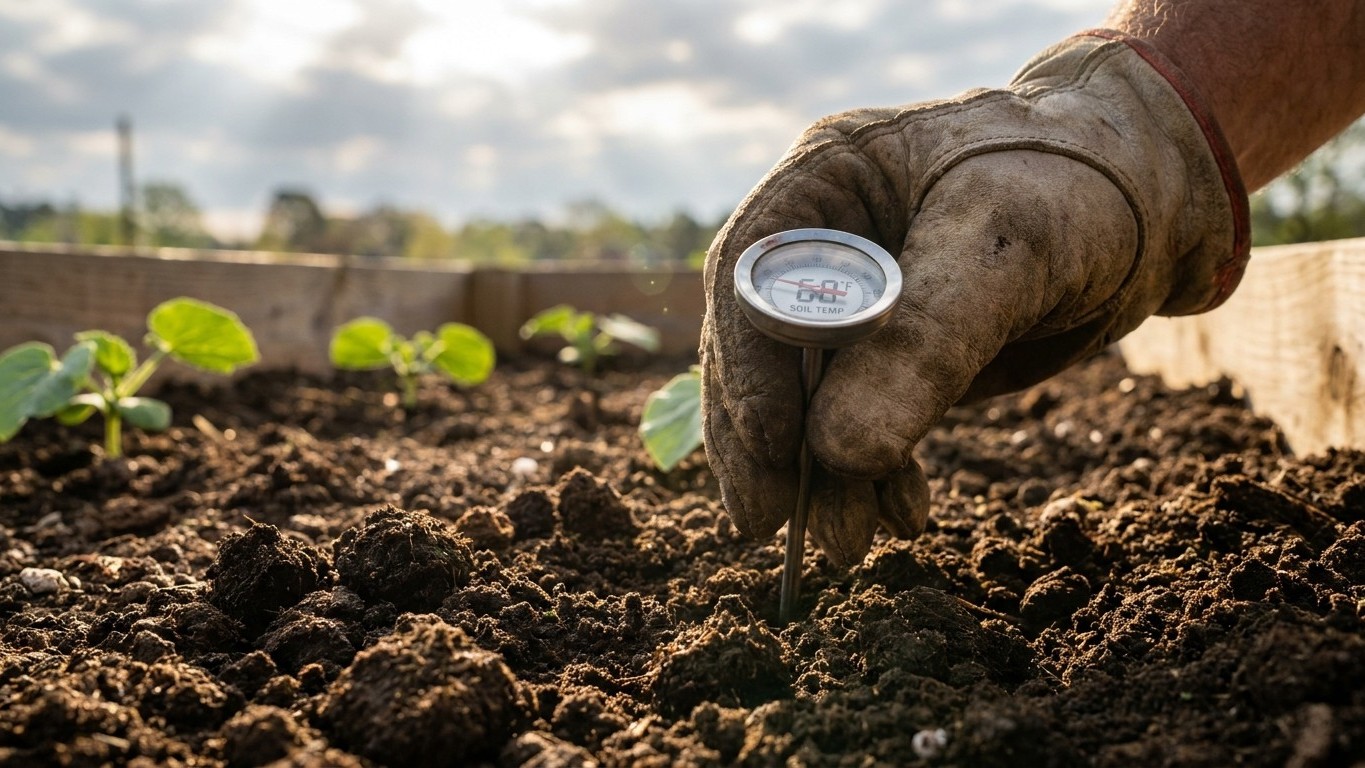

Most of Maryland can set melon transplants or seed outdoors once the soil itself has warmed, which typically lands somewhere in mid-to-late May depending on where in the state you garden. That answer changes fast at the edges: the Eastern Shore runs milder, western Maryland’s mountains run weeks colder, and the only way to know for sure is a soil thermometer, not a calendar page.
When the soil is warm enough in Maryland
The state’s last spring frost, according to NOAA’s 1991-2020 Climate Normals for the 32°F freeze-probability band, falls between April 3 and April 16 (source: NOAA NCEI, station USW00093721). That’s a useful marker, but it’s not the number that actually matters for melons. Frost is a proxy. Melon seed germinates poorly and melon roots stall out in cold soil even after the air has stopped threatening to freeze. The ground needs weeks to catch up with the air, which is why the real planting window sits well after that frost date, not right on top of it.
A frost date is also a probability, not a promise. The 30-70% band NOAA reports means frost risk is meaningfully present on either side of those dates, not that it snaps off on April 16 like a switch. Gardeners who plant the moment the “average last frost” arrives are gambling on the tail end of a curve, not a guarantee.
Soil warmth is the real gate
Melons are heat-loving vines native to warm soils, and they simply sit and sulk, or rot outright, if seeded into ground that’s still cold from winter. Waiting two to three weeks past the last-frost window, once the soil has had a real stretch of warm days to heat through, is the more reliable habit than counting days on a frost chart. Raised beds, black plastic mulch, or row cover laid down early all speed that soil-warming process along, which matters more in a state with Maryland’s range of microclimates than any single calendar date could.
That range is real and worth naming directly: Garrett and Allegany counties, up in the mountains of western Maryland, run weeks later than the frost dates above suggest, while the Eastern Shore’s milder, moisture-buffered air often lets gardeners push a bit earlier. The USDA Plant Hardiness Zone Map places the whole state across zones 5b to 8a, which is itself a signal of how much that western-to-eastern spread matters. A gardener near the Chesapeake and a gardener in the Appalachian counties are, for planting-date purposes, gardening in different states.
None of this replaces a local check. The most useful five dollars a Maryland melon grower can spend is a soil thermometer pushed two inches into the bed on a sunny morning. When that reading holds consistently in the warm range for several days running, not just for an afternoon, the soil is doing what the calendar can only guess at.
How long the season lasts here
Pairing the two frost dates from the same NOAA station gives the shape of Maryland’s frost-free window. The last spring frost falls between April 3 and April 16; the first fall frost falls between October 26 and November 5 (source: NOAA NCEI 1991-2020 Climate Normals, station USW00093721). Doing the subtraction honestly, using the earliest-to-earliest and latest-to-latest combinations, gives a frost-free stretch of roughly 203 to 206 days, somewhere around six and a half to seven months, depending on exactly where a given year’s frosts land within those bands.
That’s a genuinely long window by Northeastern standards, and it changes what’s worth attempting. A season this length gives melons real breathing room: enough time for a full-season vine to mature, ripen, and hold on the plant long enough to sweeten properly, without the grower racing the fall frost. It also opens the door, in the milder parts of the state, to succession sowing for a shorter-season type, planted a second time in early-to-mid summer to extend the harvest window into fall rather than concentrating it all in one flush. Our succession sowing guide walks through the timing logic for staggering plantings like that.
Transplant or direct seed?
A window this generous also loosens the pressure that forces gardeners in short-season states into transplants as their only option. Melons resent root disturbance, and direct seeding avoids that shock entirely. With roughly 200 days of frost-free ground to work with, Maryland gardeners in most of the state can afford to direct-seed once soil warmth arrives and still finish comfortably before the first fall frost. Transplants still earn their keep for pushing an early start in a cooler microclimate, or for stretching a longer-maturing type into a shorter local season, but they’re a choice here, not a necessity. In western Maryland, where the frost-free window shrinks and starts later, that calculus shifts back toward transplants as the safer bet, since every week gained at the start of the season matters more when the season itself is shorter.
Heat and water in Maryland
Melons don’t ripen on the calendar; they ripen on accumulated heat. Maryland’s reference station at Baltimore averages 24.6 days a year at or above 90°F (NOAA NCEI Climate Normals, 1991-2020). That’s a moderate heat load, not the kind of relentless summer that pushes vines through their full cycle on warmth alone. It means the sowing date and the soil-warming technique matter more here than they would in a hotter state further south, because there simply aren’t as many scorching days to make up for a slow start. Getting the vines established early and warm, through the practices already mentioned, black mulch, raised beds, row cover, does more work in a state with two dozen 90-degree days than it would somewhere logging sixty.
Summer rainfall tells the other half of the story. The same station logs about 12.6 inches of rain across June, July and August, broken down as June 3.98 inches, July 4.48 inches, and August 4.09 inches (NOAA NCEI Monthly Climate Normals 1991-2020, station USW00093721). June, the driest of the three, is also typically when young melon vines are putting on their earliest growth and establishing roots, which makes that early-summer dry stretch worth watching closely rather than assuming the season’s rainfall will simply average out.
Why the average doesn’t settle it
Twelve and a half inches sounds like enough water to coast on, but it never reads alone. Rain that falls as a single thunderstorm mostly runs off a compacted bed rather than soaking down to the root zone, and a sandy soil drains that same inch of rain within a day while a clay soil holds it for a week. Combine that with 24.6 days of 90-degree heat pulling moisture out of the leaves, and a Maryland melon patch can still need supplemental watering through a summer that looks, on paper, adequately wet. This isn’t the hot, dry irrigation-decides-everything climate of a desert Southwest garden; it’s a moderate-heat, moderately humid one, where mildew and slow ripening are the bigger risk in a cool, damp stretch, and where a rain gauge staked in the actual garden bed settles the watering question far better than a regional average can.
Which melons suit Maryland
Reasoning from the three facts already laid out, a frost-free window of roughly 200 days, a moderate 24.6 days above 90°F, and summer humidity from nearly 13 inches of rain, points toward a specific profile rather than a specific variety. The season is long enough to support a full-maturing type, but the heat load isn’t extreme enough to make that type a sure thing without help, so earlier-maturing types carry less risk for a first-time Maryland grower. The humidity from that summer rainfall, meanwhile, makes disease resistance to common vine diseases the first thing worth checking on a seed packet or tag, ahead of size or sweetness claims.
Airflow matters more here than the temperature figures alone suggest. A humid Chesapeake-adjacent summer, or a wet stretch anywhere in the state, sets up the exact conditions that mildew and other foliar diseases favor: damp leaves that don’t dry quickly, crowded vines, poor circulation at ground level. Spacing plants generously, keeping foliage off wet soil with mulch, and watering at the root rather than overhead all reduce that risk more reliably than any single variety choice does.
This page won’t name a specific melon variety, and that’s a deliberate choice rather than an oversight. Variety trial results shift from year to year and differ sharply between the Eastern Shore, central Maryland, and the mountainous west, and a name printed here would be a guess dressed up as a recommendation. The University of Maryland Extension runs the actual regional trials, tracks which types have performed well against local disease pressure, and updates that guidance as new results come in. For a Maryland gardener deciding what to actually put in the ground this year, that local, current source is worth more than any general list a broader guide could offer.