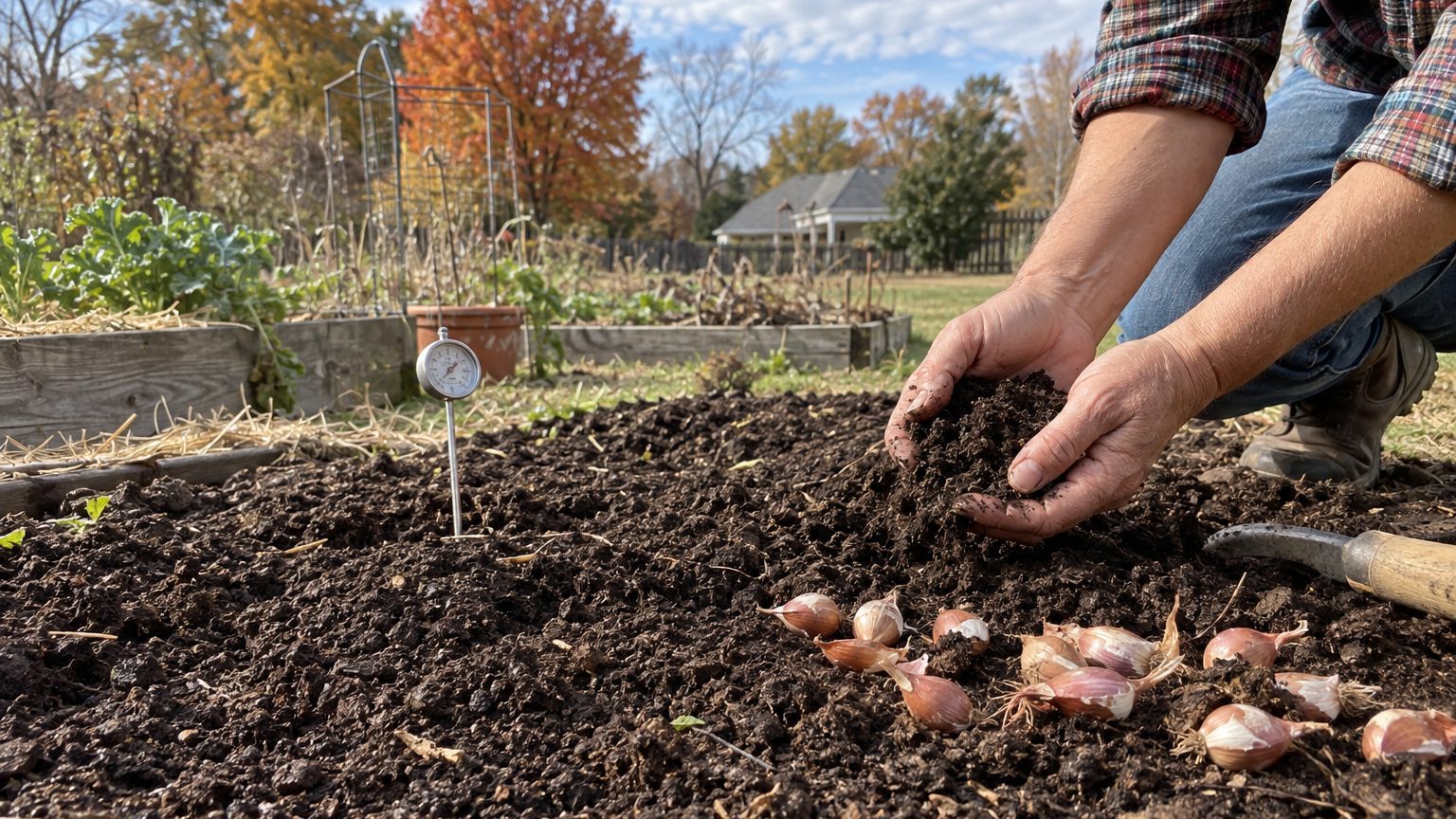

Maryland gardeners can plant shallots in autumn or in early spring, and the winter you actually get decides which is safer. Lowland and Eastern Shore beds usually favor autumn. The western mountains lean toward spring. Both seasons depend on soil conditions, not a date on the calendar. The full crop guide is Growing Shallots: One Bulb In, a Handful Out.
When the soil is warm enough in Maryland
The spring date everyone asks about is the last frost. NOAA’s 1991-2020 Climate Normals, using the 30-70% band of 32F freeze probabilities, put it between April 3 and April 16 (NOAA NCEI data file). That is a probability band, not a promise, and a late freeze can still land after it.
Frost is also a proxy. Shallots care about the soil, and the soil warms and drains after the frost risk ends, not at the same moment. A bed can be frost-free and still sit cold and soggy, and cold, waterlogged ground is where sets stall or rot. The practical test is the handful squeeze. Pick up soil from trowel depth, close your fist, and open it. If it holds as a slick ball, wait. If it crumbles, the bed is ready.
Spring planting
Sets tolerate cool soil better than most seedlings do, so planting begins once the ground crumbles instead of waiting for true warmth. In practice that means the window opens around the April 3 to April 16 band in the central part of the state. Western Maryland (Garrett and Allegany counties) is mountainous and runs weeks later, while the Eastern Shore runs milder. The dates above describe neither extreme, so adjust for your own county.
Autumn planting
Autumn planting aims for roots, not top growth, before the ground freezes. NOAA’s first fall frost band is October 26 to November 5, with the same mountain and Eastern Shore caveats. Planting in the weeks leading up to that band gives roots time to establish without pushing much green growth into winter. The mechanics are the same ones garlic growers use, so the garlic section of this site covers depth, mulch and timing in detail. What differs for shallots is that each set is a small bulb that multiplies into a cluster, so spacing has to leave room for several bulbs, not one.
Varieties differ in how they behave locally, and this page cannot rank them. The University of Maryland Extension is the place to ask which types have been trialed in your part of the state and what planting dates it recommends for your county.
How long the season lasts here
The same NOAA normals give both ends of the frost-free window. Pairing the earliest ends, April 3 to October 26, gives 206 days. Pairing the latest ends, April 16 to November 5, gives 203 days. Mix the bands the unlucky way, a late spring frost with an early fall one, and the gap shrinks to 193 days. The lucky mix stretches to 216. Either way, central Maryland sits near 200 days between frosts.
That number allows more than it first seems to. A long window means the first sowing does not have to carry the whole season. Gardeners can plant sets as soon as the soil allows, then follow with a second sowing of seed-grown shallots or of green-harvest shallots for the kitchen. The succession sowing guide on this site lays out how to stagger plantings so beds are not all ready the same week.
There is a catch, though. A second sowing in midsummer lands in the heat, and young shallots that spend their early weeks in baking weather usually give smaller bulbs than the spring planting. I would treat a later sowing as insurance and as a source of fresh green tops, not as the main storage crop.
The window also settles whether transplanting is worth the trouble. In a long season, starting seed indoors and moving seedlings out is optional, since direct sowing has time to catch up. Where the window runs short, as it does in the western mountains, the first sowing is the only one. There, indoor starts buy a head start, but only if the transplants are handled gently. Before planting out, slide a seedling from its cell and look at the roots. White, firm roots that hold the soil together are ready. A tangled brown mass or a few thin threads is not.
These figures are for the central part of the state. The mountains lose weeks at both ends, so the western counties will have a noticeably shorter window than the subtraction above suggests, and I won’t guess at it without a station figure.
Heat and water in Maryland
This page does not carry a verified count of days above 90 F, or a summer rainfall total, so it prints neither. Guessing at them would be worse than leaving them out. The question for shallots is mostly the winter anyway, because the winter decides whether autumn planting is worth it.
The reference figure is the Baltimore mean daily minimum for the coldest month, which NOAA’s 1991-2020 normals put at 25.4 F. That is below freezing most nights in midwinter, but not brutally so. The USDA Plant Hardiness Zone Map (2023 edition) rates Maryland from 5b to 8a, a wide range that reflects the mountains in the west and the milder Eastern Shore, and it measures the average annual extreme minimum, a different thing from the monthly figure above.
Read together, those numbers say autumn-planted sets are a sound bet across much of the state. A mild enough winter rewards fall planting with larger, earlier bulbs, which is why gardeners do it. The risk is in where the ground freezes hard and stays wet. There, sets can rot in cold, saturated soil, and freeze-thaw cycles can push them up out of the ground, a problem called heaving. Gardeners in the western mountains should lean spring, and anyone with heavy clay should consider a raised bed or a mulch layer for fall planting.
Summer is where airflow matters. Shallots finish by letting their tops fall and ripening as the weather dries. In a humid, damp stretch, foliage diseases such as mildew spread, ripening drags on, and necks stay green and thick. Practices that help are plain: spacing that lets air move between clusters, soil that drains, mulch to keep soil from splashing onto leaves, and rotation so that alliums do not return to the same bed year after year. The garlic pages on this site cover allium rotation in depth, and the logic is identical for shallots.
Curing deserves care because it is a food safety question. Once tops have fallen, bulbs are lifted and dried in a shaded, ventilated spot. Before storing any bulb, inspect it. Check the neck, the base and the outer skins. A soft neck, a moldy base or a damp, sour smell ends the question, and that bulb goes in the compost, not the pantry. A firm, dry-looking bulb is not proof of soundness, so keep checking stored shallots and discard any that soften. No keeping time can be promised.
Which shallots suit Maryland
The honest answer is by type, not by name. Named varieties behave differently by county, and this page has no local trial data to rank them. A name pulled from a seed catalog would be a guess, and gardeners can tell. What the facts above do support is a way of choosing.
| Condition | What to favor |
|---|---|
| Shorter season (western mountains) | Earlier-maturing types, planted in spring as soon as the soil crumbles |
| Hot, humid summers | Types known for disease resistance, given airflow and mulch at the root |
| Wet or heaving winter ground | Spring planting, or fall planting in raised, well-drained beds |
| Milder lowlands and Eastern Shore | Fall-planted sets, which suit longer, earlier bulbs |
Beyond that, shallots divide into those grown from sets, which multiply into clusters and are the usual route for home gardens, and those grown from seed, which give a single bulb and can be started indoors. Sets are quicker and simpler. Seed gives more choice and costs less per plant, but takes more attention early on.
In a humid climate, disease resistance should come first, ahead of size or color. Ask any seller or extension agent what a type’s record is against foliage disease in damp summers. Where seed catalogs go vague, the University of Maryland Extension can tell you which types have been trialed locally and which have been trouble.
For comparison, a longer, hotter summer farther south is covered in Growing Shallots in Tennessee, and Growing Shallots in Missouri shows how a harder winter shifts the planting season.
Common questions
Can I plant shallots in the fall in Maryland?
In most lowland areas, yes. NOAA’s first fall frost band runs from October 26 to November 5, and planting a few weeks ahead lets roots establish before the ground freezes. In the western mountains, where winters are harder and the ground stays wet, spring is the safer choice.
When should I plant shallots in spring?
As soon as the soil crumbles in your hand, which in central Maryland tends to follow the last frost band of April 3 to April 16. That band is a probability, not a guarantee, and the mountains run weeks later.
Is a second planting worth it?
Central Maryland has roughly 203 to 206 days between frosts when you pair matching ends of the NOAA bands, enough room for a later sowing. Treat it as a bonus crop for green tops or small bulbs, since summer heat works against it.
How do I know stored shallots are safe to eat?
Inspect them regularly. A soft neck, a moldy base or a sour smell means discard the bulb. A bulb that looks firm is not guaranteed sound, so no storage length can be promised.