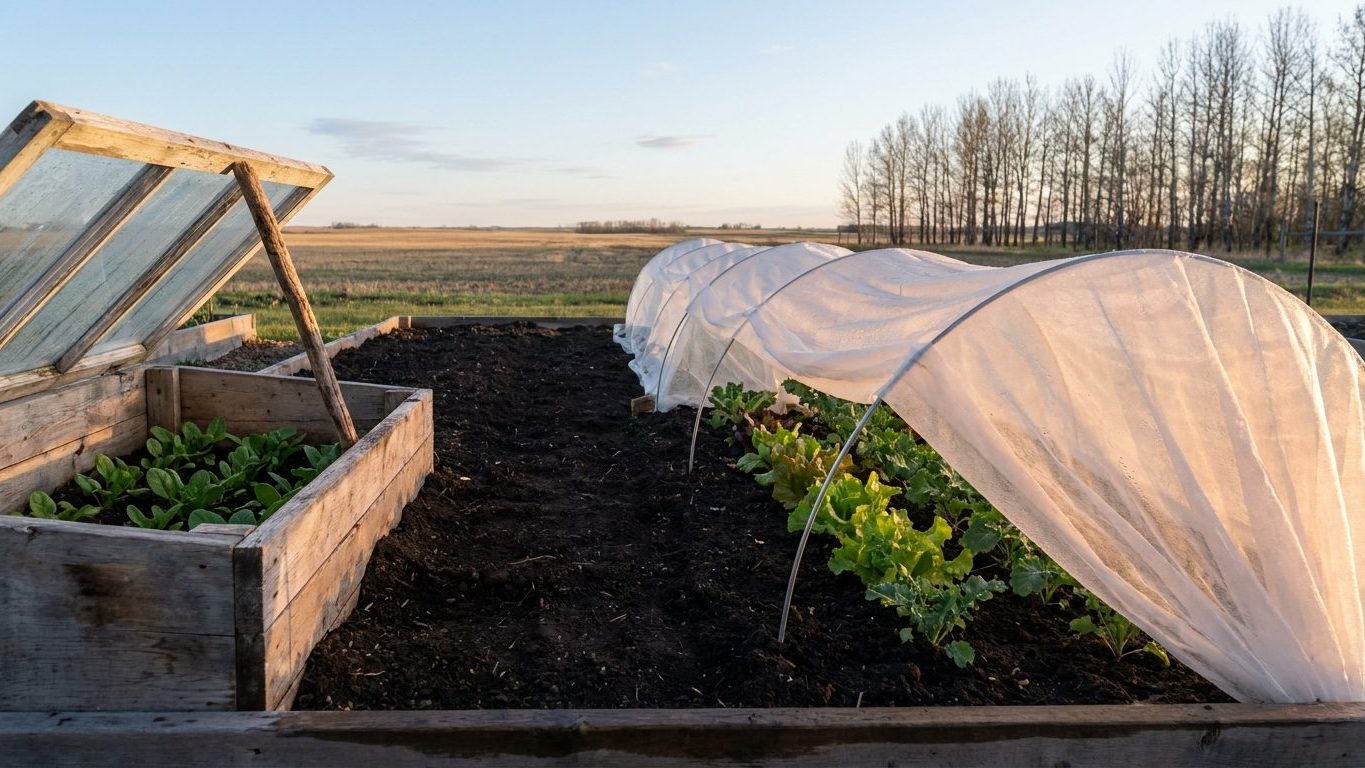

Low tunnels with row cover, cold frames, and small hoop houses are the season extenders that pay off in Massachusetts. They push the harvest of hardy greens and roots well into winter, and they let you plant a few weeks earlier in spring. Heated greenhouses are optional. How much time you gain depends mostly on where you garden, because the coast and the hill towns run on different calendars. For the wider picture, see Extending the Growing Season in Massachusetts.
The short answer for Massachusetts
Use unheated, low-cost structures: row cover over hoops, cold frames, and a walk-in hoop house if you have the room. They fit the climate because winter here is cold but rarely brutal in the east, and the real limit on growth is daylight rather than temperature.
At the Boston reference station (Logan), the 32F freeze probabilities sit in the 30 to 70 percent band from April 1 to April 8 for the last spring freeze, and from November 3 to November 14 for the first fall freeze. Those dates are the window in which a 32F freeze is still roughly a coin flip. Logan is a waterfront urban station and the mildest spot in the state. Inland suburbs and the Berkshires freeze earlier in fall and later in spring, so the same structures buy them more time on each end.
The coldest month in Boston has a mean daily minimum of 23.1F. That is cold enough to kill tender crops and to freeze the soil surface, but hardy spinach, kale, carrots, and leeks tolerate it once they are covered. The latitude of Boston is 42.36 degrees north. At that latitude, daylight shrinks noticeably by early November, and most greens nearly stop growing at that point. Covers keep the crop alive and sweet after that, but they do not make it grow. Sow for fall harvest in late summer so the plants are nearly full size before the light fades.
Which season extender fits which job?
| Extender | Best use | Main limit |
|---|---|---|
| Row cover on hoops | Frost protection in spring and fall, early direct sowing | Lightweight fabric adds only a few degrees |
| Cold frame | Hardening off seedlings, winter greens, early lettuce | Needs venting on sunny days |
| Low plastic tunnel | Early spring beds, fall greens and roots | Overheats quickly if closed in sun |
| Walk-in hoop house | Winter harvest, early tomatoes and peppers | Cost, and snow load on the frame |
Most gardeners are well served by the first two. Add a tunnel or hoop house only once you know you will actually harvest through January.
What will not work here

Planting heat lovers early under plastic fails more often than it succeeds. Tomatoes, peppers, and squash set outside in early April, even under cover, sit in cold soil and short days. At the mildest station in the state, the freeze probability is still in the 30 to 70 percent band from April 1 to April 8, and inland gardens are later. Plastic warms the air but does little for soil that is still cold. The plants stall and are no further ahead than seedlings set out in mid-May.
Trying to keep tender crops going past the first fall freeze is the same mistake in reverse. With first freeze probabilities in the 30 to 70 percent band from November 3 to November 14 at Logan, and earlier inland, a plain sheet of plastic over tomatoes helps. After that the days are too short and too cool for fruit to ripen. Pick green tomatoes and ripen them indoors.
Why won’t thin row cover carry a crop through winter?
Lightweight fabric holds a few degrees, which handles a frosty night in April or October. It will not handle a January night when the average low is 23.1F in Boston and well below that in the hills. Heavier cover, or a second layer inside a tunnel, is the minimum for winter harvest, and even then only hardy crops hold up.
What about snow and sun?
Snow load is a Massachusetts problem. Wet snow collapses flat or shallow-pitched covers and bends thin hoops, so use a rounded profile, brace the frame, and brush snow off after each storm. Sun is the quieter problem. A closed tunnel or cold frame on a bright March afternoon can overheat enough to wilt or scorch seedlings, even when the air outside is near freezing. Prop the lid or open the ends by mid-morning on sunny days, and close up again before evening.
Last, sowing in November under cover will not give you a winter harvest. With daylight around ten hours and falling, the seed germinates slowly or not at all, and seedlings stay tiny. Winter crops have to be planted well before that.
What changes across Massachusetts
The state spans USDA Plant Hardiness Zones 5a to 7b (USDA Plant Hardiness Zone Map 2023, based on 1991-2020 normals). That zone system is built on one thing, the average annual extreme minimum temperature, so it describes winter survival rather than frost dates or summer heat. A spread that wide means there is no single answer for the state. A gardener on the coast and one in the hill towns of the west are working with very different winters.
The Boston numbers (frost dates, the 23.1F coldest-month minimum, 42.36 degrees north) describe a waterfront city that sits at the mild end. If you live in the Berkshires or in an inland or northern town, shift everything toward caution. Expect spring freezes later than April 1 to April 8 and fall freezes earlier than November 3 to November 14. Use heavier fabric or a double layer for winter crops. Sow fall greens earlier in summer, because your light fades sooner and cold arrives sooner. Expect to wait longer in spring before cover gives any real benefit to warm-season crops.
Latitude also matters at the edges. Boston sits at 42.36 degrees north, and the northern and western borders of the state are further north. The difference is small in miles but it nudges day length slightly, so if you live near the state line, check your own latitude and be a bit more conservative with timing.
To find your own zone, look up your ZIP code on the USDA Plant Hardiness Zone Map. Zone lines run through the state in patches, and a town can sit in a different half-zone than the next one over.
Where to check this for your own county
Your state extension service is the next stop. UMass Extension publishes gardening and vegetable guidance for Massachusetts and has staff who know regional conditions. Look there for two things: a local planting calendar with sowing dates matched to your area, and the varieties that have been trialled in conditions close to yours.
The varieties matter more than people expect. Spinach, kale, and lettuce differ a lot in how well they hold in cold, and a variety bred for cold tolerance may carry a crop through a hard January where a standard one turns to mush. Trial results will tell you which ones the local growers rely on.
A county recommendation beats a state one. The state guidance here has to cover a coastal city, a Connecticut River Valley farm town, and a Berkshire hillside, and its dates are an average of them. Your county office knows when the local frost pockets form, which towns warm up fastest in spring, and which problems turn up in your area. If the local recommendation differs from the state one, trust the local one.
Pair that with the timing advice in When to Cover Your Garden in Massachusetts, which takes you from the frost dates to the actual calendar for putting covers on and taking them off.
Checking this against your own garden
Dates on a chart are averages. Your own garden has a microclimate shaped by slope, wind, nearby buildings, and soil. Three simple observations will tell you more than any table.
- Soil warmth by feel. Push your hand a few inches into a covered bed and an open one in spring. If the covered soil feels clearly warmer, the structure is working. If both feel cold and damp, hold off on tender seeds.
- The first male flowers on squash or cucumbers. If they appear a week or more earlier under cover than in the open, your site warms well and you can start earlier next year.
- The first true leaves on seedlings. The next pair, shaped like the adult plant, are the true leaves. Compare a covered row with an uncovered one. A big gap means your garden is cold in spring and cover pays off. A small gap means the site is already sheltered.
Also watch where frost lingers in the morning. A patch of white grass that stays long after the rest has thawed marks a low spot where cold air pools, and that is where you should cover first and plant tender things last.
Common questions
Do I need a greenhouse to extend the season in Massachusetts?
No. Row cover, a cold frame, or a low tunnel handles most of what home gardeners want, which is earlier spring greens and fall and winter harvests of hardy crops. A greenhouse helps if you want to start seedlings or grow tomatoes earlier, but it is not required.
Can I harvest vegetables all winter without heat?
Hardy ones, yes, if they were planted early enough to be nearly full size before daylight drops to around ten hours, which happens around early November at Boston’s latitude. Spinach, kale, carrots, and leeks hold well under cover. They will not grow much through midwinter, so you are harvesting what you already grew.
How much colder can it get inside a tunnel than the forecast?
Not by much. Lightweight cover adds only a few degrees, and a plastic tunnel on a clear night gives limited protection. Heavier fabric or a second layer helps, but none of these turn a 23F night into a mild one.
When should I vent or remove covers?
Vent on any sunny day, especially in March and April, when a closed cold frame can overheat quickly. Take covers off completely once the freeze risk has passed and the plants need pollination or more air.