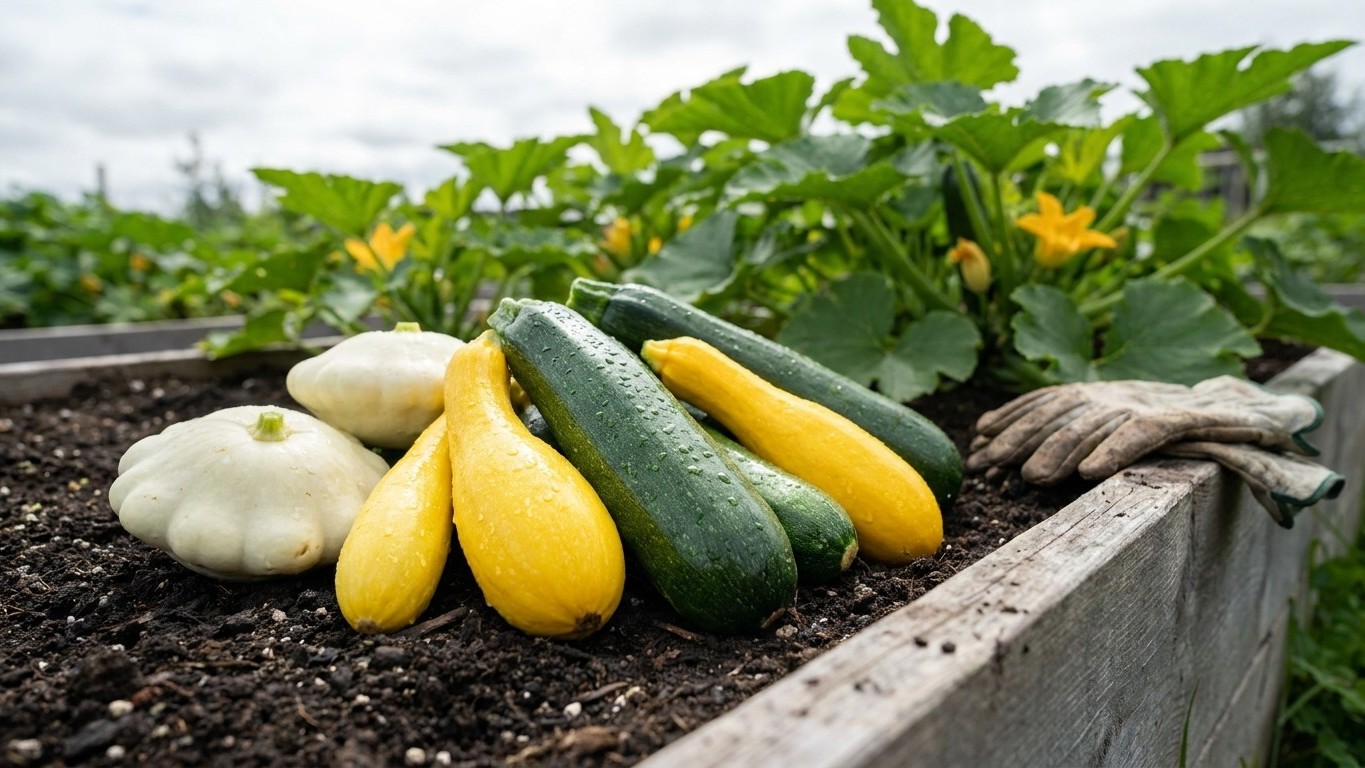

Massachusetts gardeners do best with fast bush-type summer squash, 45 to 55 days to harvest, bred for some resistance to powdery mildew. That combination fits the state’s frost dates, its moderate but not extreme summer heat, and a humidity level that punishes slow, disease-prone varieties. Coastal growers get more flexibility than the Berkshires do.
The short answer for Massachusetts
Start with the numbers instead of a variety list. At the reference weather station near Boston, the last spring frost falls between April 1 and April 8, and the first fall frost arrives between November 3 and November 14. Taken at their tightest, that’s roughly a 208-day frost-free window along the coast. That’s long by New England standards, and it means almost any summer squash type, from early bush zucchini to slower-maturing scallop and crookneck types, has room to finish before frost near Boston.
The heat load matters just as much as the season length. Boston averages 10.2 days a year at or above 90°F. That’s a moderate figure, nowhere near the desert Southwest, and it means summer squash bred for extreme, sustained heat isn’t necessary here and can actually underperform. Massachusetts summers run warm enough to set fruit reliably but not so hot that plants need heat-tolerant genetics to survive July and August.
What tips the decision toward fast bush varieties isn’t the season length at the coast. It’s the combination of humidity and the zone spread across the state. The USDA Plant Hardiness Zone Map puts Massachusetts across zones 5a to 7b, built from the average annual extreme minimum winter temperature, not summer conditions, but it signals how much the growing season itself varies between the Cape and the Berkshire highlands. Add in a summer rainfall pattern that keeps foliage damp (June averages 3.89 inches, July 3.27, August 3.23) and you get conditions that favor mildew on any squash grown at close spacing or left in the ground past its prime.
What this means by type
Bush zucchini and bush yellow crookneck, the fastest maturing types on the market, are the safest statewide choice because they outrun both frost risk in the shorter interior season and disease pressure in the humid coastal one. Vining or trailing summer squash, along with the slower heirloom scallop types, can work fine near Boston or the Islands where the season runs longest, but they’re a riskier bet inland. This page doesn’t have county-by-county frost data to sort that out precisely. That’s a job for the next section.
What will not work here
Slow-maturing summer squash is the first casualty outside the coastal belt. A variety that needs 65 or 70 days to first harvest is cutting it close even under the widest frost window this page has (April 1 to November 14), and it runs out of season fast in the Berkshires, where the same NOAA caution notes frost arrives earlier in fall and later in spring than at the reference station. A gardener there planting a 65-day scallop squash in early June, waiting on a warm soil signal, can lose weeks of that margin before the seed even germinates.
Weekly watering schedules fail here more often than gardeners expect. Total summer rainfall across Massachusetts averages about 10.4 inches over June, July and August, which sounds adequate on paper. But August, the month summer squash is setting the heaviest fruit load, is also the driest at 3.23 inches, and it overlaps with the year’s concentration of 90-degree days. Rain that does fall in summer tends to arrive as thunderstorms rather than steady soaking rain, so a lot of it runs off rather than reaching the root zone, especially on sloped or compacted soil. A squash bed watered only once a week through a dry August stretch, with no rain gauge to confirm what actually landed, is a common way to end up with blossom drop and stunted fruit.
Tight spacing is the third failure point, and it’s specific to Massachusetts humidity rather than a universal squash rule. The same rainfall pattern that keeps soil moist also keeps foliage wet longer after storms, and summer squash planted at the spacing recommended for drier states holds moisture between leaves instead of drying out by midday. Powdery mildew shows up on the underside of leaves first, and by the time it’s visible on top, yield is already dropping. Varieties chosen purely for size or heirloom appeal, with no disease-resistance breeding and no room for airflow, are the ones that collapse first in a wet, warm August.
None of this means the coast is immune. It means the margin for error shrinks the farther a garden sits from the mild, humid air the reference station measures, and grows again where humidity and heat combine to stress a plant that was already borderline for the local season.
What changes across Massachusetts
A hardiness zone range of 5a to 7b is a wide spread for a state this size, and it means there is no single frost date, no single season length, and no single squash recommendation that covers Provincetown and Pittsfield equally. Remember that this zone system is built from one measurement, the average annual extreme minimum winter temperature, not summer heat or frost timing, but the spread itself is a useful flag: a gap of roughly two and a half zones inside one state’s borders is unusually wide, and it tracks closely with elevation and distance from the ocean’s moderating effect.
Coastal Massachusetts and the Cape sit at the warmer end of that range. Gardens there inherit something close to the reference station’s frost window, April at the earliest for the last spring frost and into mid-November for the first fall one, giving the longest runway in the state for summer squash, including slower vining types that would struggle elsewhere.
Inland valleys, the higher ground of central Massachusetts, and especially the Berkshires sit at the colder end. The same NOAA caution behind the frost-date facts is explicit that inland and elevated sites frost noticeably earlier in fall and later in spring than the coastal reference station shows. A gardener at higher elevation should plan on a shorter effective season than the statewide dates suggest, which pushes the decision further toward the fastest bush varieties and away from anything marketed as slow-maturing or specialty.
This page can describe that spread. It can’t tell an individual reader which zone their own yard falls into, since microclimate, elevation, and even which side of a hill a garden sits on can shift the local frost date by a week or more from the town average. The next step for pinning that down is a map, not a guess.
Where to check this for your own county
The University of Massachusetts Amherst runs the state’s land-grant extension service at ag.umass.edu, and it’s the right next stop for anyone who wants a recommendation sharper than a statewide one. This page works from a single reference station’s climate normals and a statewide hardiness zone range. A county extension office works from local trial data and local frost records, and that’s a meaningfully different, more accurate source for a specific garden.
Two things are worth looking for once there. First, a local or regional planting calendar that translates the frost-date ranges on this page into a specific recommended sowing window for a given county or growing region within Massachusetts, since the Berkshires and the Cape shouldn’t be planting summer squash on the same week. Second, any variety trial results or extension bulletins naming summer squash cultivars that performed well in University of Massachusetts research plots or in on-farm trials elsewhere in the state, since those trials capture how a given variety actually handled local humidity and disease pressure, not just its seed-packet maturity date.
A county-level recommendation will always outrank the statewide picture built here. This page draws on one reference station’s frost and rainfall normals and a hardiness zone map covering the entire state, which is useful for understanding the range of what’s possible in Massachusetts but not a substitute for local trial data tied to a specific county’s soil, elevation, and microclimate. Treat this page as the starting frame and the extension service as the source that narrows it down.
Checking this against your own garden
No frost date on this page beats what a gardener can feel and see in their own soil. Three signals are worth tracking before trusting a calendar over direct observation.
Soil warmth by feel is the first. Summer squash seed sits and rots in cold soil rather than germinating, regardless of what the frost-date range suggests. Pushing a bare hand a few inches into the planting bed on a sunny mid-morning and feeling for warmth roughly like a comfortable bathwater temperature is a better signal of readiness than the calendar date, especially in a low, shaded, or heavy-clay spot that lags behind the rest of the yard.
The first flush of male flowers is the second. Summer squash typically produces male blossoms before female ones, and a strong early show of males followed a week or two later by females with a small swollen bulge behind the petals is the plant confirming it’s actually in active growth, not just alive. A long gap with only male flowers, especially during a stretch of cool or wet weather, points to a local microclimate running behind the season this page describes.
The appearance of the first true leaves, the second set that emerges after the rounder seed leaves, is the third. Fast, sturdy true-leaf growth within a week or two of germination signals a garden running warm and on pace with a normal Massachusetts season. Slow, pale, or stalled true leaves are the plant reporting that this particular spot, this particular year, is running cooler or wetter than the statewide normals suggest, and it’s worth adjusting watering and expectations accordingly rather than the calendar.