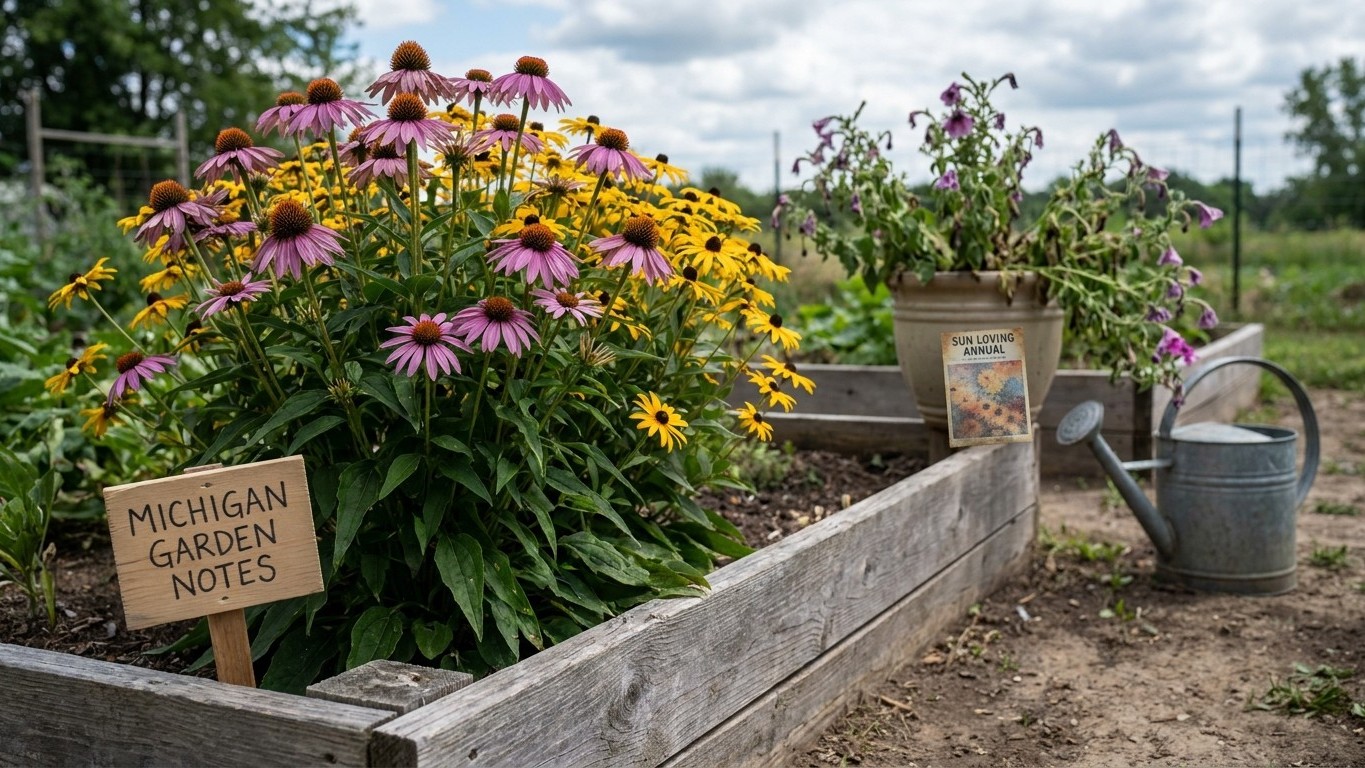

Coneflower, daylily, peony, aster — those are the flowers that come back year after year in a Michigan bed, because they don’t just tolerate the cold, they need it. Michigan’s real test isn’t summer heat, it’s how a plant’s roots handle a hard winter, and most of the state sits in a zone range those four sail through without complaint. So before you fall for something pretty at the garden center, flip the tag over and check the hardiness zone against your own township, not the state as a whole, because a plant that survives fine two hours south of you might not make it through your winter at all.
What thrives in Michigan

Cold hardiness decides more in a Michigan flower bed than anything else. The USDA Plant Hardiness Zone Map puts the state in a range of zone 4a to zone 6b, with the coldest pockets in the northern Upper Peninsula and the mildest strip along the Lake Michigan shoreline. NOAA’s 1991-2020 climate normals put the average minimum temperature in the coldest month at 19.2°F at the Detroit reference station, and that figure is the real test a perennial has to pass. A plant tagged hardy to zone 5 can shrug off a Detroit winter most years. The same plant pushed into a zone 4a township farther north will lose more of its root mass to cold, and some years it won’t come back at all.
Cold, not heat, is the limiting factor
Michigan summers are not brutal by national standards. Detroit averages just 10.3 days a year at 90°F or hotter, according to NOAA’s NCEI climate normals, so heat stress rarely kills a plant outright the way it does in the Deep South or the desert Southwest. That means drought tolerance matters less here than winter survival, except on fast-draining sandy soils near the lakeshore dunes, where a dry July can still stunt a shallow-rooted annual. Humidity is moderate rather than oppressive, so powdery mildew on susceptible varieties like garden phlox is more of a nuisance than an outright killer.
Families that carry the traits Michigan asks for keep showing up in successful gardens for a reason. The daisy family, Asteraceae, supplies coneflower, black-eyed Susan and aster, all of which combine cold-hardy roots with a long bloom window that shrugs off an early fall chill. The iris family and the lily family both include Michigan mainstays, iris and daylily, that go dormant below ground in winter and lose nothing to a hard freeze. Peonies, in the separate family Paeoniaceae, actually need a real cold winter to set buds well, which makes the state’s frost load an advantage rather than a limitation. Compare that to a place with a much shorter, colder growing season, covered in Flowers That Actually Thrive in Yukon, and the Ones That Struggle, and Michigan’s zone range starts to look generous rather than restrictive.
Native plants worth the space
A plant native to the wider Great Lakes and Upper Midwest region has already spent thousands of years adapting to this soil, this rainfall pattern and this freeze-thaw cycle, so it needs far less babying once it’s established than an imported cultivar bred for a nursery in a milder state. Established natives typically need no supplemental watering after the first year or two, no winter mulch, and no fungicide programme, because the traits that let them survive here evolved on-site rather than in a breeding trial three states away.
A short list to start with
Purple coneflower, Echinacea purpurea, is native across much of the eastern and central United States including the Upper Midwest, and it tolerates the region’s clay soils and winter swings without complaint. Wild bergamot, Monarda fistulosa, brings lavender-purple flowers that draw in bumblebees and hummingbird moths through mid and late summer. Butterfly milkweed, Asclepias tuberosa, is the host plant monarch caterpillars actually need, not just a nectar source, and its orange flower clusters hold up in poor, dry soil where other perennials sulk. New England aster, Symphyotrichum novae-angliae, closes out the season with violet blooms right as migrating monarchs are fueling up for the trip south, and blazing star, Liatris spicata, sends up a purple spike that native bees and swallowtail butterflies both work hard.
None of these plants need the soil amending or the winter protection that a bed of tender roses or hybrid tea varieties demands. Skip the compost-heavy planting hole for natives and put them straight into the existing soil. Rich, amended soil actually works against plants that evolved for lean ground, encouraging floppy growth and fewer flowers. A native planting also spreads bloom and pollen across more of the season than a bed built entirely from imported perennials, since wild bergamot, coneflower and aster stagger their peak bloom from midsummer into the first hard frost instead of all flowering in the same three weeks of June.
Buying straight species rather than a heavily bred cultivar matters more with natives than with most garden flowers. A double-flowered coneflower cultivar can look striking but often provides less accessible pollen and nectar for bees than the single-flowered wild form, and some double forms set almost no seed for goldfinches to eat over winter. Look for straight species labels at nurseries that specialize in native plants, since genetics sourced from a population several states south may leaf out on a schedule that doesn’t line up with Michigan’s frost window.
Perennials that come back

A perennial’s plant tag lists the zones it can survive, and the number that matters is the low end of that range compared against your own zone, not the state’s zone range as a whole. Since Michigan spans zone 4a to 6b according to the USDA hardiness map, a plant tagged hardy to zone 5 through 9 will come back reliably in a Detroit-area garden most winters but may fail two or three winters out of ten in a colder zone 4a township farther north or in the interior of the Upper Peninsula.
Reading the tag against your zone
Find your own zone before you buy rather than trusting the state-wide range printed on a big-box nursery sign, since a tag calibrated for the mild end of Michigan can disappoint a gardener two counties north. Neighboring Minnesota runs colder across more of its territory, and gardeners there have to be even more conservative about the low end of a plant’s tag, a distinction covered in Flowers That Actually Thrive in Minnesota, and the Ones That Struggle. In Michigan, lean toward buying for one zone colder than your address if you’re near a zone boundary, since microclimates and an unusually hard winter can push actual conditions below the average.
Some plants sold as perennials in southern catalogues are grown as one-season annuals here because Michigan’s winter minimum kills them outright. Dahlias and gladiolus, both tender to frost, need their tubers or corms dug up and stored indoors over winter if a gardener wants to keep the same plant going, something gardeners in zone 8 and warmer never have to think about. The table below shows how some popular border plants actually behave once planted in a Michigan yard.
| Plant | Typical tag zone | Behavior in Michigan (4a-6b) |
|---|---|---|
| Peony | Zone 3-8 | Reliable perennial, needs a cold winter to bloom well |
| Daylily | Zone 3-9 | Reliable perennial across the whole state range |
| Russian sage | Zone 4-9 | Reliable perennial except in the coldest 4a pockets |
| English lavender | Zone 5-9 | Marginal, best in zone 5b-6b with sharp drainage |
| Dahlia | Zone 8-11 | Grown as an annual, tubers dug and stored over winter |
| Gladiolus | Zone 8-10 | Grown as an annual, corms dug and stored over winter |
Lavender is the plant most likely to disappoint a Michigan gardener who shops by fragrance alone rather than by hardiness number. English lavender, Lavandula angustifolia, is tagged hardy to zone 5, which technically covers the southern half of the state, but it fails just as often from wet feet in heavy clay over winter as it does from cold. Raised beds or gritty, fast-draining soil matter more than the zone number for lavender’s survival here.
Putting a border together
Height layering is the first decision, and it’s the one most beginner borders get backwards by putting tall plants in front where they hide everything behind them. Sort plants roughly like this before you dig a single hole:
- Back or center: Russian sage, hardy hibiscus, garden phlox
- Middle: coneflower, daylily, black-eyed Susan, bee balm
- Front edge: catmint, creeping phlox, dwarf coreopsis
Bloom succession across a short season
Michigan’s growing season runs from the last spring frost, which MSU Extension puts at around April 30 in the Detroit area and early to mid May across most of the Lower Peninsula, to the first fall frost, which MSU Extension’s Michigan Garden Calendar puts between October 6 and October 21 for zone 6a. That’s a workable but not endless window, so a border built entirely from plants that bloom in June leaves the bed looking tired by August. Stagger bloom time on purpose: peony and iris open in late spring, coneflower and daylily carry midsummer, and aster along with Russian sage keep flowering right up to that first fall frost. Aim for at least one plant in bloom in every few-week stretch from last frost to first frost rather than a single big spring show.
Repeating a color at intervals through the border, rather than grouping every plant of one color in a single clump, is what makes a bed read as designed instead of scattered. Three or four plantings of the same purple coneflower spaced along a twenty-foot bed pull the eye through the whole planting the way a single mass at one end never does. Leave real space at planting time even though a new bed looks sparse the first year. A daylily clump that looks lonely at eighteen inches wide in May will be three feet wide by its third summer, and perennials crowded too close at planting fight each other for root space and light within two or three seasons, which brings on the exact disease and overcrowding problems that wider spacing was meant to prevent.
Local help
MSU Extension runs a Master Gardener program with volunteers trained on plant lists suited to a specific county, not just the state as a whole, and staff there can tell you which side of a zone boundary your address actually falls on. Start at the MSU Extension outreach directory to find the office nearest you. For more on planning a yard around the state’s frost dates and soil types, browse our Michigan guides.
Common questions
Can I grow hydrangeas in Michigan?
Yes, but the type matters more than the state does. Panicle hydrangea (Hydrangea paniculata) and smooth hydrangea (Hydrangea arborescens) bloom on new wood each year and tolerate the state’s winter lows without trouble. Bigleaf hydrangea (Hydrangea macrophylla), the type with big blue or pink mophead flowers, sets buds on old wood and often loses those buds to a hard winter, so it blooms poorly or not at all in the colder parts of the state.
Why did my perennial come back smaller or not at all after a mild winter?
A mild winter isn’t always the culprit. Wet soil, poor drainage, or a plant that was already marginal for the local zone can fail even when the winter minimum wasn’t especially harsh. Check the drainage at the planting spot before assuming cold killed it.
Do I need to mulch perennials for winter here?
Most perennials genuinely hardy to Michigan’s zone range don’t need winter mulch once established. A perennial planted that same fall benefits from a layer of shredded leaves or straw applied after the ground freezes, not before, to buffer the freeze-thaw cycles that heave shallow roots out of the soil.
What’s the difference between a hardy annual and a perennial that’s just grown as an annual here?
A hardy annual, like snapdragon or calendula, completes its life cycle in one season everywhere and shrugs off a light frost while it’s at it. A plant grown as an annual here, like dahlia or gladiolus, is actually a perennial in a warmer climate, but Michigan’s winter lows kill it outright unless the tuber or corm is dug up and stored indoors before the ground freezes.
Related guides
- Flowers That Actually Thrive in Ohio, and the Ones That Struggle
- Flowers That Actually Thrive in Indiana, and the Ones That Struggle
- Flowers That Actually Thrive in Minnesota, and the Ones That Struggle