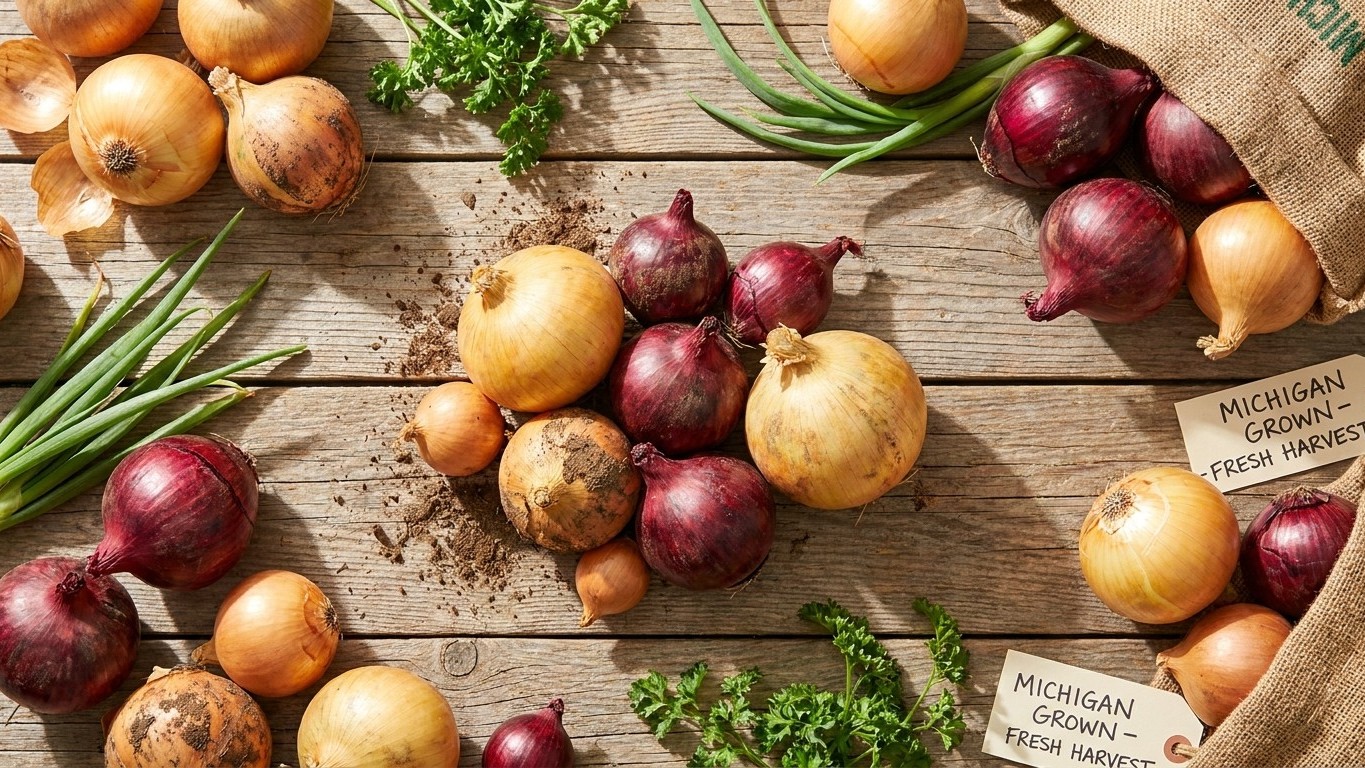

Michigan sits at 42.23 degrees north, the latitude of the National Weather Service station near Lansing, and on the longest day of the year that spot gets 15 hours and 5 minutes of daylight. That number puts the state squarely in long-day onion territory, with intermediate-day varieties also fitting comfortably. Here is which onions actually bulb here, which ones waste a season, and how the answer shifts if you garden near the Ohio line or up in the Upper Peninsula.
The short answer for Michigan

Onions do not bulb because the weather warms up. They bulb because the day gets long enough, and each variety has a published threshold for that trigger. Long-day types wait for something in the 14 to 16 hour range before they stop making leaves and start making a bulb. At 15 hours and 5 minutes on the summer solstice, Lansing clears that bar with room to spare, which means Michigan gardens are long-day country, plain and simple.
That is not the only group that works, though. Intermediate-day onions, which bulb somewhere around 12 to 14 hours, also do fine here. They simply start the bulbing process a little earlier in the season than a long-day type would, at a slightly smaller plant size. Twenty-one varieties documented on this site have a published latitude range that covers 42.23N, and they split roughly evenly between the two groups.
Long-day varieties for Michigan
- Ailsa Craig
- Barolo
- Blush
- Bridger
- Frontier
- New York Early
- Patterson
- Red Carpet
- Rossa di Milano
- Safrane
- Talon
- Walla Walla Sweet
Intermediate-day varieties for Michigan
- Cabernet
- Calibra
- Elsye
- Expression
- Monastrell
- Red Long of Florence
- Red Long of Tropea
- Scout
- Sierra Blanca
Two more, Powell and Redwing, sit right at the edge of their published ranges (43-47N and 43-65N respectively). Both are long-day types, and both may bulb well in Michigan, but a gardener growing them here is working at the low edge of what the catalogue data supports rather than in the middle of it.
What will not work here
Short-day onions are built for a different climate entirely, and planting one in Michigan is not a risk, it is a guaranteed disappointment. A short-day variety starts bulbing once the day reaches about 12 hours, which in this state happens in April, while the plant is still a handful of thin leaves. The bulb that forms at that point is whatever size the plant already reached, and that size is small. The rest of the season does not help. The plant keeps trying to grow leaves after the bulb has already sealed off, and the extra energy has nowhere useful to go.
Five varieties on this site’s list have a published range that tops out below Michigan’s latitude, meaning they were bred for southern day lengths and were never meant to see 15 hours of June sunlight:
- Gabriella, short-day (20-35N): bulbs at a Gulf Coast day length, far too early for a Michigan spring, resulting in a small, immature bulb.
- Madalyn, short-day (20-35N): same issue, a variety bred for latitudes 700 miles or more south of Lansing.
- Red Rock, short-day (30-36N): its range stops well short of Ohio, let alone Michigan.
- White Castle, short-day (30-38N): tops out south of the Great Lakes region entirely.
- Candy, intermediate-day (33-40N): not a short-day type, but its published range still ends at 40 degrees, two degrees south of Lansing, so it bulbs early here and gives up size it never gets back.
Plant any of these in a Michigan garden and the story is the same: healthy green leaves all spring, a bulb that forms weeks earlier than it should, and a harvest that fits in your palm.
What changes across Michigan
Michigan is not one garden. The state runs from roughly 41.7 degrees north at the Ohio border to nearly 48 degrees north out toward Isle Royale in Lake Superior, a spread of more than six degrees of latitude. The 15-hour-5-minute figure above belongs to the Lansing station at 42.23N, which sits close to the state’s southern half. A gardener in Marquette or the rest of the Upper Peninsula is gardening several degrees farther north, under a longer summer day, and that shifts two things at once: the long-day varieties on the list above bulb with even more daylight margin, while the growing season itself runs shorter and colder, with a later last frost and an earlier first one.
| Location type | Approximate latitude | What it changes |
|---|---|---|
| Southern Michigan (reference, near Lansing) | 42.23N | 15h05 on the solstice; long-day and intermediate-day varieties both fit comfortably |
| Upper Peninsula | ~46-47N | Noticeably more June daylight, favoring long-day types even more strongly, but a shorter frost-free window to grow into that daylight |
A reader near the Indiana or Ohio line is close enough to the reference latitude that none of this changes their plan. A reader gardening near Marquette or along the Lake Superior shore should treat Powell and Redwing, the two edge-case varieties above, as a safer bet than they are for someone near Lansing, since more daylight works in their favor. That same northern gardener also needs to start earlier indoors, because the frost-free season arrives later and leaves sooner than it does downstate.
Sweet now, or onions that last
Every onion variety makes a trade, and it is chemistry, not marketing. The compounds that make an onion sharp, the volatile sulfur compounds released when you cut into one, are the same compounds that protect the bulb from rot in storage. A variety bred to be mild has fewer of those compounds. It tastes better raw in July. It also will not make it to Thanksgiving in good shape.
According to University of Missouri Extension, “as a rule, ‘sweet’ onions do not store as well as the more pungent types,” and that rule tracks with day length across the country. Southern gardens, running short-day varieties bred for a milder bite, harvest onions meant to be eaten within weeks. Michigan’s long-day and intermediate-day varieties skew the other way. Walla Walla Sweet is the clear exception on this list, a long-day onion bred specifically for mildness, and it should be treated as an eat-it-soon onion regardless of the fact that it bulbs fine here. Most of the rest, Patterson, Talon, Safrane, Red Carpet, carry more of that sulfur chemistry and are the ones a Michigan gardener should count on for a pantry that still has onions in it come March.
The practical move is to grow both. A row of Walla Walla Sweet for sandwiches in August, and a longer row of a sharper, long-day keeper for the root cellar or the back of the pantry. Trying to get both qualities out of one variety is not really on the table. The chemistry does not allow it.
Checking this against your own garden
Everything above is built on one station’s data, and Michigan is wide enough that your own backyard may sit far enough from Lansing to matter. Before you commit a row to any variety on this page, run these checks:
- Look up your own latitude if you garden well north of Lansing, particularly in the Upper Peninsula, since that shifts how confidently the edge-case varieties will perform.
- Confirm your local average last spring frost date and first fall frost date, since these determine how early you can start onion sets or transplants and how long your bulbing season actually runs.
- Call your county MSU Extension office, which keeps frost-date and soil data specific to your township rather than a statewide average.
- If you are within an hour of the Indiana or Ohio border, treat your conditions as close enough to the reference figures above to follow this page without adjustment.
- If you are near Lake Superior, plan to start onions indoors earlier than a downstate calendar would suggest, since your frost-free window opens later.
None of this changes which varieties belong on a long-day list. It just tells you where in the state that list applies without a second thought, and where it is worth a five-minute call before you order seed.