
Start pepper seed indoors about 8 to 10 weeks before you plan to transplant. In the Detroit area, where the last spring frost lands around April 30, that means sowing in late February through the first week of March. Across most of the rest of the Lower Peninsula, where frost lingers into early or mid-May, back the date up to early or mid-March. The exact week depends on how fast your soil warms to 60 F, not just the calendar.
The short answer
Michigan’s summer heat load, measured at the Detroit reference station, averages 10.3 days a year at or above 90 F. That number matters more than it looks. Pepper fruit set collapses once daytime temperatures push past 90 F, whether the plant is a bell type or a slim frying variety. Blossoms open, but pollen turns sticky and clumped, and the flower drops without setting fruit. Ten days a year isn’t a constant siege, but it’s rarely one clean day either. Heat tends to arrive in stretches, three or four days in a row in July or August, and that’s exactly the pattern that stalls pepper production for a week or two at a time even after the thermometer drops back down.
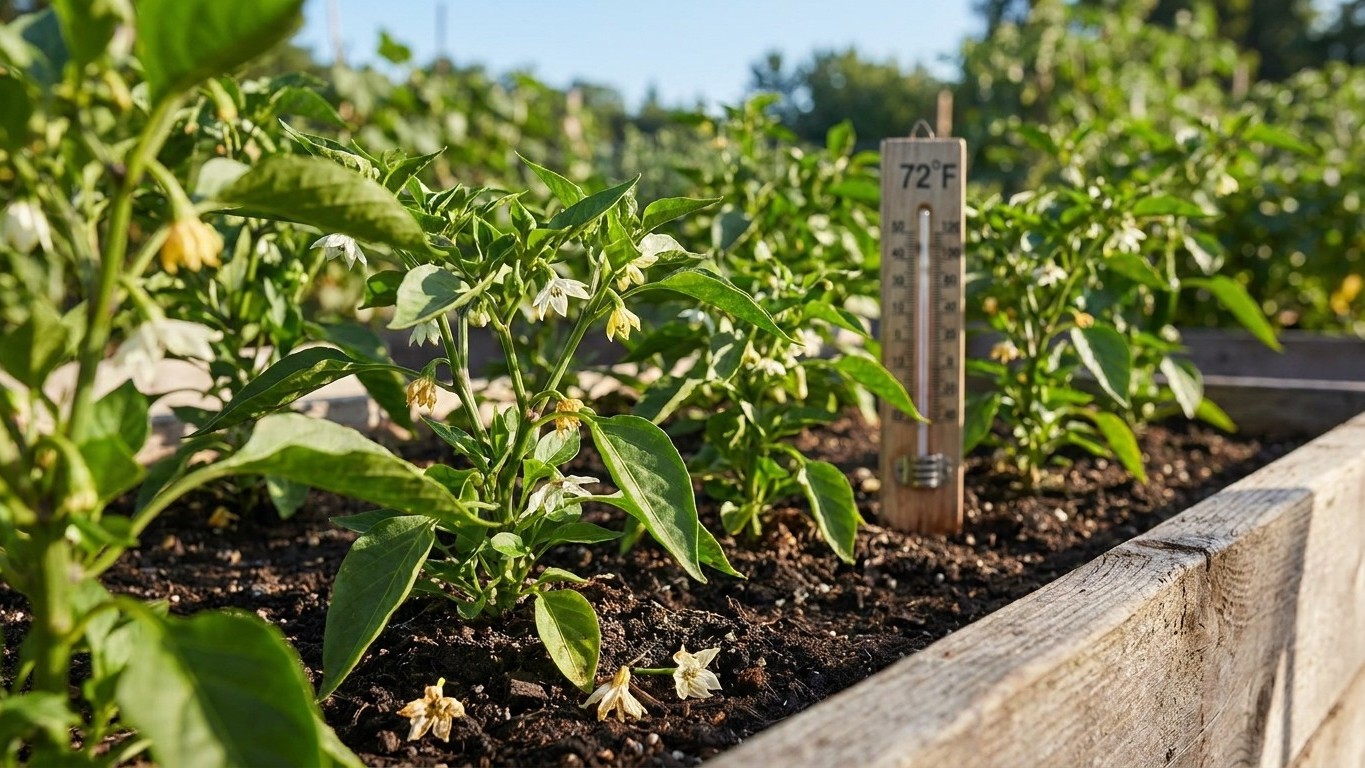
The other failure point sits at the opposite end of the scale, and it deserves equal attention because gardeners tend to fixate on heat and forget the cold side entirely. Peppers stop setting fruit when nighttime temperatures fall below 55 F, even if the daytime high looks perfectly pleasant. A 78 F afternoon followed by a 48 F night in early June, which happens often enough in Michigan gardens close to the Great Lakes or in low-lying inland spots, will cost you a flush of blossoms just as surely as a 95 F afternoon will.
Here’s where this article has to stop short of giving you a number. This site tracks summer daytime heat, the days-above-90 count, for Michigan, but it does not carry summer night minimum temperatures for this state or any other. There’s no published figure here for how many nights in a Michigan June or July dip under 55 F, and guessing from latitude or from how cold January gets would be misleading, since night minimums in growing season depend on local factors like lake proximity, elevation, and how open or sheltered your yard is that a statewide or even county-level average can’t capture. The practical move is to keep a min-max thermometer in the garden during the first few weeks after transplant and watch what your own nights are actually doing, rather than assume they match some regional guess.
Put those two thresholds together and the message is straightforward: Michigan peppers have a workable window, but it’s bounded on both sides. Get the plants in too early and cool nights stall them. Push through the hottest stretch of summer without adjusting watering or shade and hot afternoons stall them again. The seed-starting date you choose is really an attempt to land the plant’s most vulnerable flowering weeks somewhere in the middle of that window.
When to start seed here
The math is simple once you break it into steps, and it works whether you garden near Detroit or further north in the Lower Peninsula.
- Find your last spring frost date. For the Detroit area, that’s around April 30. For most of the rest of the Lower Peninsula, expect early to mid-May instead, sometimes later the further you are from Lake Michigan or Lake Huron’s moderating influence.
- Don’t transplant on the frost date alone. Peppers also need soil that has warmed to 60 F, and in a cool, wet Michigan spring that can lag a week or two behind the last frost. Check soil temperature with a simple soil thermometer pushed 4 inches down rather than trusting the air temperature or the date on a calendar.
- Set your transplant target. For a Detroit-area garden, a realistic transplant date is early to mid-May, once both frost risk and soil temperature line up. Further out in the Lower Peninsula, push that to mid- to late May.
- Count back 8 to 10 weeks for seed starting. If you’re transplanting around May 10, count back 8 weeks to March 15, or 10 weeks to March 1. That gives you a starting window rather than a single date, and starting on the later end is usually the safer bet if your indoor setup runs a bit cool or your light is limited.
- Adjust for your own microclimate. If your garden sits in a low spot that collects cold air, or close enough to a lake to catch a cooler spring, push both the transplant date and the seed-start date a few days later than the regional average. If you garden in a warmer, sheltered urban lot, you may be able to nudge earlier.
Redo this arithmetic for your own county rather than borrowing someone else’s date wholesale. A gardener in a warm pocket near Detroit and one in a cooler spot further north in the Lower Peninsula can easily be two to three weeks apart on both frost date and soil warm-up, and that gap should show up in when the seed tray goes under lights.
What goes wrong here
- Blossom drop from a hot spell. When daytime temperatures push past 90 F, which happens on average about 10.3 days a year around Detroit, flowers open and then drop without setting fruit. There’s no fix that stops the heat, but shading cloth over the row during the worst afternoons, and keeping soil moisture consistent so the plant isn’t fighting drought stress on top of heat stress, both shorten the setback. Once temperatures ease back down, new blossoms typically resume setting within a week or two.
- Blossom drop from a cool night. This is the flip side, and it’s easy to miss because the daytime weather can look fine. Nights below 55 F stall fruit set just as effectively as scorching afternoons, and since this site doesn’t publish summer night minimums for Michigan, the only reliable defense is watching your own garden with a thermometer, especially in late May and early June before summer nights fully settle. Floating row cover pulled over the plants on a night that looks like it’s dropping into the 40s or low 50s can buy a few critical degrees.
- Sunscald on exposed fruit. Where sun exposure is strong, especially on plants that have lost leaves to disease, wind damage, or over-pruning, fruit sitting fully exposed can develop pale, papery patches on the sun-facing side. Keeping the plant’s natural leaf canopy intact is the simplest prevention; resist the urge to strip leaves to “let the sun in,” since peppers actually need that foliage cover to protect their own fruit.
- Blossom-end rot. This shows up as a sunken, leathery brown patch on the bottom of the fruit, and it traces back to inconsistent watering more often than to a true calcium deficiency in the soil. Michigan’s swing between wet spring weeks and dry summer stretches makes this a recurring issue; even, regular watering, plus a layer of mulch to hold soil moisture steady, addresses most cases without needing a soil amendment.
Common questions
Can I start pepper seed earlier than 8 weeks before transplant to get a head start?
Starting much earlier than 10 weeks tends to backfire. Plants get root-bound in their trays, growth stalls, and they often transplant worse than seedlings started right on schedule. The 8 to 10 week window is a range for a reason, not a minimum to beat.
What if my soil is still cold on the date I planned to transplant?
Wait for the soil, not the calendar. Transplanting pepper seedlings into soil below 60 F sets them back further than simply holding the plants indoors a few extra days under grow lights would.
Does the days-above-90 count mean I should skip growing peppers outdoors in Michigan?
No. Ten days a year of extreme heat is a manageable stretch, not a dealbreaker, especially with shade cloth and steady watering during those spells. It’s a factor to plan around, not a reason to avoid peppers altogether.
How do I know if my nights are too cold for fruit set if this site doesn’t track that number?
Put a min-max thermometer in the garden bed itself, not just on a porch or windowsill, and check it each morning through late May and early June. If readings are regularly dipping under 55 F, cover the plants overnight with row cover until nights stabilize.