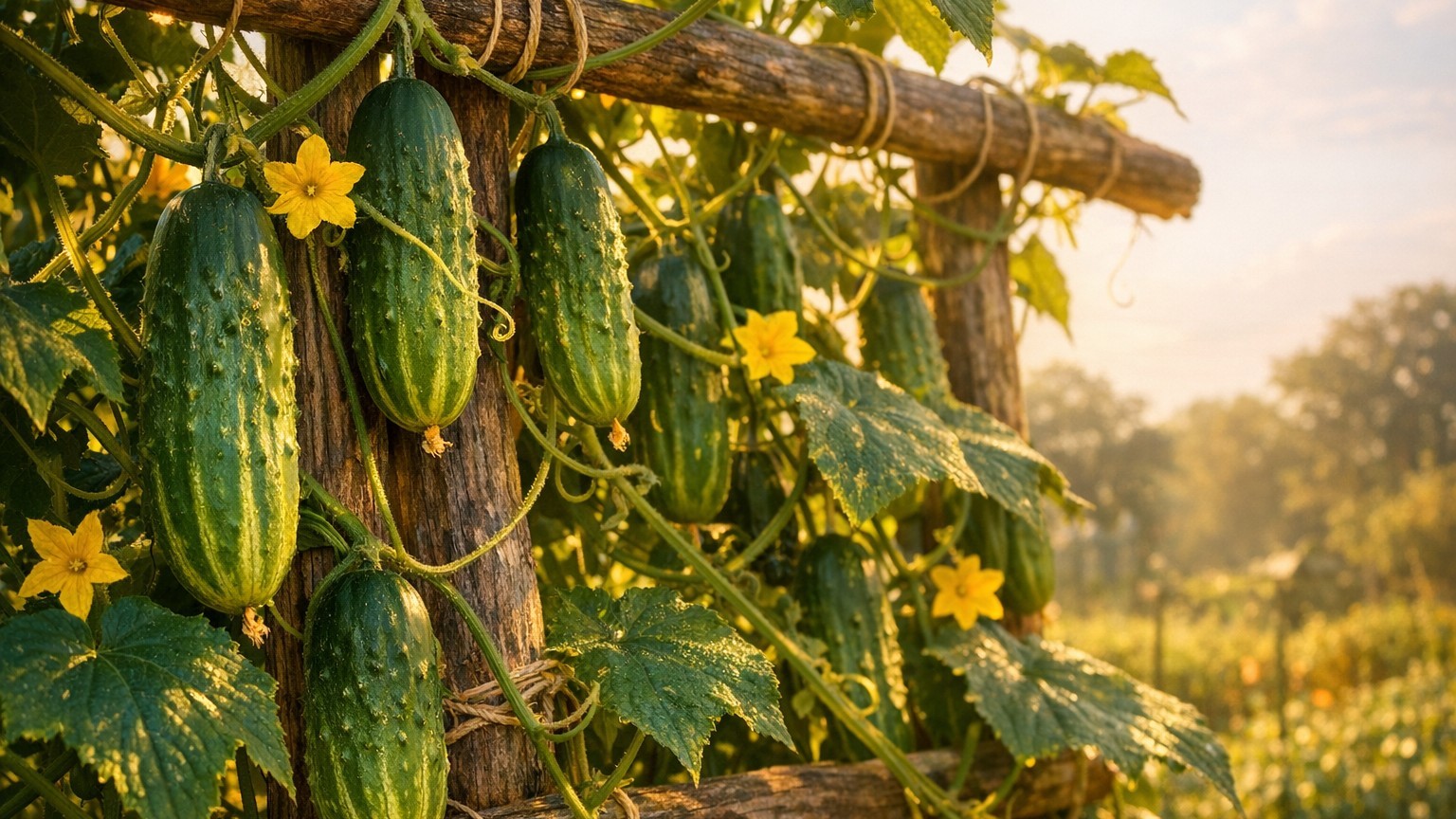

Short-season, disease-resistant cucumber types built for a roughly five-month window are the safe bet across Minnesota. Pickling types and compact bush slicers mature fast enough to beat the state’s frost dates, while parthenocarpic (self-fruiting) varieties buy extra insurance when a cool, wet spring delays pollinators. Skip anything bred for a long, hot season.
The short answer for Minnesota
Start with the calendar. The Twin Cities reference station sees its last spring frost between April 17 and April 30, and its first fall frost between October 11 and October 23 (NOAA NCEI 1991-2020 Climate Normals). That puts the frost-free window at roughly 164 to 189 days in the state’s mild south. Add a heat profile that’s moderate rather than punishing, an average of just 10.6 days a year reaching 90°F or higher, and you get a growing season that’s decent in length but never scorching. That combination is what should drive variety selection, not a name on a seed rack.
Match the type to the season, not the season to the type
With a season this length and heat this mild, three categories make sense for most Minnesota gardens:
- Pickling types — bred to size up fast and produce a heavy early flush, which matters when your effective season might be closer to 150 days than 190.
- Parthenocarpic (burpless) slicers — these set fruit without pollination, a real advantage in a cool, rainy spring stretch when bee activity is spotty and every warm day counts.
- Bush habit cucumbers — compact, quick to establish, and forgiving in a raised bed or container if your garden runs shorter on space or sun.
Long-vine, extended-harvest slicing types can work, but only in the state’s mildest pockets and only if the plant goes in the ground promptly once soil has warmed. That’s a narrower margin than most of the state gets. None of this is a cultivar recommendation. Trial results for specific named varieties in your county come from your state extension service, not from a statewide climate normal.
What will not work here

Three habits fail predictably in Minnesota, and each one traces back to a specific number above.
Long-season types run out of runway
A cucumber that needs a long, uninterrupted stretch of warm weather to finish its full harvest cycle is gambling against an October frost that can arrive as early as the 11th. In a cool year, or anywhere outside the mild south, that gamble loses. Long-maturing vining slicers, started late or set out after a slow spring, simply run out of season before they hit peak production.
Weekly watering doesn’t match the rainfall pattern
Summer rainfall across June, July and August averages about 13.0 inches, with July, the driest month, delivering only 4.06 inches. Cucumbers are shallow-rooted and thirsty, and 10.6 days a year at 90°F or above means evaporation spikes hard on exactly the days plants need water most. A once-a-week watering schedule assumes rain fills the gaps evenly. It doesn’t. Minnesota’s summer rain tends to arrive as thunderstorms, meaning a big dump on one day and dry stretches after it, and on sandy soil that water is gone within hours. Anyone counting on the sky to do the work of a hose is setting up a July slump.
Tight spacing invites disease after a storm
When rain comes in bursts rather than a steady drizzle, foliage stays wet longer after each event, especially where plants are crowded and air can’t move through the leaves. That’s the setup for powdery and downy mildew on cucumber vines. Planting cucumbers shoulder to shoulder along the ground, without room for airflow, turns a normal rainy week into a disease outbreak. Trellising or wider spacing costs a little garden real estate. It buys a lot of leaf health.
What changes across Minnesota
Minnesota isn’t one growing zone, it’s a spread from USDA Hardiness Zone 3a to 5a (USDA Plant Hardiness Zone Map, 2023, based on 1991-2020 normals). That’s a wide enough range that no single planting date or variety pick applies statewide, and the frost dates cited above come from the Twin Cities station, the mild southern end of that range. Northern Minnesota runs two to three weeks tighter at both ends of the season, meaning a shorter frost-free window on both the spring and fall side.
What that means in practice, without pretending to know any one reader’s exact location:
| Region within Minnesota | Season shape | Practical shift |
|---|---|---|
| Southern MN / Twin Cities area (warmer end, roughly Zone 5a) | Closest to the frost dates cited in these facts | Standard-length pickling and slicing types have room to finish |
| Northern MN (colder end, roughly Zone 3a) | Frost-free window two to three weeks shorter on each end | Lean harder toward bush and quick-pickling types; season-extension (row cover, black plastic mulch) becomes less optional and more standard practice |
The USDA zone number reflects one thing only, the average annual extreme minimum temperature. It doesn’t measure summer rainfall, heat days, or frost timing on its own, which is why it’s paired here with the frost-date normals rather than used alone. This page won’t tell any individual reader which zone they’re in. That’s what the USDA hardiness zone map is for.
Where to check this for your own county
Everything above comes from statewide and single-station normals. A county-level recommendation will beat it every time, and Minnesota has one available. The University of Minnesota Extension maintains county offices and Master Gardener programs that track planting calendars and variety trial results specific to local conditions, something a state-level climate normal simply can’t do.
Two things are worth pulling up on that site before you buy seed:
- The local planting calendar for your county, which will reflect the tighter frost window if you’re in the northern part of the state rather than the Twin Cities dates used here.
- Variety trial results for cucumbers grown in your county or region, since those trials name specific cultivars tested under local soil and disease pressure, which this page deliberately does not do.
Think of this page as the statewide baseline, useful for understanding the mechanics (season length, heat load, rainfall pattern) behind a decision. The county extension office turns that baseline into an actual variety list suited to your soil, your microclimate, and the disease pressure your neighbors have already dealt with. That’s a resource worth using before committing a whole row to one type.
Checking this against your own garden
Climate normals describe an average year. Your garden is having one specific year, and it will tell you more than any date on this page if you know what to watch.
Three signals matter more than the calendar:
- Soil warmth by feel. Cucumber seed wants warm soil to germinate reliably. Push a finger a couple of inches into the bed; if it still feels cool and damp rather than warm, the soil hasn’t caught up to the air temperature yet, no matter what the date says.
- The first flush of male flowers. Cucumber plants typically send out male flowers before female ones. Seeing male flowers first is normal, not a sign of trouble, and it’s an early clue that the plant has shifted into reproductive mode for the season.
- The first true leaves. The rounded seed leaves that show up first aren’t the plant’s real leaves. Watch for the next set, the true leaves with the jagged cucumber-vine shape, since their size and color are a quick read on whether the plant has enough light, warmth and nitrogen where it’s actually growing.
None of these require a thermometer or a soil probe, just attention. A backyard that sits in a low spot, gets shaded by a fence line, or has heavier clay than the county average will run its own schedule, sometimes by a week or more in either direction, and that schedule is the one that actually decides harvest day.