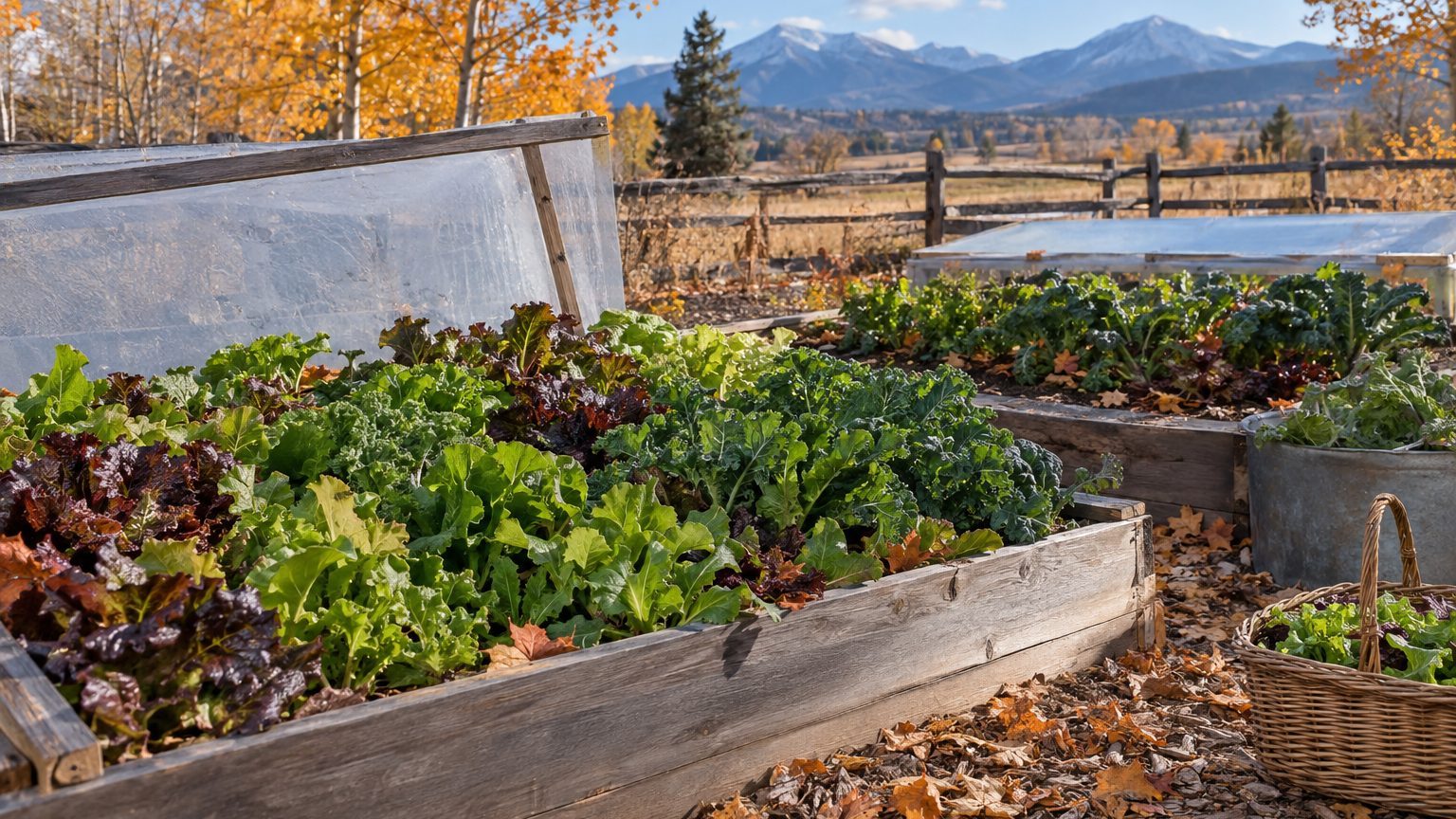

Start Minnesota winter salads by watching the soil, not the calendar. In the Twin Cities the last spring frost falls between April 17 and April 30, but beds warm later than that. The first fall frost arrives October 11 to 23. Between those dates sits one fairly tight growing window, and the hardiest leafy greens, given a cover, are the ones that can use the end of it.
When the soil is warm enough in Minnesota
The date most gardeners want is the last spring frost, and for the Twin Cities it runs from April 17 to April 30. That range comes from the NOAA NCEI 1991-2020 Climate Normals, specifically the band where the chance of a 32°F freeze sits between 30 and 70 percent. It is a probability, not a promise, so a late freeze after that band is always possible.
Frost is also a proxy. Air temperature crosses the line first, and soil follows days or weeks behind, because wet ground holds cold far longer than the air above it. Winter salads wait for warm soil, and soil warms after the frost risk ends, not with it. A bed that is technically past its last frost can still be cold and sodden, and seed sown into that stalls, rots or comes up patchy.
Reading the bed instead of the date
A cheap soil thermometer settles the argument better than any almanac. Push it a couple of inches down in the morning, when the reading is at its lowest, and check it over several days rather than once. Your University of Minnesota Extension office can give you the germination thresholds for each crop, and those numbers matter more than the frost date.
The hand test works too. Squeeze a fistful of soil: if it crumbles when poked, it is workable, and if it holds as a slick, sticky lump, wait. Raised beds and sandy or well-drained ground reach that point sooner. Heavy clay, low spots and north-facing edges lag behind.
The Twin Cities are the mild south of the state. Northern Minnesota runs two to three weeks tighter at both ends, so anyone gardening up there should shift every date in this article accordingly, and wait for the soil even longer.
Cold-tolerant types, such as spinach, arugula and the hardy rosette greens, germinate in cool ground and are the first things to go in once the bed is workable. Cold-tolerant does not mean waterlogged-tolerant. Ask the extension office which varieties have been trialled locally, because this page can only speak in types.
How long the season lasts here
Do the subtraction with the Twin Cities dates. From the later end of the spring range (April 30) to the earlier end of the fall range (October 11) is 164 days. From the earlier spring date (April 17) to the later fall date (October 23) is 189. So the frost-free window runs roughly 23 to 27 weeks, depending on the year and on which side of the probability band it lands.
That is long enough for something, and short enough that planning matters. A window in that range allows a spring sowing, a second sowing when the first bolts or gets cut out, and a final late-summer sowing meant to carry into the cold months. It does not allow loose timing on that last one.
Here the first fall frost date is misleading. The October 11 to 23 range is when frost starts, but a winter salad needs to reach useful size before the light fails, because growth slows hard as days shorten and plants that are still tiny in late fall mostly sit there. Count backward from the fall frost, not forward from the spring one, and sow the last round with room to spare. The succession sowing guide on this site lays out how to stagger those rounds. For the general logic of the crop, the parent piece, Winter Salads: What Grows When Lettuce Will Not, covers what grows and why.
Window length also settles the transplanting question. With a long window, starting seedlings in modules and moving them out is a fine way to gain a week or two, and a root check is a price you can afford. In a short one, as in the northern part of the state where both ends shrink by two to three weeks, direct sowing is usually the better bet for leafy greens, because there is no transplant stall to absorb. Any gardener in the north should treat the first sowing as the main one, since a second may not have the days it needs.
Heat and water in Minnesota
This page does not carry a verified count of days above 90°F or a summer rainfall total for the state, so it will not quote either. Offering a number I cannot source would be worse than leaving a gap. What the data does support is that, for this crop, the cold decides nearly everything.
The Minneapolis reference station shows a mean daily minimum of 8.8°F in the coldest month (NOAA NCEI Climate Normals, 1991-2020). That is the average night, not the record low, and the extremes run well below it. The USDA Plant Hardiness Zone Map, which rates zones on the average annual extreme minimum, puts Minnesota at 3a to 5a. That is a wide range, so the Twin Cities and the northern counties differ considerably.
Those numbers sort the salad crops into three groups. A few of the hardiest rosette greens can stand uncovered through fall and early winter and keep their leaves. Many more, including most spinach and the chicories, stay in edible condition only with a cover such as a cold frame, low tunnel or unheated greenhouse. And tender head lettuce cannot manage deep winter here, covered or not, and belongs to the warm months. Even under glass, expect growth to nearly stop in midwinter, so the cover keeps leaves in shape for cutting rather than producing new ones.
Summer still has a job to do. When the summer is warm and dry, the late-summer sowing meets hot, parched soil that crusts and dries out, and shade cloth plus steady moisture at seeding time save the stand. When the summer runs cool and damp, you get a different set of troubles: powdery and downy mildew, slow growth and fungal rot at the base of crowded plants. Spacing, airflow and watering at the soil rather than overhead are the practices that matter, and they cost nothing.
The first fall frost sets how late a sowing can still make useful size. That is why, in the Twin Cities, a final sowing needs to go in well ahead of the October 11 to 23 range, and why northern gardeners will be working against a calendar that closes two to three weeks sooner.
Which winter salads suit Minnesota
Choose by type, and let the short season and the cold do the narrowing. The table sorts the main types by how they handle a Minnesota fall and winter, in general terms.
| Type | Cold behavior | Role in Minnesota |
|---|---|---|
| Hardy rosette greens (mâche, claytonia) | Tolerate hard freezes, best under cover in deep winter | Backbone of the winter bed |
| Spinach | Cold-tolerant, usually needs cover to stay usable | Late-summer sowing, cut into late fall |
| Arugula and mustard-type greens | Quick, accept light frost, bolt in heat | Fast fillers early and late in the window |
| Chicories (endive, escarole, radicchio) | Vary, many take a frost | Good late-fall crops given airflow |
| Tender lettuce | Light frost only | Spring and early fall, not winter |
A short season favors the earliest types, the ones that reach cutting size fast, because the window leaves little room for slow growers. Wet or humid weather makes disease resistance the first thing to ask about on a seed packet. And wherever summer heat arrives, the answer is airflow and some shade at the root, not a different crop.
Naming varieties is where this page stops, on purpose. The only recommendation worth following is one that has been trialled where you garden, and a Duluth bed and a Rochester bed are not the same test. Your best source is University of Minnesota Extension, whose horticulture staff know which varieties have performed locally. A variety name from a page that cannot source one is the quickest way to waste a season.
All of this is salad grown in beds and containers, and it stays that way. Foraged leaves are not part of it: wild watercress from water that livestock graze can carry liver fluke, and several plants that resemble young salad leaves are seriously toxic. For neighboring cold-climate comparisons, see Winter Salads for Vermont Gardens and Winter Salads for Nova Scotia Gardens.
Common questions
When can I sow winter salads outdoors in Minnesota?
Wait for the soil, not the frost date. In the Twin Cities the last spring frost falls between April 17 and April 30, and workable, warming soil comes after that. Check the bed with a thermometer and confirm crop thresholds with your extension office.
Do winter salads in Minnesota need a cover?
Most do. The coldest month’s mean daily minimum at Minneapolis is 8.8°F, so only the hardiest greens hold uncovered, and only for a while. A cold frame, low tunnel or unheated greenhouse keeps the rest in edible condition.
Is northern Minnesota different from the Twin Cities?
Yes. The Twin Cities are the mild south of the state, and the north runs two to three weeks tighter at both ends of the season. Sow earlier in the fall run-up and plan on fewer succession rounds.
Which varieties should I plant?
Ask University of Minnesota Extension. It can tell you which varieties have been trialled in your part of the state, which is more reliable than any list that does not come from local trials.