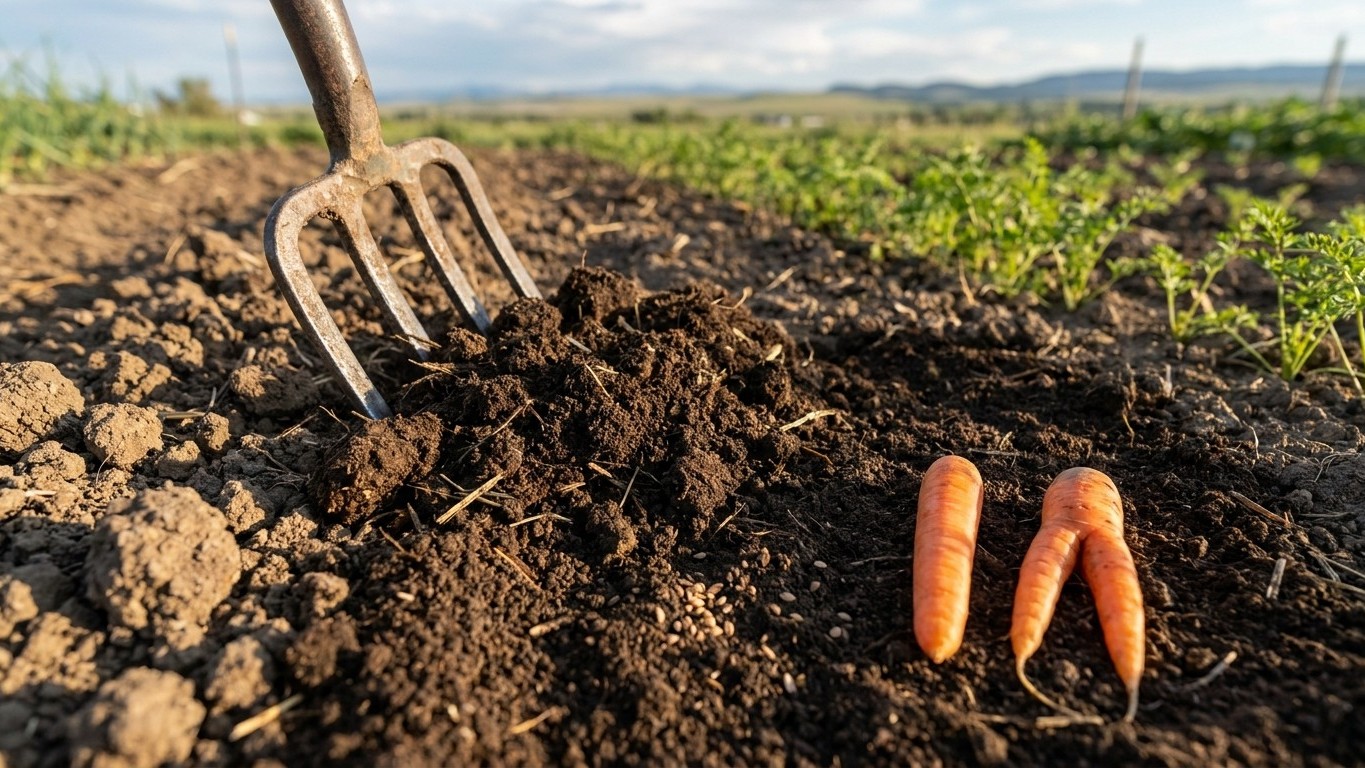

Pull carrots when the orange shoulders at the soil line have reached the width the seed packet promises. That usually falls somewhere between 65 and 100 days after seeding, depending on the type. Cut the tops off right away, then chill the roots near 33 °F in high humidity. Left with their leaves on, they hold about 10 to 14 days. Missouri’s silty ground and swinging fall weather change a few details.
When carrots are ready in Missouri
Carrots are ready when the shoulders showing at the soil line match the width on the seed packet, and in most Missouri gardens that means 70 to 100 days counted from seeding. Clemson Extension puts harvest at about 65 to 75 days after planting, which fits the quicker types. Slower, longer roots take the rest of that range.
The clock matters more than the calendar, and it starts on sowing day. Carrots are sown in place, so there is no transplant date to count from, only the day the seed went into the row. A spring sowing and a late-summer sowing will not take the same number of days, because growth slows as the days shorten.
This page carries no Missouri frost dates, and the state stretches a long way north to south, so a single date would mislead half of you. Look up the average first fall frost for your county, count backward 70 to 100 days, and you have the latest sensible sowing date for a fall crop. Leave slack, since fall roots size up slowly. The Growing Carrots in Missouri guide covers sowing in more detail.
The surest check is a test pull. Loosen the soil beside one carrot, ease it out, and look at its color and width. If it is still thin and pale, the rest can stay in the row another week.
Soil also decides how easy the pulling is. USDA lists the Menfro series as Missouri’s representative soil, a well-drained loam to silt that is 4 percent sand, 19 percent clay and 77 percent silt, with about 2.0 percent organic matter. Utah State University Extension says carrots want deep, sandy, well-drained soil rich in organic matter, and that heavy or rocky ground makes the root fork. Menfro drains well but is far from sandy, so it tends to set hard when dry. Water the row the day before harvest and work a garden fork a few inches to the side of the row.
Your own bed may look nothing like Menfro. River bottoms, hill country and scraped subdivision lots all differ. To find out what you have, fill a straight-sided jar one-third with soil, top it with water, shake it, and let it settle for a day. The layers of sand, silt and clay show up as bands. Then read Will Carrots Fork in Missouri Soil? for what to do about heavy ground.
Keeping them, and for how long
Clemson Cooperative Extension, through its Home & Garden Information Center, gives the storage recipe in one line: “Store them at 33 °F and high humidity to prevent wilting.” The same source says bunched carrots, meaning plants with the tops still on, can be stored for about 10 to 14 days. It publishes no humidity percentage, so “high” is as precise as the source gets. The full factsheet is at hgic.clemson.edu.
Read 33 °F carefully. Water freezes at 32 °F, so this is one degree above ice. It is not a cellar temperature in the usual sense, and it is not a cool pantry. A reader who keeps carrots at 50 °F will lose them to sprouting and softening in a fraction of the time the cold room would give.
Why the tops come off first
The leaves are the catch. They keep drawing moisture out of the root long after harvest, so a carrot with its greens attached slowly dries into something limp. That is why bunched carrots keep only 10 to 14 days while trimmed roots, stored cold and humid, keep for months. Cut the tops off within a day of pulling, leaving about an inch of stub, and the roots stop losing water through their leaves.
Treat every duration here as a ceiling under ideal conditions. Ten to fourteen days for bunched carrots and months for trimmed ones assume steady cold, high humidity, and sound roots to begin with. A nicked carrot, a soggy one or one stored in a fluctuating spot will fall short of those numbers. Do not wash them before storing if you can avoid it. Brush off the loose soil and let the surface dry for an hour or so, then pack them in a container or bag that holds moisture in.
A perforated plastic bag or a lidded tub works for that. It keeps the air around the roots damp without letting condensation pool on them. Check the pack every couple of weeks and pull out any soft ones, since one rotting carrot spoils its neighbors quickly.
Where in the house that actually is
Few rooms in a Missouri house sit near 33 °F. The refrigerator does. Its crisper drawer is the closest match for cold and humidity, and for most households it is the place trimmed carrots will keep longest. A kitchen counter, pantry or heated basement room is far too warm, and carrots there turn soft and start sprouting.
Garages, sheds and unheated porches are the tempting alternatives, and they are the risky ones. Missouri autumns swing from balmy afternoons to hard overnight cold, and an unheated space follows the weather. It can sit at 55 °F in October and drop below freezing on a January night, and frozen carrots turn mushy once they thaw. A basement or root cellar built into the ground stays steadier, but it is usually warmer than 33 °F until deep winter.
The fix costs a few dollars. Put a thermometer in the spot you plan to use and read it morning and evening for several days before you commit a harvest to it. A cheap min-max thermometer is better, since it records the overnight low you would otherwise miss. Skipping this step is how a season’s carrots end up either frozen or sprouting.
Refrigerators are not identical either. Crisper drawers tend to run slightly warmer than the back shelf, and a fridge that is packed full or opened constantly drifts around. Put the thermometer inside the drawer, not on the door. If the drawer reads well above 33 °F, drop the dial one notch, wait a day, and read again. If the drawer cannot hold every carrot, a spare refrigerator in the garage, kept above freezing, is the usual answer for a big crop.
What goes wrong here
A frozen storage spot is the first failure. A garage or cellar that holds 33 °F in November can slip below 32 °F when a cold snap arrives, and the carrots come out glassy and limp. Watch the forecast in winter, check the min-max thermometer after any cold night, and move the crop to the refrigerator when the spot gets close to freezing.
A damp autumn is the second. Wet weather leaves carrots sitting in saturated ground, and Menfro-type silt holds a sticky film of mud on the roots. Muddy, split or nicked carrots rot first in storage. Sort them at harvest and eat the damaged ones now, storing only clean, unbroken roots. Split roots are common after heavy rain follows a dry spell, and they will not keep. Insects and other pests belong in another discussion, which is covered in What Eats Carrot in Missouri, and When.
The third failure is a glut. A well-grown 10-foot row produces more carrots than most families eat in a week, and they all ripen together. Pulling everything at once is the surest way to end up with a fridge full of soft carrots. Instead, leave part of the row in the ground and pull as you need them, and mulch the row with straw or shredded leaves to protect it. Share the surplus with neighbors and food pantries while the roots are still crisp.
Common questions
How many days after seeding are carrots ready?
Plan on 70 to 100 days counted from seeding. Clemson Extension gives about 65 to 75 days after planting for harvest. Because carrots are sown directly, both counts start on sowing day. Confirm with a test pull.
Do I have to cut the tops off before storing carrots?
Yes. The leaves keep pulling moisture from the root, so bunched carrots keep only about 10 to 14 days. Trimmed roots kept cold and humid last for months at best.
Can I keep carrots in a cellar or garage?
Only if a thermometer shows it stays just above freezing, near 33 °F, and never dips to freezing. Most cellars run warmer, which speeds sprouting and softening. Most garages swing with the weather, which risks freezing. The refrigerator is the reliable choice.
Is Missouri’s state soil good for carrots?
Menfro is well drained, which helps, but it is 77 percent silt with only 4 percent sand and about 2.0 percent organic matter, so it can set hard. It is only the state’s representative soil, not necessarily yours. Do the jar test at home, and add compost or use a raised bed if the ground is heavy.