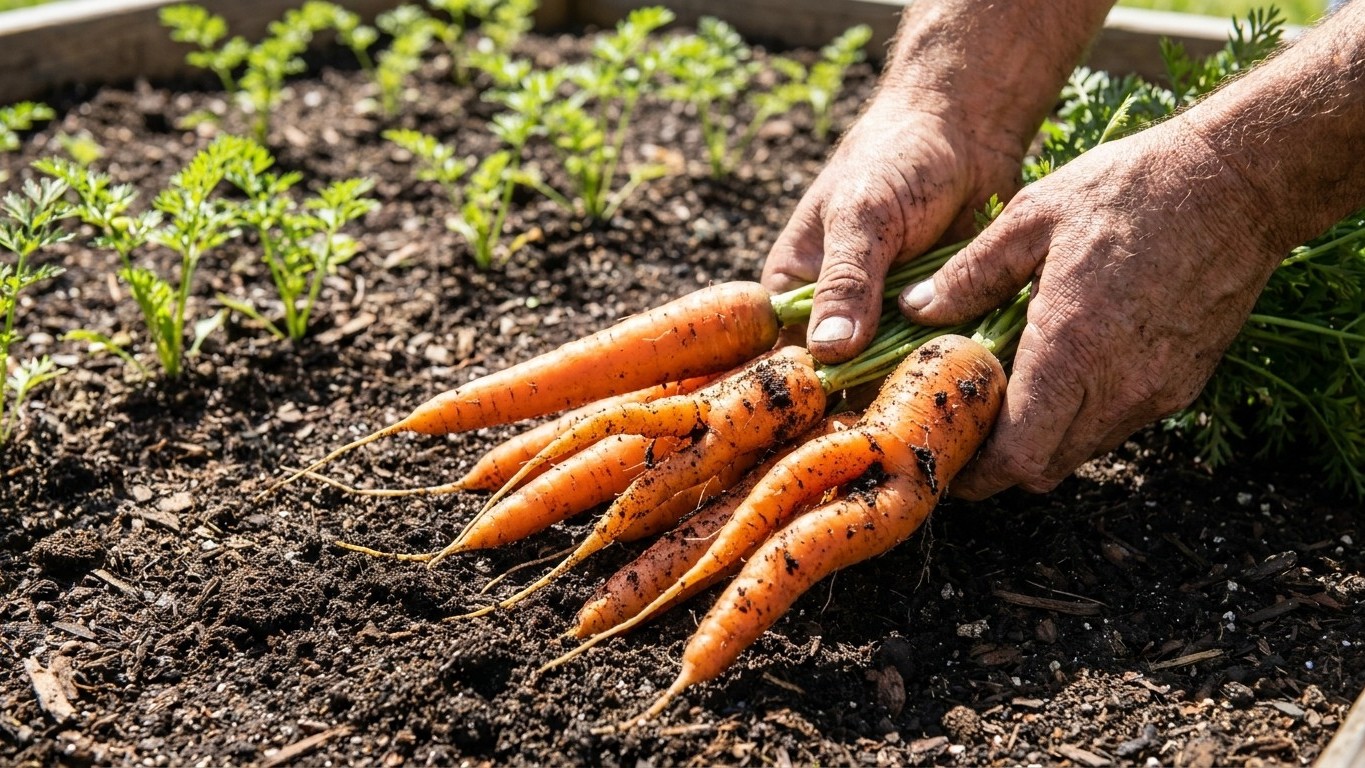

Carrots go into Missouri ground while the soil is still cool, counted backward from the last frost date for your county rather than a fixed calendar day. That counting only works if the ground itself cooperates: carrots are sown directly where they’ll grow, never transplanted, and the 70 to 100 days to harvest start the moment seed touches soil. Get the timing right and the wrong soil still ruins the root. Here’s what Missouri dirt does to a carrot, and how to check your own before you plant.
The short answer
The soil USDA lists as representative of Missouri is the Menfro series, an Alfisol formed under forest cover. It’s a moderately fertile ground that holds nutrients reasonably well, with a surface pH around 6.2, which is slightly acid and sits inside the range most vegetables tolerate without complaint. Texture-wise it runs 4 percent sand, 19 percent clay and 77 percent silt, a silt loam by any measure, with organic matter around 2.0 percent and a well-drained rating.
That combination matters for a root crop that’s picky about what it grows through. Utah State University Extension is blunt on the point: carrots want deep, sandy, well-drained soil rich in organic matter, and heavy or rocky ground makes the root fork instead of growing straight down. Menfro’s clay content, at 19 percent, is nowhere near the heavy clay that typically causes bad forking, and the well-drained rating is a point in its favor. The catch is the silt. A soil that’s 77 percent silt can crust over after a hard rain and compact under foot traffic or a rototiller, and at 2.0 percent organic matter it’s leaner than the humus-rich ground carrots prefer. In practice, that means a bed built on ground like this benefits from the same fix Utah State recommends for heavier soil anyway: work in plenty of compost and double dig, or skip the guesswork and build a raised bed filled with a loosened, sandier mix.
None of that is a verdict on any one backyard. Missouri spans hundreds of mapped soil series, and Menfro is simply the one USDA names as representative of the state as a whole. A garden in a river bottom, a lot on a hillside, or any yard a builder graded and filled years ago can carry a completely different soil than the one described here, sometimes just a few miles from where Menfro is mapped. Treat this section as the starting point for the conversation, not the answer for your raised bed. The next section is how you get the actual answer, in your own dirt, with a shovel and about twenty minutes.
The test that settles it in your own garden
- Dig a hole about a foot deep in the bed you plan to sow. Pay attention to how the shovel moves through the ground: soil that crumbles and gives way is workable, soil that resists in dense, sticky clumps or clangs against buried rock tells you something before you’ve even pulled a sample out.
- Check the depth and look for obstructions. Carrots need open ground straight down with nothing to deflect the root, so note any rock, gravel, a hardpan layer, or old construction fill you hit along the way. A shallow layer of loose soil sitting on top of something dense is exactly the setup that produces forked, stunted roots.
- Feel the texture. Take a handful from the bottom of the hole, dampen it slightly, and roll it between your fingers. Gritty and loose means sand. Sticky, moldable, and able to hold a ribbon shape means clay. Smooth, silky, and floury when dry means silt. Most garden soil is some blend of the three, and the blend tells you how it will behave once carrot seed goes in.
- Watch how water drains. Fill the hole with water and see how long it takes to disappear. Water that vanishes quickly points to a loose, well-drained bed. Water that sits for a long stretch points to compaction or a clay-heavy layer holding moisture where carrot roots don’t want it sitting.
- Repeat in more than one spot. Soil can change character across a single yard, so a reading from one corner of the garden shouldn’t stand in for the whole bed.
What goes wrong here
- Forking in heavy or compacted ground. When roots meet resistance from clay, compaction, or buried rock, they split or twist instead of growing straight. Utah State University Extension points to the fix directly: work compost in generously and double dig the bed before sowing, or build up a raised bed filled with a looser, sandier mix so the root never has to push through anything dense.
- Poor germination during a hot spell. Carrot seed is small and shallow-sown, and a dry, crusted surface during a stretch of summer heat can keep it from sprouting at all. Keeping the seedbed consistently damp until seedlings appear, and shading it lightly with straw or a board until germination starts, keeps a hot week from wiping out the row.
- Splitting from uneven watering. A carrot that dries out and then gets soaked, whether from a missed week followed by a heavy rain or an inconsistent hose schedule, tends to split as the root swells unevenly. A steady watering routine, backed by a couple inches of mulch to hold moisture between waterings, keeps growth even and the root intact.
Common questions
Do carrots need a raised bed in Missouri clay?
Not automatically, but if your dig test turns up dense clay and slow drainage, a raised bed filled with a loosened, compost-rich mix is the simplest way to guarantee the deep, unobstructed run a carrot root needs.
Can I sow carrots directly into unimproved silt loam like Menfro?
You can, since it’s well drained and reasonably low in clay, but its silt-heavy texture and modest organic matter mean it will crust and compact more than carrots prefer. Working in compost before sowing improves the odds considerably.
Is there a transplant date for Missouri carrots?
No. Carrots are sown directly where they’ll grow and are never transplanted, so there’s no transplant date to track. The 70 to 100 days to harvest count from the day seed goes into the ground.
Why does my carrot come out forked even though the top looked fine?
Forking happens below the surface, where the root hits rock, a compacted layer, or a change in soil density it can’t push through. It’s a soil problem, not a seed or variety problem, and the dig test described above is how you catch it before you plant rather than after harvest.