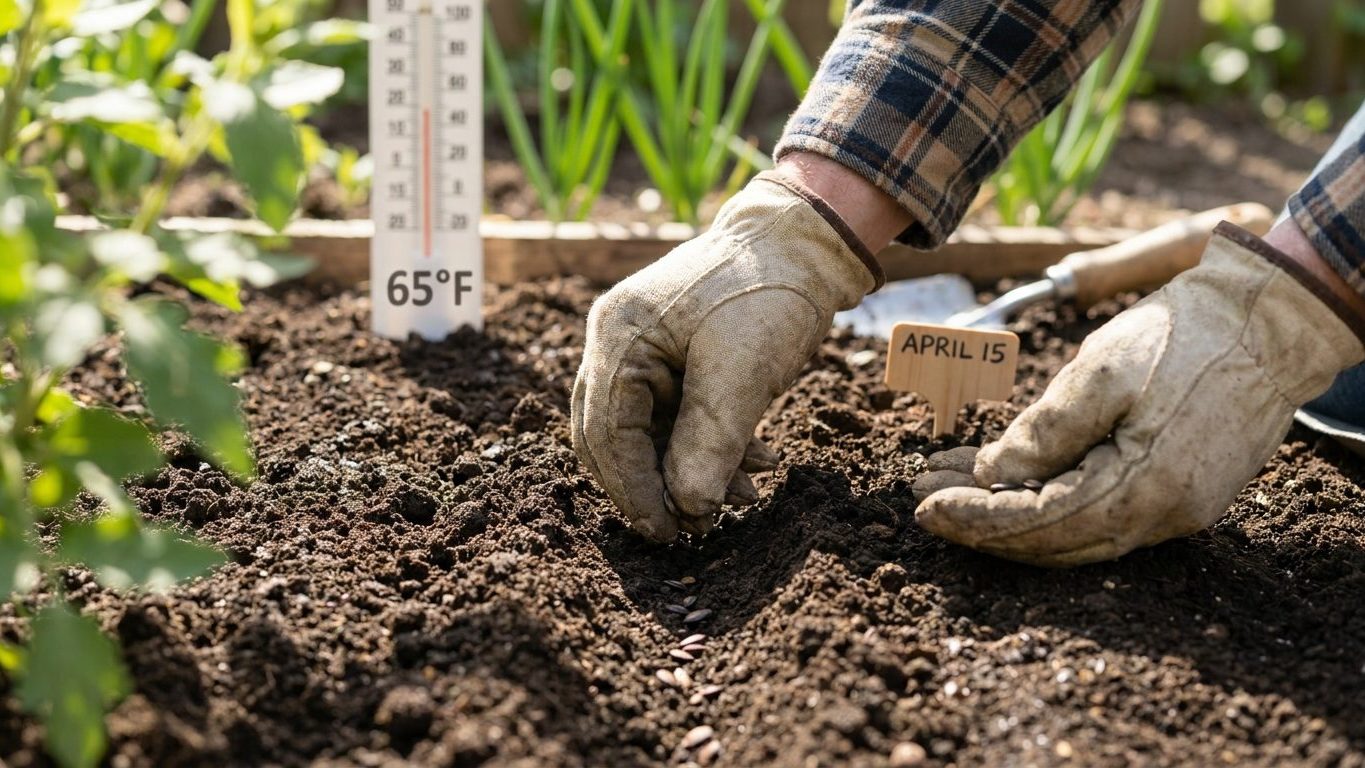

Missouri gardeners can direct-seed or transplant melons once the last spring frost has passed and soil has warmed into the high 60s, which usually lands somewhere between late April and mid-May depending on where in the state you garden. The safe window narrows again by midsummer, since melons need enough time on the vine before the first fall frost arrives. The exact dates depend on which part of Missouri you’re standing in.
The short answer for Missouri
Set melon transplants or direct-seed after your last spring frost, which for the Kansas City reference station falls somewhere between April 6 and April 20. That’s not a single date. It’s a 30 to 70 percent probability band for a 32F freeze, built from 1991-2020 NOAA climate normals. April 6 is the early edge, where there’s still roughly a 70 percent chance of a freeze occurring after that date. April 20 is the late edge, where the odds have dropped to around 30 percent. Neither date is a guarantee, and melons planted into cold soil right at the early edge of that window will simply sit and rot rather than germinate.
That matters more for melons than for most vegetables, because melon seed wants soil in the high 60s to low 70s before it sprouts reliably. Soil that has just cleared a frost risk is rarely that warm yet. In practice, most Missouri gardeners wait one to three weeks past their local last-frost date before seed goes in the ground, and set out transplants on the same schedule rather than earlier. That pushes the realistic sowing window into late April through mid-May for much of the state.
The other end of the season matters just as much. First fall frost at the same reference station runs October 18 to October 29, again a 30 to 70 percent probability band for that first 32F event. Count backward from the early edge of that window, October 18, and subtract the days-to-maturity listed on your melon variety’s seed packet, plus a buffer of a week or two for slow ripening in a cool stretch. A melon that needs 85 days to maturity, planted in mid-May, finishes around early August with plenty of room to spare. One planted in late June is cutting it close against an October 18 frost, especially if the season runs on the early side of that band.
One caution worth carrying into every date on this page: the reference station used for these normals sits at Kansas City International Airport, which is well north of the city itself. The downtown Kansas City station typically runs about five days earlier in spring, and southern Missouri, well below the Kansas City latitude, clears frost earlier still. A gardener in the Bootheel is very likely working with a longer season on both ends than these numbers show for the reference station.
What will not work here
Planting too early is the single most common melon mistake in Missouri, and the frost data explains why. Even after the calendar clears the last-frost date, soil temperature lags behind air temperature by days to weeks. Seed sitting in soil below 65F simply stalls, and stalled seed in wet spring ground is seed that rots before it sprouts. Transplants set out too early don’t fare much better; they survive but sulk, producing stunted vines that never catch up to a planting made two weeks later into warmer ground.
Weekly watering on a fixed schedule will not hold up through a Missouri summer. The reference station averages 32.7 days a year at or above 90F, and that heat load drives evaporation hard, especially through July and August when vines are sizing fruit. Summer rainfall totals about 14.1 inches across June, July and August, with August the driest month at 4.24 inches. That sounds like enough moisture on paper, but it rarely arrives on a schedule that matches plant demand. Missouri summer rain tends to come as thunderstorm bursts rather than steady soaks, and a hard downpour on dry ground mostly runs off instead of soaking down to root depth. A melon patch watered once a week regardless of what the sky did can swing between drought stress and waterlogging inside the same seven days, and that swing is what splits fruit and invites rot at the blossom end.
Tight spacing is the other quiet failure. Missouri’s combination of summer heat and periodic heavy rain creates exactly the warm, humid canopy that fungal diseases favor once vines are planted too close together. Crowded plants stay wet longer after a storm, air doesn’t move through the leaves, and powdery mildew or downworm-borne wilts can move through a dense planting faster than a spaced one. None of this is unique to melons, but melon vines sprawl enough that the spacing on the seed packet is often treated as a suggestion rather than a requirement, and this is the state where that habit gets punished.
What changes across Missouri
Missouri is not one climate for melon growing. The USDA Plant Hardiness Zone Map, built on average annual extreme minimum winter temperature, places the state across a span from zone 5b to zone 7b. That’s a wide spread for a single state, and it matters here even though melons are an annual crop that doesn’t overwinter, because zone reflects the broader temperature gradient running from Missouri’s northern border down to the Bootheel, and that same gradient tracks with frost timing and season length.
A gardener at the colder end of that spread is working with a shorter frost-free season and later soil warm-up in spring, which argues for choosing quicker-maturing melon varieties and leaning on transplants rather than direct seed to buy extra weeks. A gardener at the warmer end, in the state’s southern counties, typically sees an earlier last frost, a later first frost, and a longer stretch of soil warm enough for direct seeding, which opens the door to slower, larger-fruited varieties that need the extra season length to finish properly.
There is no single hardiness zone number that applies to Missouri as a whole, and this page won’t guess which one covers your yard. The USDA’s own zone map, searchable by ZIP code, is the tool built for that job, and it’s worth five minutes before you commit to a specific melon variety’s days-to-maturity number. Elevation shifts the picture too, in ways a statewide zone map can only partly capture. A garden on a river-bottom flat warms faster in spring than one on an exposed ridge a few miles away, even within the same county, so treat the zone map as a starting point rather than the final word on your own ground.
Where to check this for your own county
Everything above comes from a single reference station’s climate normals, which is a reasonable state-level starting point but not a substitute for what your own county extension office has already worked out. The University of Missouri Extension is the state’s land-grant extension service, and it publishes county-level guidance built from local trial data rather than one airport’s weather record.
What’s worth looking for on their site is twofold. First, a local planting calendar for vegetables, which will translate the frost-probability bands cited here into a practical range of planting dates for your specific county rather than the Kansas City reference station. Second, and this is the part a statewide page like this one genuinely cannot give you, a list of melon varieties that have actually been trialled in Missouri conditions, often broken down by region within the state. Extension trial data reflects real seasons, real disease pressure and real yield outcomes on Missouri soil, which is a different kind of evidence than a probability band drawn from 30 years of temperature readings.
A county-level recommendation will beat a state-level one every time, for the simple reason that it’s closer to your actual garden. This page has done the job a state page can do: lay out the frost windows, the heat load, and the rainfall pattern that shape a Missouri melon season, and flag where the numbers shift as you move across the state. Turning that into a planting date for a specific county, with variety recommendations tested on local ground, is a job for the extension office covering that county, not for a page built around a single airport’s climate record.
Checking this against your own garden
Every date on this page is built from 30-year averages at one weather station. Your own garden will tell you something more current and more local, and it’s worth trusting that observation over any calendar date once the two start to disagree.
Soil warmth by feel is the first check. Push a bare hand a few inches into the planting bed in mid-morning, after the sun has been on it a while. Soil that still feels cool and damp to the touch, even weeks after your area’s last frost date has passed, is telling you the ground hasn’t caught up yet, and melon seed sitting in that soil will stall rather than sprout. Wait until the soil feels closer to room temperature before committing seed to it.
The first flush of male flowers is the second signal, and it arrives before the female flowers that actually set fruit. Male blooms open first on melon vines as a matter of course, sometimes two weeks ahead of the females, so an early flush of yellow blossoms with no fruit forming yet isn’t a problem to fix. It’s the plant’s normal sequence playing out, and it’s a useful marker of where a particular season stands relative to a typical one on that same patch of ground.
First true leaves, the leaves that emerge after the initial pair of seed leaves and actually look like miniature melon foliage, mark the point where a seedling has moved past its most fragile stage. A planting that’s slow to reach true leaves compared to a previous year on the same ground is a sign that soil temperature or light that spring ran cooler than usual, regardless of what the calendar says the date should support.