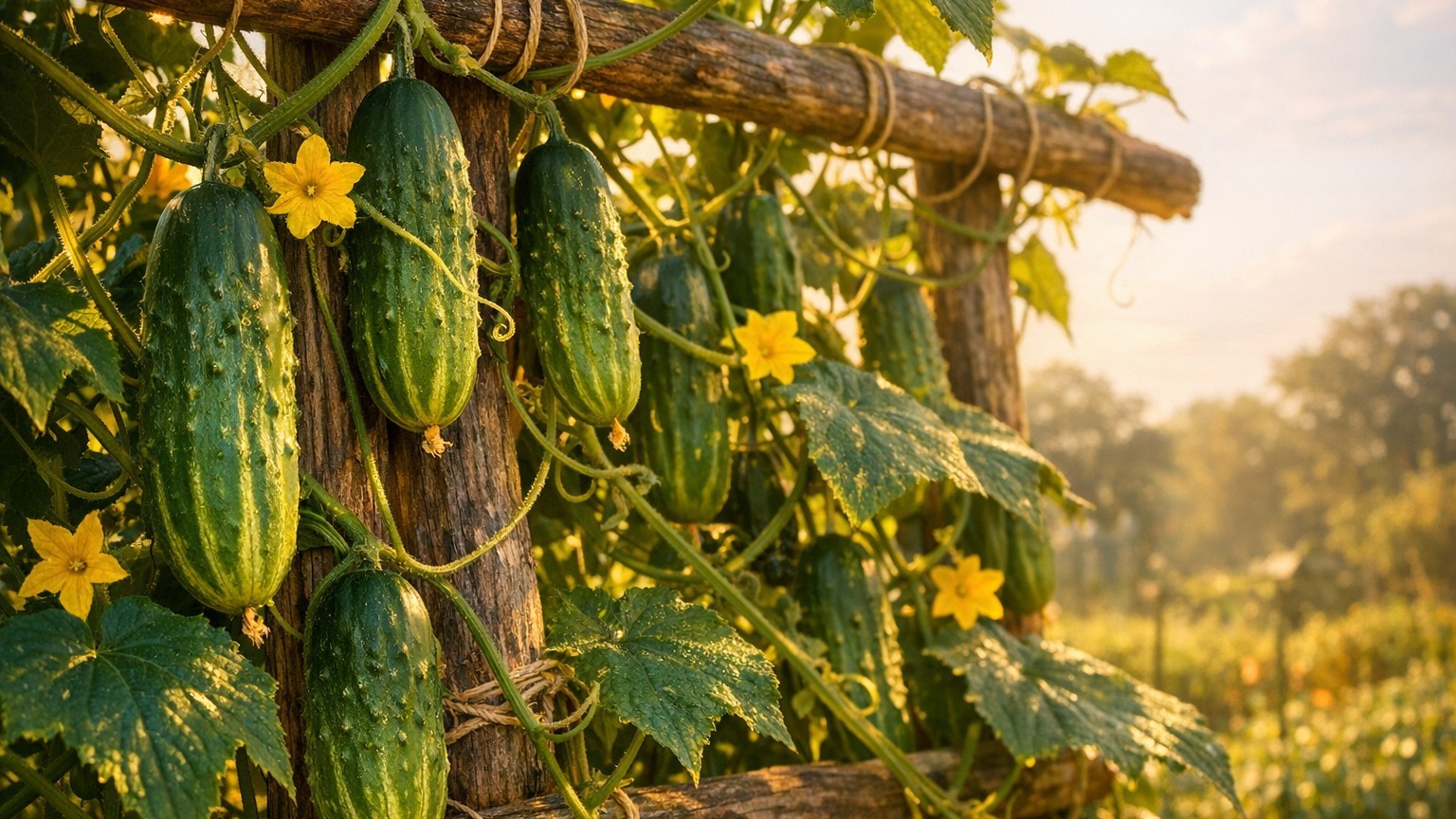

Montana’s growing season runs roughly 144 to 168 days at the state’s milder valley stations, and it drops fast at elevation. That math favors fast bush and pickling types over long-season vining slicers, especially where summer nights stay cool. Parthenocarpic types, which set fruit without pollinators, also earn a spot when a short season leaves little room for a poor pollination week.
The short answer for Montana
Start with the frost dates themselves, because they set the whole conversation. The reference station used here, Billings, sees its last spring freeze between April 29 and May 10, and its first fall freeze between October 1 and October 14. Do the subtraction and the frost-free window comes out somewhere between 144 and 168 days, depending on which end of each date range you land on in a given year. That is a real season, not a punishingly short one, but it is also measured at one of the milder valley locations the state has to offer.
Cucumbers are frost-tender from seed to harvest, and they also want warm soil to germinate at all. A 144-to-168-day window sounds generous on paper, but a chunk of it gets eaten up by soil that is still too cold to plant into during the first two or three weeks after the average last frost date. That trims the usable stretch for anything started from seed directly in the ground, and it is the reason the decision here is about type, not about chasing a specific brand name.
Given that math, the types worth favoring are pickling cucumbers and bush-habit slicers bred to finish quickly, since both tend to reach harvest sooner than a long vining slicer bred for a longer, hotter season elsewhere. Bush types also matter for a second reason: they take up less bed space and warm up faster in a raised bed or container, which helps when the ground itself is slow to shed spring cold. Parthenocarpic varieties, the ones that set fruit without needing a bee to move pollen from a male to a female flower, are worth considering too, particularly for anyone growing under row cover or in a high tunnel where pollinator traffic is thin in a cool spring.
What the numbers do not point toward is a long-season, open-pollinated vining slicer that expects a full, uninterrupted 90-plus days of warmth from transplant to first harvest. That style of cucumber is built for regions with a longer runway than Montana’s valley floors provide, let alone its higher ground. For the actual varieties trialled and recommended county by county, that call belongs to the Montana State University Extension Service, not to a general state-level page like this one.
What will not work here

Long-maturing vining slicers are the first casualty of Montana’s math. If a variety needs a long, steady run of warm days after transplant to size up its fruit, and the usable warm-soil window on a 144-day year is already trimmed down from the frost-free total, that plant is racing a fall freeze it is not going to win. The failure shows up as vines still flowering heavily in early September with fruit that never fills out before the first hard freeze ends the season outright.
Watering on a weekly schedule is the second failure point, and it is a summer-rainfall problem, not a spring one. June brings about 2.22 inches of rain on average, July drops to 1.22 inches, and August, the hottest stretch of the growing season, falls to just 0.87 inches. Layer that dry August onto the 28.3 days a year that reach 90°F or higher, and a cucumber bed watered once a week is going to sit dry and stressed for days at a time right when fruit is sizing up. Cucumbers are over 90 percent water by weight, and a plant that dries out between waterings responds with bitter fruit, blossom drop, or fruit that stops growing altogether. This isn’t a climate that punishes cucumbers with extreme heat the way the desert Southwest does; 28.3 days above 90°F is a moderate heat load, not a brutal one. The problem is dryness colliding with that heat, not the heat by itself.
Direct-seeding into unwarmed ground is the third trap, and it is specific to a state where mountain valleys can post a frost in any month of the year, not just around the average dates. Cucumber seed sown into soil that has not yet warmed will simply rot or sit dormant, burning through calendar days the plant does not have to spare. A transplant started indoors and set out once the soil has actually warmed, rather than once the calendar says it should have, sidesteps that loss entirely.
What changes across Montana
Montana is not one growing zone, and treating it like one is where a lot of general advice falls apart. The USDA Plant Hardiness Zone Map, built from 1991-2020 average annual extreme minimum temperatures, places the state anywhere from zone 3a to zone 6a. That is a four-zone spread inside a single state’s borders, which means there is no single answer to “when do I plant” or “how long is my season” without knowing where in that range a particular garden sits.
A zone 6a pocket in a warmer valley behaves nothing like a zone 3a location at altitude. The 144-to-168-day frost-free window cited above comes from Billings, one of the milder valley stations in the state; it is not a promise that a garden two thousand feet higher or further north gets anywhere close to that number. The caution attached to both frost dates is blunt about this: mountain valleys elsewhere in Montana can see a freeze in any month of the year, growing season included. That single fact should reshape how a reader in colder or higher ground plans a cucumber bed.
The practical shift for anyone gardening in the colder end of that 3a-to-6a spread is to lean harder into everything that buys time: starting seed indoors well before the last expected frost, using black plastic mulch or row cover to push soil temperature up faster in spring, and choosing the fastest-finishing bush or pickling types available rather than anything marketed for a long season elsewhere. None of that replaces knowing which zone a specific garden actually falls in, and that number is not something this page can assign from a state-level range. It comes from the map itself.
Where to check this for your own county
The Montana State University Extension Service is the source built to close the gap this page cannot close on its own. Its site sits at montana.edu/extension, and it is organized by county office precisely because a state-level range like zone 3a to 6a is too wide to act on directly.
Two things are worth pulling from a local county extension office specifically. The first is a local planting calendar, built around the frost dates and soil temperatures actually recorded in that county rather than the reference-station numbers used on a page like this one. The second is a list of cucumber varieties that have actually been trialled in that county’s conditions, which is a far more useful filter than a general type recommendation like “choose a fast-maturing bush cucumber.” A county extension agent, or a county-level fact sheet, can name specific cultivars that have performed well locally, something a statewide overview is not positioned to do responsibly.
A county recommendation beats a state one every time, for the simple reason that it is measured closer to the actual garden. This page works from statewide averages and a single reference station; a county office works from local frost records, local soil types, and often several seasons of trial results from growers in that exact area. Treat this page as the broad framework, useful for understanding why bush and pickling types make sense and why long-season slicers are a risk, and treat the county extension office as the place that turns that framework into an actual variety list and an actual planting date.
Checking this against your own garden
Every date and average on this page is a regional pattern, not a guarantee about one particular yard. The garden itself, checked directly, outranks all of it, and three simple observations do most of the work.
Soil warmth by feel is the first check, and it matters more for cucumbers than almost any other crop in the vegetable garden. Push a hand a few inches into the soil in the bed where cucumbers are headed; if it still feels cold rather than merely cool, the seed or transplant is going in too early regardless of what the calendar says. Cucumber roots stall in cold soil even when air temperatures look fine.
The first flush of male flowers is the second signal worth watching. Cucumber plants typically produce a wave of male flowers before the female flowers, the ones with a tiny swollen cucumber shape at the base, start appearing in any real number. Seeing plenty of male flowers with few or no females yet is normal early on, but if that pattern drags on for weeks, it usually points to stress, often from uneven watering or temperature swings, worth addressing before fruit set can even start.
The appearance of the first true leaves, the serrated ones that follow the smooth seed leaves, marks the point where a seedling has moved from surviving on stored seed energy to actually photosynthesizing on its own. A garden where true leaves show up quickly and look a healthy deep green is running warmer and more favorably than the regional average suggests. One where seedlings sit at the seed-leaf stage far longer than expected is signaling a colder or slower microclimate than the county norm, and that is worth factoring into every planting decision that follows.