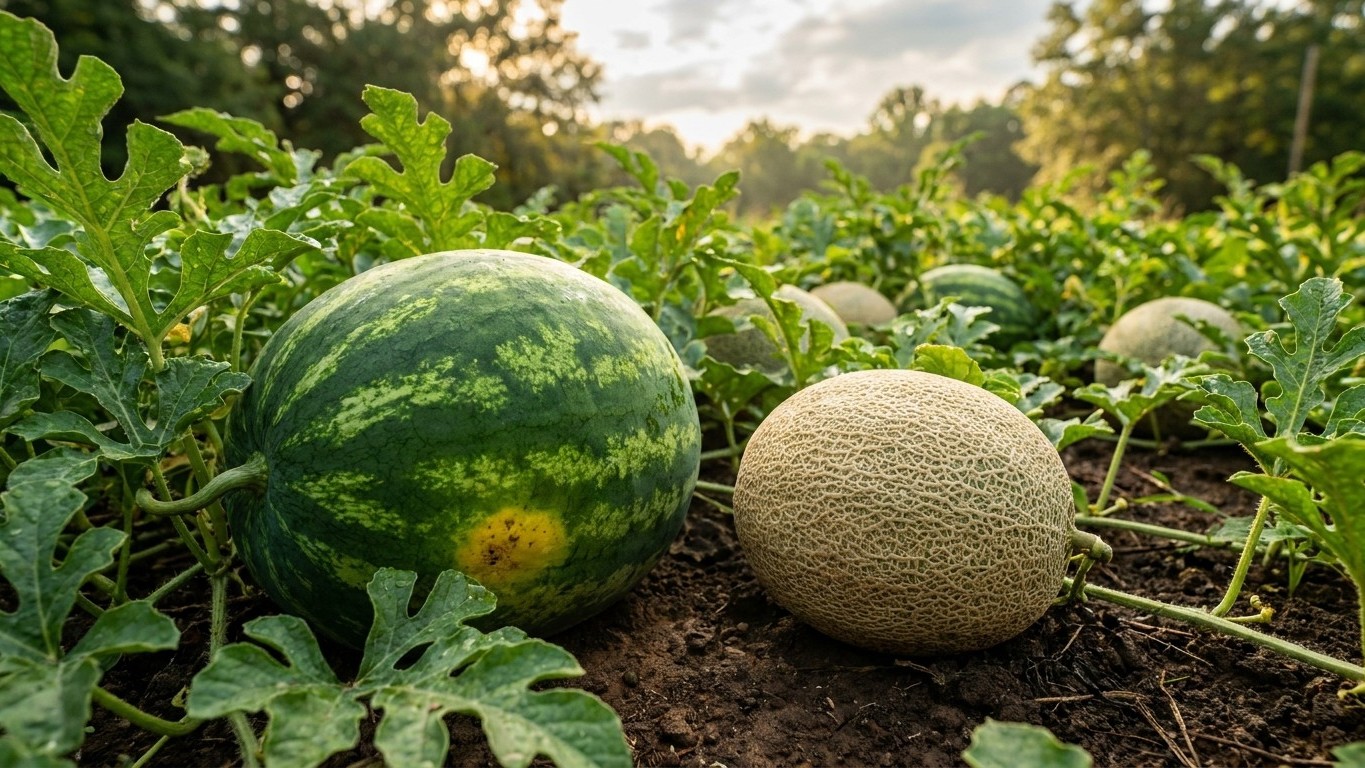

Nevada’s answer depends on elevation more than on the calendar. In the high valleys around Reno and Carson City, only fast, short-season melons ripen before fall cold shuts things down. In the low desert around Las Vegas, the limiting factor flips to extreme heat rather than a short season. There is no single “best” melon for the whole state, only a best type for each end of it.
The short answer for Nevada
Start with the one fact that actually covers the whole state: Nevada’s USDA hardiness zones run from 4a to 10a, per the USDA Plant Hardiness Zone Map (2023, built on 1991-2020 normals). That is a six-zone spread inside one state’s borders, which is the real reason a single melon recommendation cannot exist here. Zone 4a behaves like the northern Great Plains. Zone 10a behaves like the low Sonoran Desert. Between them, growing-season length changes by months, not weeks.
In the cold end of that range, zone length is the constraint. Melons that need a long, unhurried season, the 90 to 100-day heirloom types, simply run out of frost-free days before they finish sizing and sweetening. The fix is to shift toward short-season, fast-fruiting types: bred for around 65 to 75 days to maturity, smaller-fruited, and forgiving of a cool start. Icebox-type watermelons and compact muskmelons bred for northern gardens (the kind extension offices in short-season states routinely recommend) fit this slot far better than a big, slow-ripening classic.
In the hot end of that range, season length stops mattering and heat load takes over. The reference station used for Nevada’s climate normals logs an average of 131.3 days a year at or above 90°F. That is not a heat wave, that is nearly four and a half months of the calendar year running at or past 90 degrees. Melons that stall pollen viability past a certain daytime high, or that scald on exposed rind, lose fruit even with a season long enough to finish three times over. The better fit there is heat-tolerant, thicker-rinded cantaloupe and watermelon types that set fruit early in the morning before the heat peaks and that tolerate intense, dry sun without cracking.
| Zone band (approx.) | Limiting factor | Melon strategy |
|---|---|---|
| 4a-6a (mountain valleys) | Short frost-free season | Fast, short-season icebox watermelon and compact muskmelon types |
| 6b-8a (mid elevations) | Moderate on both fronts | Standard 80-90 day cantaloupe and watermelon varieties |
| 8b-10a (low desert) | Extreme summer heat load | Heat-tolerant, thick-rind types, early morning fruit set |
Where you land inside that table is not something this page can decide for you. It depends on elevation and local terrain, which is exactly what the map and your county extension office are for.
What will not work here
Two failure modes show up over and over in Nevada gardens, and both trace directly back to the numbers above. The first is planting a long-season melon in a short-season pocket. A 95-day heirloom sown at the last realistic frost date in a zone 4a or 5a valley may still be flowering when the first fall freeze arrives, which means fruit that never finishes sweetening. That is a calendar problem, not a soil or watering problem, and no amount of fertilizer fixes it.
The second failure mode is treating Nevada’s summer like a normal-rainfall summer. It is not. Summer rainfall at the reference station averages about 0.7 inches total across June, July and August, with June, the driest month, delivering just 0.04 inches. A melon vine getting watered on a once-a-week schedule that might work in a wetter state runs a real risk of blossom drop, bitter fruit, or blossom-end rot here, because there is essentially no rainfall filling the gaps between waterings. Combine that near-zero rainfall with 131.3 days a year above 90°F, and evaporation from soil and leaf surfaces accelerates fast. A watering routine built for a humid or moderate-rainfall region will underwater a Nevada melon bed even if the calendar says it is “enough.”
A third, less obvious trap: borrowing the Las Vegas airport’s frost dates as a statewide planting window. Those figures (roughly January 7 to February 1 for the last spring freeze probability, and December 8 to December 23 for the first fall freeze) come from an urban desert station with a strong heat-island effect. They describe an extreme, not the state. Reno, Carson City, and most higher-elevation ground freeze months earlier in fall and thaw months later in spring. A gardener at elevation who plants by the Las Vegas calendar is planting straight into frost, twice.
None of this means Nevada is a bad melon state. It means the two easy defaults, “long-season varieties are safer” and “water once a week,” both work against you here rather than for you.
What changes across Nevada
A hardiness range of 4a to 10a is one of the widest spreads of any state, and it means the honest answer to “what should I plant” splits into at least three different gardens depending on where in Nevada you stand. Zone 4a sits at the cold edge of the national scale, the kind of extreme minimum temperature found in parts of the northern Rockies. Zone 10a sits near the warm edge, comparable to stretches of coastal South Texas. Those two zones exist inside the same state.
What that spread changes in practice is not just frost timing, it changes which melon category is realistic at all. A gardener at higher elevation is working with a compressed window: shorter frost-free stretch, cooler soil at planting time, and a real chance of a surprise late-spring or early-fall cold snap. Starting seedlings indoors three to four weeks before the expected last frost and setting out transplants rather than direct-seeding buys back some of that lost time. A gardener in the low desert basin is working with the opposite problem: frost is barely a factor most years, but the growing window includes months of daytime heat intense enough to abort blossoms and scorch fruit, which argues for shade cloth during the hottest stretch and choosing varieties that set fruit in the cooler morning hours.
Neither of those is “the” Nevada garden. Elevation, slope direction, proximity to a valley floor where cold air pools, and even how close a property sits to pavement or a large body of water all shift the local reading of that 4a-10a range. This page cannot tell an individual reader which zone applies to their own yard, only that the state contains close to the full national spread, and that the USDA Plant Hardiness Zone Map is the tool built to answer that question at the address level.
Where to check this for your own county
The state-level picture above is useful for understanding why Nevada does not have one melon answer. It is not a substitute for what your county extension office already knows about your specific ground. The University of Nevada, Reno Cooperative Extension, reachable at extension.unr.edu, is the land-grant extension service for the state and the right first stop for anything county-specific.
Two things are worth pulling from that site before you commit to a variety. First, a local planting calendar, if your county office publishes one. County-level guidance accounts for the microclimate around a specific valley or basin in a way a statewide range never can, including realistic last-frost and first-frost windows for that exact location rather than the state’s full 4a-10a spread. Second, look for any list of melon varieties that have actually been trialled in your county. Extension offices and their master gardener programs frequently test varieties under local conditions and publish which ones performed well against local heat, water restrictions, or soil type. That kind of trialled, local track record outranks any general variety advice, including everything above on this page.
Worth being direct about this: a county recommendation beats a state recommendation every time they disagree. This page is the state-level view, useful for understanding the shape of the problem across Nevada’s elevation range, but it is not the last word for any single garden. If your county office’s calendar or variety list contradicts something written here, follow the county office.
Checking this against your own garden
Every date and zone number on this page describes an average. Your own garden is a single data point, and it settles ties that averages cannot. Three things to watch, each telling you something different about the specific piece of ground you are working with.
Soil warmth by feel is the first and most reliable check before planting anything. Push a finger a couple of inches into the bed in the morning. Melon seed germinates poorly in cold soil no matter what the calendar says, so if the ground still feels cool and damp rather than warmed through by midday sun, waiting another week or two costs less than a failed germination and a second planting.
The first flush of male flowers tells you the plant has shifted into reproductive mode, but it is not yet the signal to relax. Male flowers typically appear before female flowers (the ones with the small swelling at the base that becomes the fruit), sometimes by a week or more. Seeing only male flowers means pollination has not started yet, and a run of extreme heat during that gap can push female flower formation back further.
First true leaves, the serrated leaves that follow the rounder seed leaves, mark the point where the plant is running on its own root system rather than seed reserves. A slow, pale emergence of true leaves in a bed that other plants nearby are handling fine is a useful, low-tech signal that the specific spot (shade, compaction, drainage) may be working against that particular melon more than the general climate is.