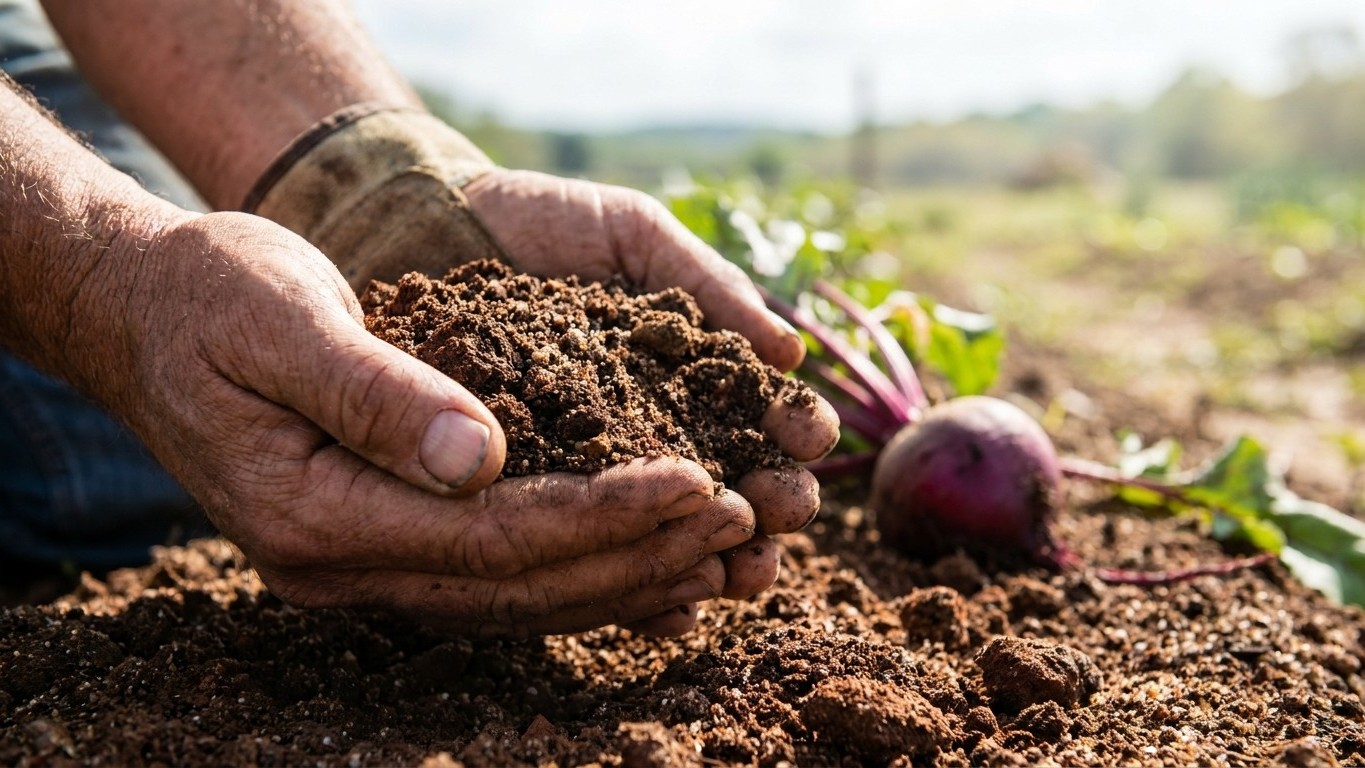

New Brunswick beets root into acid, sandy-loam-to-silt Podzol ground that drains well but runs strongly acid, a combination that favors germination and root shape but starves the crop of the near-neutral chemistry beets prefer. Sow two to three weeks ahead of the province’s average last frost, then watch soil moisture for the first six weeks. That window, not the heat of August, decides whether the root stays sweet or bolts early.
The short answer
The soil most often mapped across New Brunswick’s farmed regions is a Podzol, the acid, leached profile that forms under conifer stands once rain has stripped the bases out of the topsoil. It covers 46 percent of the mapped surface, with Gleysolic ground, the wetter, poorly drained order that shows up in low-lying and river-adjacent spots, coming in second. The median surface reading sits at pH 4.7, which counts as strongly acid, and the texture runs 47 percent sand, 16 percent clay and 37 percent silt, a loam-to-silt blend that Agriculture and Agri-Food Canada’s Canadian Soil Information Service classes as well drained, based on 418 mapped soil components read in late August. Organic matter averages about 3.4 percent.
For a beet, the texture is close to what the crop wants. Utah State University Extension describes the ideal bed as deep, sandy and well drained, rich in organic matter, and New Brunswick’s median profile checks two of those three boxes without any digging on your part. The mismatch is chemistry, not structure: a beet planted straight into pH 4.7 ground is working against acidity most root vegetables would rather not fight, and a soil test before planting matters more here than it would in a neutral-pH state. The organic matter figure also sets a ceiling on what you should add. USU Extension caps composted amendment at 1 inch per 100 square feet, and ground that already sits near 3.4 percent organic matter doesn’t need a heavy hand.
On heat, the published dataset behind this page doesn’t carry a day-count of 90-degree readings for the reference station, so no specific figure appears here. What the soil and climate data together suggest is that New Brunswick’s maritime pattern rarely produces the sustained mid-90s stretches that turn a beet root woody on their own. USU Extension ties woodiness to heat above 85 F combined with water stress, and in this province the water-stress half of that equation, not the thermometer, is the one worth watching.
None of this is a diagnosis for one backyard. A province spans hundreds of mapped soil series, and this median profile is a starting point, not a verdict on the dirt behind your house. River flats, old bog ground, and anywhere a builder has scraped or filled a lot will read differently, sometimes completely differently, from the number above.
The six weeks that decide it here
Beets are direct-sown, never transplanted, and the 60 to 80 days growers usually count run from the seed going into the ground, not from any seedling stage. Sowing two to three weeks before the last frost puts the crop’s first six weeks, the stretch USU Extension flags as the trigger window for premature flowering, squarely inside New Brunswick’s spring.
The average last spring frost for the province, based on the Moncton station in Environment and Climate Change Canada’s Canadian Climate Normals covering 1981 to 2010, falls on May 23. That date is a mean, not a safe cutoff. In roughly half of all years, frost arrives later than May 23, so a gardener who sows on that date alone and skips a check of the extended forecast is gambling with the seedbed. Districts north or inland of the coast, and anywhere at higher elevation, typically lag weeks behind the Moncton figure, which makes a local frost record worth more than the provincial average once you’re past the planning stage.
New Brunswick’s spring pattern, shaped by its maritime position, tends toward cool, damp weeks rather than the abrupt dry spells that hit prairie or interior climates hardest. That works in the beet’s favor during the bolting-risk window, since consistent spring moisture is exactly what USU Extension says the first six weeks need. But “tends toward wet” is not “guaranteed wet.” A dry stretch of even a week or two, layered onto light, well-drained sandy-loam ground that doesn’t hold moisture the way heavier clay would, can still push a young beet plant toward flowering instead of root growth. The well-drained texture that makes this soil easy to work also means it lets go of water fast, so the six-week window deserves a hand on the soil, not an assumption that a maritime spring will handle it alone.
What goes wrong here
- Acid ground locking up nutrients. A median pH of 4.7 sits well below where most root vegetables perform best, and strongly acid soil can tie up nutrients the plant needs for root bulking. Test before sowing and lime according to the test results rather than a guess.
- Crusting after rain on the finer pockets. With clay at 16 percent and silt at 37 percent, patches of this ground can crust over once heavy spring rain dries, which blocks the fine beet seed from pushing through. Rake the surface lightly after a hard rain and before germination, and keep a thin layer of compost, within that 1-inch-per-100-square-foot ceiling, over the seed row to reduce crusting.
- Early bolting from a dry spell in the first six weeks. This is the water-stress failure, distinct from heat damage, and it happens when the sown bed goes dry during establishment, even briefly. Water on a set schedule through the six-week window rather than waiting for visible wilting.
- Woody roots from a warm, dry stretch later in the season. This is the second, separate failure: heat above 85 F paired with dry soil, per USU Extension, coarsens the root’s texture. Mulch to hold soil moisture through any warm spell and don’t let the bed dry out just because spring’s bolting risk has passed.
- Waterlogged pockets on Gleysolic ground. Gardens sitting on the province’s second-most-common order, often found near rivers or in low spots, can hold water long enough to rot a beet root rather than dry it out. Raised beds or added drainage matter more on this ground than the general well-drained median suggests.
Common questions
What soil pH should I aim for before sowing beets in New Brunswick?
No target pH for beets appears in the sourced data used for this page. What’s documented is that New Brunswick’s median surface reading is pH 4.7, strongly acid, so a soil test ahead of planting is the practical first step rather than sowing directly into ground you haven’t checked.
Should I sow exactly on the average last frost date, May 23?
Treat May 23 as the midpoint of a window, not a safe calendar mark. Because the figure is a mean from the Moncton station’s 1981-2010 normals, frost falls later than that date in roughly half of all years, and gardens north or inland of the coast typically run further behind it still.
Does one of the five beet varieties named by Utah State University Extension suit New Brunswick’s soil better than the others?
The source names five garden beet varieties but attaches no season, color or climate suitability to any of them, so no name from that list can be tied to New Brunswick’s conditions on the strength of that source alone.
Why did my beets turn woody in late summer even though I watered them in spring?
Spring watering addresses the bolting risk from the first six weeks, a separate failure from woodiness. Woody roots come from heat above 85 F combined with dry soil later in the season, so a bed that got through spring fine can still toughen up if it dries out during a warm summer stretch.