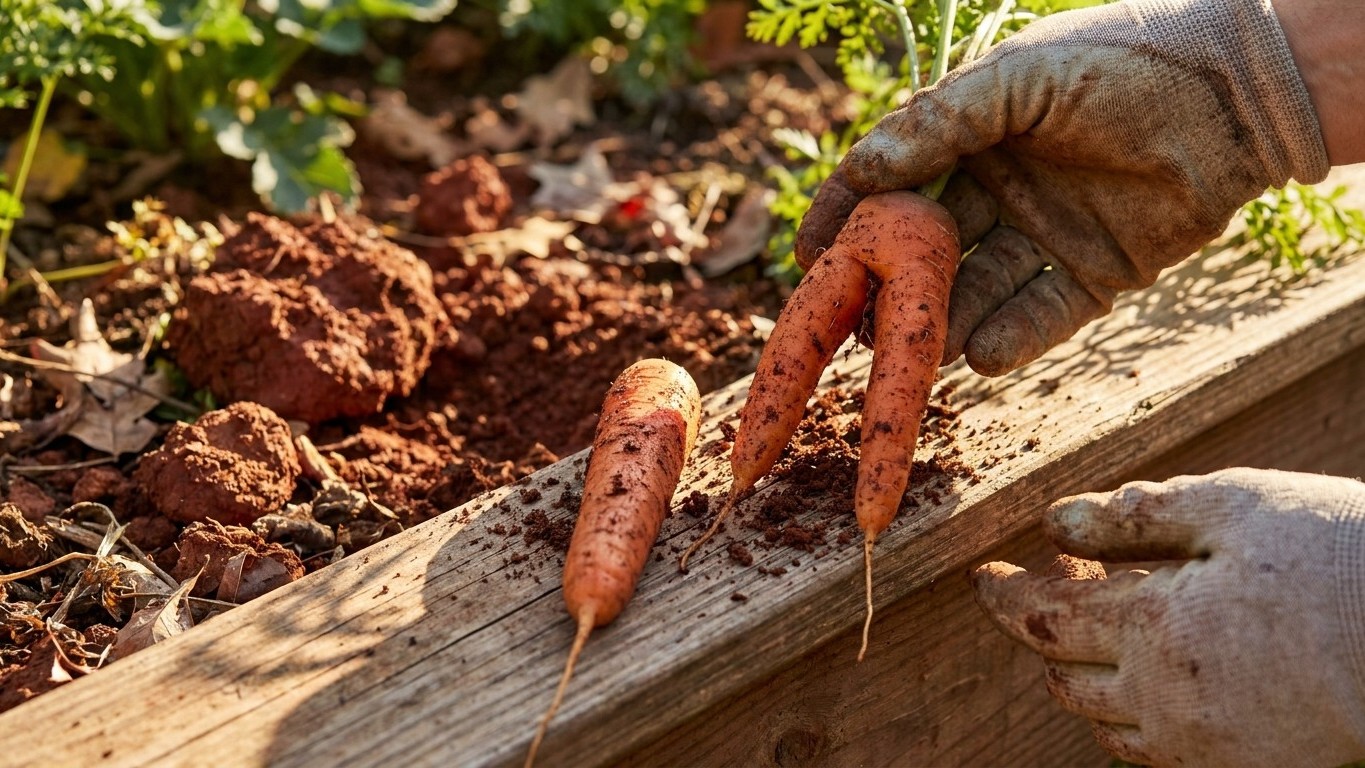

Straight answer: probably not, if your plot matches the province’s typical ground, but yes if you’re in one of the clay pockets scattered through New Brunswick’s farmland. The dominant soil here is loose enough to let a carrot root run straight, but “dominant” doesn’t mean “yours.” The fix, when forking does show up, is the same everywhere: work in compost, double dig, or build a raised bed.
The short answer
The soil mapped most often across New Brunswick’s agricultural land is a Podzol, the acid, leached type that forms under conifer stands once rain has stripped the surface of its bases. It shows up on 46 percent of the mapped surface, with Gleysolic soils as the runner-up. The median texture comes out as a loam: 47 percent sand, 16 percent clay, 37 percent silt, with organic matter around 3.4 percent and a drainage class described as well drained. The surface runs strongly acid, with a median pH near 4.7.
That texture profile is, on paper, decent news for carrots. Utah State University Extension is blunt about what the crop wants: deep, sandy, well-drained soil rich in organic matter. Heavy or rocky ground is what makes a carrot root fork, splitting into two or three legs instead of growing down as one clean taproot. A loam that leans sandy, sitting at 47 percent sand against only 16 percent clay, is a long way from the heavy clay that causes the worst forking. Well-drained soil also means roots aren’t sitting in standing water, which matters just as much as texture.
So the mechanism that would change this answer is clay. Sixteen percent clay province-wide is moderate, not heavy, but it’s a median across 418 mapped soil components, and plenty of individual plots run higher. Where clay content climbs and drainage slows, the same crop in the same province forks the same way it would in any other clay-heavy state. The acidity matters less for forking itself; carrots tolerate a range of pH, and Utah State’s guidance on root shape is about texture and stones, not soil chemistry.
Here’s the catch nobody should skip: a province spans hundreds of individual soil series, and this Podzol profile is a median, not a description of any one backyard. River bottoms tend to run heavier and wetter. Any lot that’s been graded, filled, or scraped during construction can carry a completely different soil underneath the topsoil that got spread on top. The provincial number tells you what the region tends to do, not what your raised bed or your side yard is actually made of. Treat it as a starting point for figuring out whether you need to worry about forking, not as a verdict on your own dirt.
The test that settles it in your own garden
- Dig a hole about a foot deep where you plan to sow carrots. Look at what comes out: is it the same color and texture all the way down, or does it change into something denser, grayer, or wetter partway down?
- Check that depth for obstructions. Carrots need open ground to run straight, so note any rocks, roots, or a compacted layer your shovel has to fight through. A hard pan a few inches down is a common cause of forking that has nothing to do with the surface soil looking fine.
- Rub a handful of the soil between your fingers. Sand feels grainy and falls apart. Clay feels smooth, sticky when wet, and holds its shape when you squeeze it into a ball. Loam sits in between, crumbly but able to hold together loosely.
- Fill the same hole with water and time how long it takes to drain. Water that disappears within a few hours points to decent drainage. Water that sits for the better part of a day is telling you the ground holds moisture the way clay and compacted soil do, which raises both the forking risk and the odds of rot.
- Repeat the dig-and-feel check in more than one spot if your yard has any slope, any low corner, or any area that was clearly disturbed by construction. Soil can change completely within a few feet, especially on a lot that’s been built on.
None of these steps require a lab, and none of them will hand you a precise clay percentage. What they will tell you is whether your ground behaves like the sandy loam that lets a carrot grow straight, or like the dense, slow-draining ground that calls for a raised bed before you sow a single seed.
What goes wrong here
- Forking in heavy ground. Wherever a plot runs heavier than the provincial median, roots hit resistance and split around rocks, clay clumps, or a compacted layer. Utah State University Extension’s remedy is direct: work in plenty of compost and double dig the bed before sowing, loosening and enriching the soil well below where the root will travel. On the worst ground, a raised bed filled with a lighter mix sidesteps the problem entirely rather than fighting it.
- Poor germination during a hot, dry stretch. Carrot seed is small and sits near the surface, so a crust that dries out fast can stop it from sprouting evenly. Since carrots are sown directly in place, with no transplant step to fall back on, a poor stand at germination means a poor stand for the season. Keeping the top inch of soil consistently damp until seedlings show, with light, frequent watering rather than one heavy soak, keeps that thin layer from drying into a crust.
- Splitting from uneven watering. Roots that dry out, then get soaked, then dry out again tend to crack along the length of the root as the outer layer expands faster than it can stretch smoothly. This shows up most on soil that drains fast, since sandy stretches lose moisture between waterings quicker than a loam does. A steady watering schedule, rather than sporadic heavy watering after the ground has gone dry, keeps the growth rate even and the roots intact.
- Strongly acid surface soil. A median pH near 4.7 is well into acid territory. It doesn’t cause forking, but soil chemistry that’s off for the crop can slow growth and stress the plant in ways that make every other problem, from pests to uneven watering, harder on the root. Since this page doesn’t carry a reader-specific pH, a home soil test is the only way to know where a given plot actually sits.
Common questions
Does New Brunswick’s acidic soil hurt carrot roots directly?
The province’s median surface pH runs around 4.7, which is strongly acid. Utah State University Extension’s guidance on carrot root shape points to texture and stones as the cause of forking, not soil chemistry, so acidity on its own isn’t what’s splitting the root. It can still affect overall plant vigor, which is a separate issue from forking.
Is a raised bed necessary everywhere in the province?
No. Where the ground matches the typical loam described here, sandy enough and well drained, a raised bed isn’t required. It becomes the practical answer specifically where a plot runs heavier or drains more slowly than that median, which the dig-and-feel test at home will reveal.
Can I fix forked carrots once they’ve already grown that way?
No. Forking happens as the root develops underground in response to what it hits along the way, so a root that’s already split stays split. The fix is preventive: loosen and enrich the soil with compost, or switch to a raised bed, before the next sowing.
Do carrots need to be started indoors and transplanted to avoid this problem?
No. Carrots are sown directly in place, and the crop’s 70 to 100 day timeline runs from seeding, not from any transplant date, because there isn’t one. Disturbing the taproot by transplanting would cause its own problems, so the soil prep has to happen before seeding, not after.