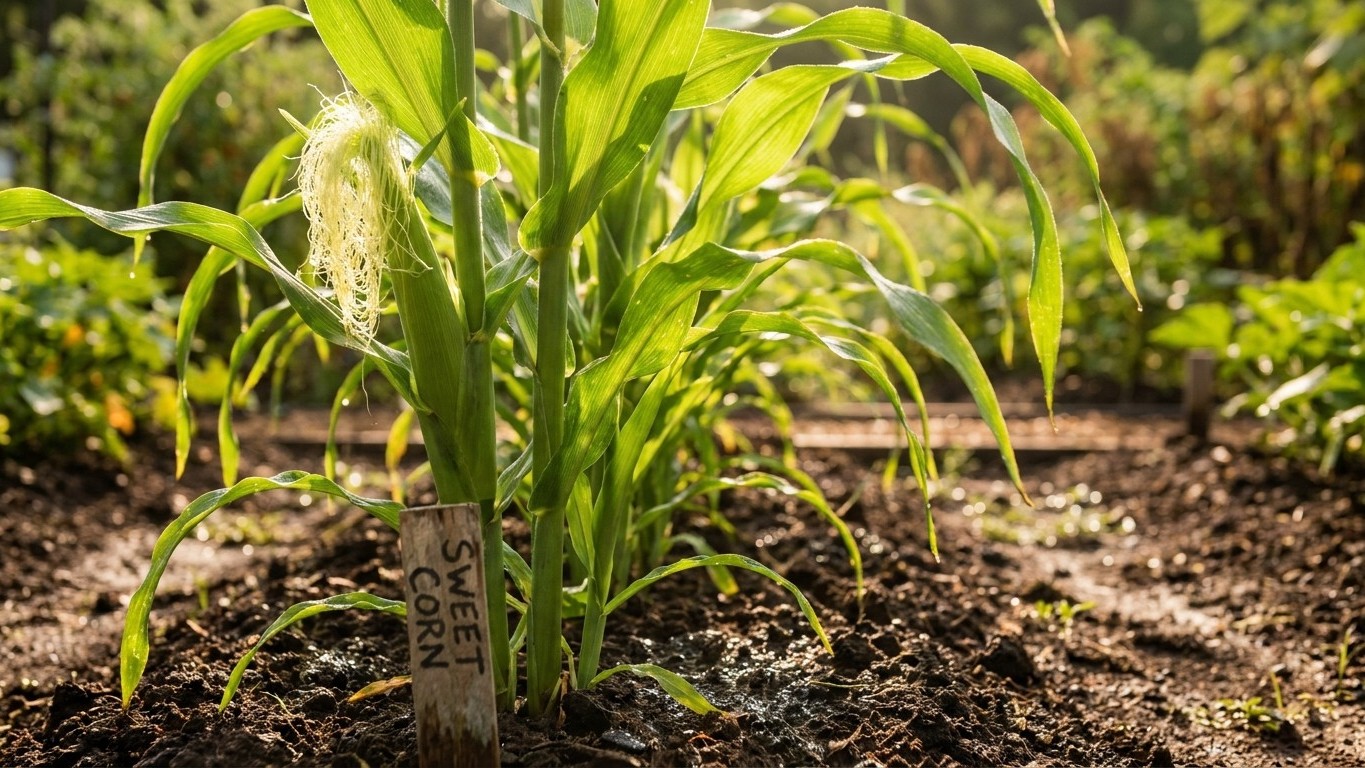

Yes, sweet corn can ripen in New Brunswick, but the window is tighter than the calendar suggests. Soil needs to climb past 60°F before seed goes in the ground, and that moment lands well after the last spring frost. Once planted, the crop needs 60 to 90 days of growing before the first fall frost shuts things down. The math works, but only for the right variety planted at the right time.
The short answer
Start with the frost dates, because everything else depends on them. Environment and Climate Change Canada’s normals for the Moncton station put the average last spring frost at May 23 and the average first fall frost at October 2. That’s a mean, not a guarantee. In roughly half of all years, frost arrives later than May 23 in spring and earlier than October 2 in fall. Treat both dates as the middle of a range, not a safe edge to plan around.
Soil temperature is a separate clock from air temperature, and gardeners who confuse the two end up planting too early. Air can clear 32°F on a calm sunny afternoon while the ground six inches down is still cold from weeks of frost and snowmelt. Soil in this part of the Maritimes typically needs several more weeks past that May 23 frost mark before it holds steady above 60°F, the threshold sweet corn actually needs for reliable germination. That pushes realistic planting into June for most gardens here, not late May.
Run the arithmetic from there. Between May 23 and October 2 sits a stretch of roughly 132 days. Subtract the weeks it takes soil to warm past 60°F, and the actual growing window most years lands somewhere in the neighborhood of 100 to 115 days, not the full 132. That’s still enough room for a crop needing 60 to 90 days from planting to harvest, but the margin shrinks fast if soil warms late or if a season runs cool.
The cool-summer factor matters more here than in most of the corn belt. Moncton’s normals record 0.0 days a year reaching 90°F. Sweet corn is a heat-loving plant, and the “days to maturity” printed on any seed packet is calculated under warmer growing conditions than New Brunswick typically delivers. Without hot stretches to push growth along, a variety rated for a set number of days on paper often takes longer in the ground here. That doesn’t rule out sweet corn. It means the margin built into that 60-to-90-day range needs to work in the grower’s favor, not against it, and that comes down to picking a variety suited to a short, cool season rather than pushing the calendar.
Does a late variety fit here?
A 60-day variety
A short-season type sits comfortably inside New Brunswick’s window. Even if soil doesn’t clear 60°F until well into June, a crop that only needs 60 days to mature would typically be ready by mid-to-late August, a good six weeks before the average October 2 frost. That buffer matters because it absorbs the unpredictability baked into these average dates: a cool spring that delays planting, a slow stretch of growth from the lack of hot days, or a fall frost that arrives ahead of schedule. A 60-day type gives all of that room to happen without threatening the harvest.
A 90-day variety
A long-season type is a much tighter call, and honestly, it doesn’t fit here with any real margin. Plant it once soil clears 60°F in June, and on paper it should mature around mid-September, roughly two to three weeks ahead of the average October 2 frost. That sounds workable until the two risk factors stack up. First, this region logs zero days a year above 90°F, and sweet corn’s maturity clock slows without that heat, meaning a “90-day” variety can easily run longer than its label promises in a New Brunswick summer. Second, October 2 is only the average fall frost date, not a floor. In half of all years, frost lands earlier than that, sometimes by a week or two. A 90-day variety with a slow-running clock and a frost that shows up early has very little room left to reach maturity. Given both factors together, a late-season type is a genuine gamble in this climate, not a safe bet.
What goes wrong here
- Soil sown too cold. Planting on the calendar date rather than the actual soil condition is the most common mistake. Seed dropped into ground still under 60°F germinates unevenly, rots in patches, or sits dormant long enough for early weeds to get ahead of it. The fix is simple: check the soil directly with a thermometer before planting, rather than counting days from the last frost.
- A variety too late for the season. Choosing a 90-day type because it sounded like a bigger, better harvest often backfires when the cool summer here slows its clock and an early frost cuts it short before the ears fill out. The remedy is matching the variety to the season on the ground, not to the longest days-to-maturity number on the seed rack.
- Sweetness lost to cross-pollination. This one has nothing to do with weather. Sweet corn comes in different genetic types (commonly labeled su, se, and sh2), and when two of those types tassel at the same time nearby, wind-blown pollen crosses between them and the sweetness of the harvest suffers, even if every other growing condition was perfect. The fix is timing, not distance: stagger planting dates so the types don’t tassel together, or grow only one type in a given season. Corn also needs to be planted in blocks of three or more rows rather than a single thin row, since that shape is what allows the wind-pollinated plants to pollinate each other properly in the first place.
Common questions
Can I go by the last frost date instead of testing soil temperature?
No. The last spring frost date and the day soil clears 60°F are two different events, and the soil warms up well after the air does. Relying on the frost date alone leads to planting into ground that’s still too cold for sweet corn seed to germinate reliably.
How do I know when the corn is actually ripe, not just old enough on paper?
Look for three signs together: the silks have turned dry and brown, the husks are still moist and green, and a punctured kernel releases milky juice rather than clear liquid. All three need to line up, not just one.
Is the 60-to-90-day rule the same as the time from silk to harvest?
No, and mixing these up is a common error. The 60-to-90-day figure counts from planting to maturity. A separate, much shorter window, generally 17 to 24 days from when silks first appear, tells a grower which week to start checking ears for ripeness. They answer different questions.
Does a hard frost date ever get published for this region?
Not here. The figures available for the Moncton station cover only the average last spring frost and average first fall frost from the Canadian Climate Normals. No separate light-frost or hard-freeze threshold is published in these normals, so treat the average dates as the reference point rather than looking for additional thresholds that aren’t part of this dataset.