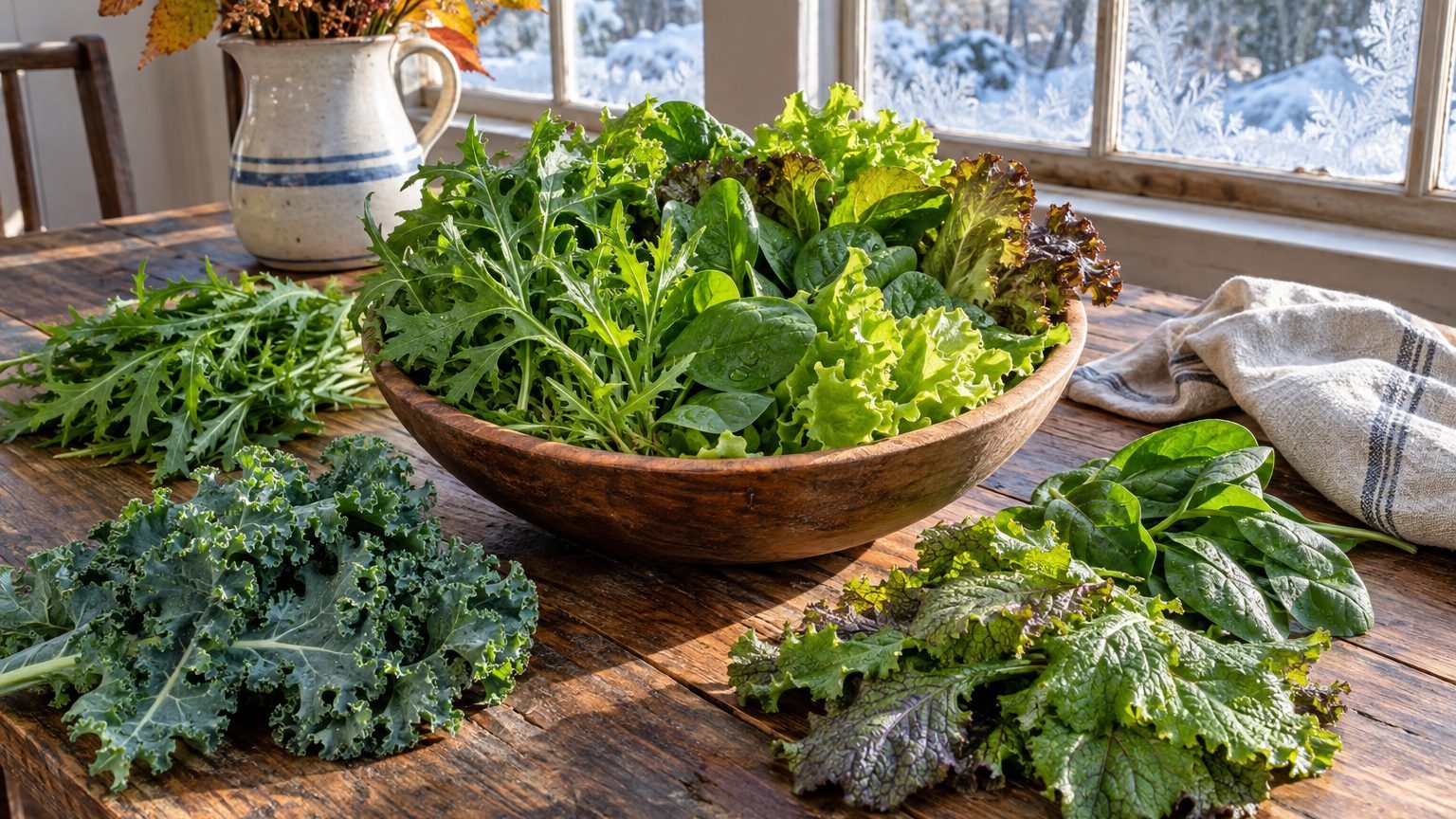

The best winter salads for New Brunswick are the cold-tolerant leaf crops: mâche, claytonia, spinach, kale, arugula, and Asian mustards such as mizuna and tatsoi. Sow them in late summer and shelter them under a low tunnel or cold frame, and they keep producing through the dark months. Soft heading lettuce and slow chicories struggle here.
The short answer for New Brunswick
Choose by hardiness. Mâche and claytonia carry the coldest weeks, spinach and kale form the backbone, and quick mustards and arugula fill the autumn and early-winter shoulders. Everything else depends on how much shelter you give it.
The Moncton reference station shows why. The mean last spring frost falls on May 23 and the mean first fall frost on October 2, which leaves about 132 frost-free days between them. Both are averages from Environment and Climate Change Canada’s 1981-2010 normals. In one year out of two the last spring frost comes later than May 23, and in one year out of two the first fall frost comes earlier than October 2. Treat each as the middle of a window.
The coldest month has a mean daily minimum of -13.9 °C (6.9 °F), and the reference city sits in Canadian hardiness zone 5a. That zone comes from Canada’s own system, which uses seven climate variables and does not convert to a USDA zone. Winter salad growing here works as a late-summer race. Plants need to be close to full size before the days shorten, because after that growth nearly stops and the bed becomes a cold-storage unit you harvest from.
| Type | Examples | Role in the winter bed | Shelter |
|---|---|---|---|
| Ultra-hardy small greens | Mâche, claytonia | Harvest through the coldest weeks | Light cover keeps leaves clean |
| Hardy leaf crops | Spinach, kale (baby leaves) | Hold through winter, restart in early spring | Low tunnel recommended |
| Mustards and arugula | Mizuna, tatsoi, arugula | Fast fall salads, early-winter cuts | Cover stretches the season |
| Chicories | Radicchio, escarole, endive | Bitter-sweet fall salads | Early sowing plus cover for hard freezes |
| Lettuce | Loose-leaf and heading types | Fall harvest only | Cold frame, and still short-lived |
Which winter salad greens are hardiest?
Mâche (also sold as corn salad) and claytonia (miner’s lettuce) top the list. Both are small, low-growing rosettes that shrug off hard freezes, and both taste better after cold nights. Spinach comes next. A fall-sown spinach bed under a tunnel often gives a first picking in early spring, before anything sown that spring has germinated.
Which ones are worth growing for flavor?
Mizuna and tatsoi give mild, mustardy leaves with little effort, and arugula adds bite. Kale cut young makes a tender salad green, and cold sweetens it. Pick two or three from the table rather than all of them. A small bed of well-sown hardy greens beats a big bed of marginal ones.
For sowing dates, see When to Sow Winter Salads in New Brunswick. Packet days to maturity count from sowing for all of these direct-sown greens, so work backward from the fall frost window, not forward from the day you happen to have seed in hand.
What will not work here

Lettuce left uncovered all winter will not make it. A mean daily minimum of -13.9 °C in the coldest month is an average, so plenty of nights run colder than that. Loose-leaf lettuce under a single layer of plastic can give a fall harvest. It will not stay productive into January, and it is the first crop to turn to mush after a hard freeze.
Late sowing fails just as reliably. The mean first fall frost arrives October 2, and in half of all years it comes earlier. A seedling that has only two or three leaves when the light fades will sit there until spring. Slow crops suffer most. Radicchio and big heading escarole need a long stretch of frost-free weather to form a head, so a late sowing gives you leaves with no heart. The faster crops, such as mizuna and arugula, forgive a late start but not a very late one.
Why do winter salads rot under plastic in a damp climate?
Fall in the Maritimes brings fog, rain, and long stretches of damp, still air. A tunnel closed tight holds that moisture against the leaves, and close spacing keeps it there. The result is gray mold on leaf edges and mildew on spinach and mustards. Thin seedlings to the spacing on the packet or slightly wider, and open the ends or lift the cover on mild days so the air moves.
Mid-winter thaws cause a different kind of damage. A sunny day can heat the air under clear plastic well above what the plants like, and the next night freezes them again. Those swings hurt leaves more than steady cold does. A layer of floating row cover inside the tunnel evens out the swings and adds protection on the coldest nights.
Can you expect regrowth in the dead of winter?
No. When days are shortest, even sheltered plants add almost nothing. Whatever size they reached before the light faded is the size they hold until it returns. Harvest lightly, take the outer leaves, and leave the growing center. A bed picked bare in December has little left to restart in February.
Heavy, wet snow can also flatten hoops. Use sturdy hoops, set them close enough together, and knock snow off before it freezes into a load. Mulch piled over a bed can attract slugs, which are active in any thaw, so go light with it near the leaves.
What changes across New Brunswick
The Canadian hardiness zone 5a figure belongs to the reference city, not to the whole province. Zones shift between the Fundy coast, the river valleys, the northern districts, and the uplands, so there is no single answer for the province. The frost dates shift with them, and northern and upland districts run weeks behind Moncton. For a broader look at the province, see Winter Salads for New Brunswick Gardens.
To find your own zone, use the municipality lookup on Natural Resources Canada’s Plant Hardiness Site. It uses 1991-2020 normals and gives a zone for each municipality. Read the number as a Canadian zone. It will not match a USDA zone with the same digits.
In the north or at altitude, shift three things. Sow earlier, since the window between sowing and the first hard frost is shorter. Add a second layer of cover, such as row cover under the tunnel plastic. And lean on the hardiest types: mâche, claytonia, and spinach. Drop heading chicories and tender lettuce from the plan.
Mild coastal and southern gardens can stretch things the other way. A sheltered spot against a south wall may carry mustards and arugula further into winter, and fall sowings can go in a little later. Even so, treat those extra weeks as a bonus. A garden near open water may also stay damper in fall, which raises the mold risk covered above.
Where to check this for your own county
A county recommendation beats a state one. Everything above is a provincewide picture drawn from one reference station at Moncton, and a valley bottom or a ridge twenty miles away can behave differently. The Canadian frost normals also cover 1981-2010, while US normals cover 1991-2020, so do not line the two up date for date.
For local help, start with Agriculture and Agri-Food Canada, the federal department, and from there look for the New Brunswick Department of Agriculture and its regional offices. Those are the places that answer local questions about vegetable growing.
When you get through, ask for two things. First, the planting calendar for your area, with sowing dates for fall-sown leaf crops and the frost dates they are built on. Second, the varieties that have been trialled near you. A variety that held through a winter in your region is worth more than a catalog description.
If your local office offers a fall vegetable or season-extension bulletin, read it. Advice from someone who has watched a tunnel through your last three winters outranks any average.
Checking this against your own garden
Your own observations outrank every date above. Three are worth watching, and none needs an instrument.
- Soil warmth by feel. Push your hand into the bed in late summer. Soil that still feels warm lets seed germinate fast; soil that feels cool means slower starts, so sow earlier next year. A bed against a south wall or fence will usually feel warmer for longer than an open one.
- First true leaves. Look at seedlings in mid-fall. If they have their first true leaves, the ones after the seed leaves, they are far enough along to hold through winter. If they are still bare seed leaves when the first frost arrives, they were sown too late for your spot.
- Where frost lands first. After the first frosty night, walk the yard at dawn. White grass marks the cold pockets, and bare grass marks the warmer ones. Put your tunnel in the warmer spot, and treat the cold pocket as a place for the hardiest crops only.
Check where snow melts first after a storm. A patch that clears days ahead of the rest is a natural early-spring bed for spinach and mâche.
Common questions
Can I grow salad greens outdoors all winter in New Brunswick without any cover?
Mâche and claytonia are the best bets uncovered, and spinach may survive in a sheltered spot, but results vary with the winter. With a mean daily minimum of -13.9 °C in the coldest month at the reference station, covered beds give far more reliable pickings.
Is Canadian hardiness zone 5a the same as USDA zone 5a?
No. The Canadian system uses seven climate variables and the USDA system uses one, and the two do not convert. Natural Resources Canada’s own comparison shows one Canadian zone overlapping several USDA zones. Use the Canadian zone for your municipality when you read Canadian planting advice.
When is the last frost in New Brunswick?
At the Moncton reference station the mean last spring frost is May 23, and the mean first fall frost is October 2. They are midpoints, so frost can come later in spring and earlier in fall in about half of all years. Northern and upland districts run weeks behind Moncton.
What is the easiest winter salad to start with?
Spinach is a good first choice. It is hardy, it grows quickly in fall, and it comes back in early spring. Add mâche or claytonia once you have a tunnel, and keep mizuna or arugula for the fast autumn cuts.