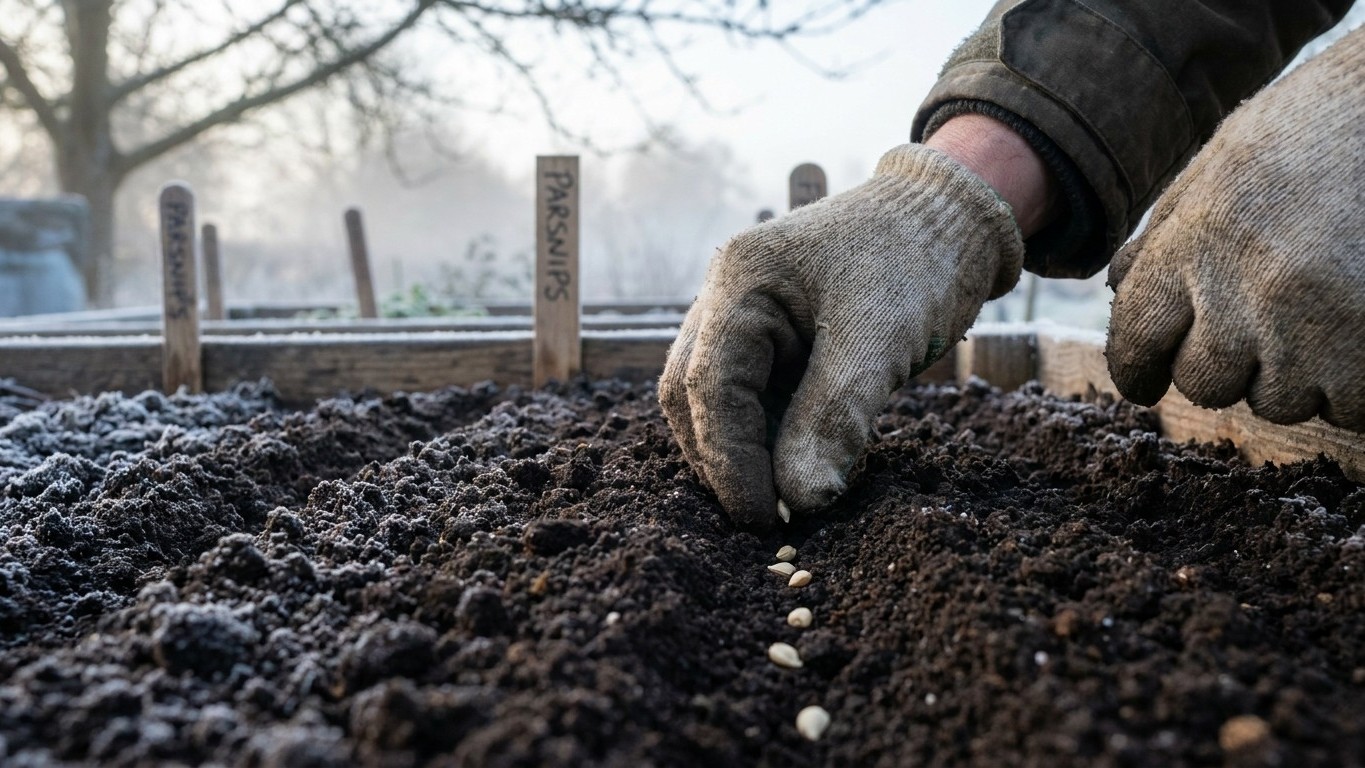

Sow parsnips in New Hampshire in place, directly in garden soil, roughly two to three weeks before the last spring frost. Given a Manchester-area last frost window of April 16 to April 27, that puts sowing in late March through mid-April. New Hampshire’s cold winters mean the crop won’t just mature here, it will sweeten, because the state delivers exactly the kind of frost exposure parsnips need.
The short answer
Everything about growing a sweet parsnip comes down to one question: does this place actually deliver several weeks of hard, sustained cold, or does it just flirt with frost and move on? In New Hampshire, the answer is unambiguous. The mean minimum temperature of the coldest month, based on 1991-2020 NOAA NCEI climate normals from the Manchester reference station, sits at 17.1°F. That is not a light frost brushing the leaves once or twice. That is weeks on end of nights well below freezing, the kind of sustained cold snap that forces a root vegetable to convert its stored starch into sugar as a defense against the cold.
This distinction matters because hardiness zone and frost exposure are not the same thing, and gardeners mix them up constantly. A hardiness zone tells you the average annual extreme minimum temperature, useful for perennials that need to survive winter dormant in the ground. Frost sweetening in parsnips has nothing to do with that number. It depends on repeated exposure to freezing temperatures during the weeks the roots sit in the soil after maturity, ideally with several frosty nights in a row rather than one isolated cold snap. New Hampshire’s coldest month average minimum of 17.1°F confirms that this state delivers exactly that kind of sustained, reliable cold.
So a parsnip sown here, tended through the growing season, and left in the ground into the fall cold will not just survive to harvest. It will develop that dense, nutty sweetness that separates a good parsnip from a merely edible one. Gardeners in states with mild winters, coastal zones where frost barely dips below freezing a handful of times a season, don’t get this advantage no matter how carefully they time their sowing. New Hampshire gardeners do, and it’s the best reason to grow this particular root crop here rather than something less climate-dependent.
None of this means timing doesn’t matter. Sow too late and the roots won’t reach maturity before the ground freezes solid. Sow too early into cold, wet spring soil and germination stalls or rots. The frost advantage only pays off if the arithmetic of the growing season lines up first.
Does the season fit?
- Start with the last spring frost window. The Manchester reference station puts it between April 16 and April 27. That’s the anchor date for everything that follows, though your own yard, especially if it sits at elevation or away from the immediate river valleys, will likely see frost linger later than this airport-based figure suggests.
- Count back two to three weeks for sowing. Parsnip seed tolerates cool soil and benefits from an early start, so gardeners sow that far ahead of the last frost date. Counting back from April 16 to April 27 lands the sowing window at roughly late March into mid-April, seed going into soil that’s workable but still cool.
- Add germination time before anything visible happens. Parsnip seed is notoriously slow, taking 14 to 21 days to germinate. A gardener who sows in late March shouldn’t expect to see rows of seedlings until mid to late April, and shouldn’t dig up the bed and re-sow out of impatience in the meantime.
- Add 100 to 120 days from seeding to harvest maturity. This is the crop’s own timeline, running from the day seed goes into the ground, not from germination. Sowing around March 26 puts maturity between roughly July 4 and July 24. Sowing around April 13 puts maturity between roughly July 22 and August 11.
- Compare that maturity date against the first fall frost. The Manchester station’s first fall frost window runs October 13 to October 26. Even the latest maturity estimate, early August, leaves a wide two-and-a-half-month buffer before the first frost arrives.
- Conclusion: the season fits comfortably, not tightly. New Hampshire’s frost-free window is long enough that parsnips reach full maturity well before the first frost, leaving weeks of margin for the crop to sit in the ground afterward and sweeten through the cold, without any risk of the season running out first.
What goes wrong here
- Forked, hairy roots from heavy or stony native soil. Parsnips push a single taproot straight down, and any resistance, rocks, clay lenses, compacted subsoil, splits that root into forks or hairy side-shoots. New England’s rocky, clay-heavy ground is a common culprit. The remedy is deep, loose, sandy soil, and where the native ground is heavy, that means double digging the bed to break up compaction well below normal spade depth before sowing.
- Forked roots from overwatering. This is a separate cause from soil texture, easy to confuse with it but not the same problem. Excess water, especially inconsistent heavy watering after dry spells, causes the root to split or crack as it swells unevenly. The fix is a steady, moderate watering schedule rather than occasional soaking, particularly once the roots start bulking up in mid-summer.
- A season that runs out because sowing was delayed. Push sowing past mid-April, waiting for warmer soil or simply getting to it late, and the 120-day upper end of the maturity window starts crowding the first fall frost date. In most years this state still has margin, but a delayed sowing paired with a naturally early frost year erodes that buffer. Sow within the late March to mid-April window rather than treating it as a soft suggestion.
- Digging too soon, before the frost has done its work. Even in a state with New Hampshire’s dependable cold, an eager gardener who harvests the moment roots reach size skips the sweetening entirely. The starch-to-sugar conversion needs several weeks of sustained frost exposure after maturity. Leave the roots in the ground, mulched if the ground threatens to freeze too hard to dig, and harvest through the cold weeks of late fall rather than at the first sign the roots are ready.
Common questions
Can I start parsnip seed indoors and transplant it?
No. Parsnips are sown directly in place because the taproot doesn’t tolerate transplanting; disturbing it typically causes the forking and stunting gardeners are trying to avoid in the first place.
How long should I leave parsnips in the ground after the first fall frost?
The sweetening comes from several weeks of frost exposure, not a single cold night, so plan to leave roots in the ground well past that first frost date, digging through late fall rather than immediately after the temperature first dips below freezing.
Why hasn’t my parsnip seed come up after a week?
That’s normal. Germination takes 14 to 21 days, considerably longer than most garden seed, so a week of bare-looking soil is expected and not a sign of a failed sowing.
Does New Hampshire’s soil need special preparation for parsnips?
Deep, loose, sandy soil suits parsnips best, and the state’s rockier, heavier native ground often needs to be double dug well below normal depth to prevent the forked and hairy roots that heavy or stony soil causes. Treat any general soil description as a starting point, and dig a test hole to see what your own bed actually holds before sowing.