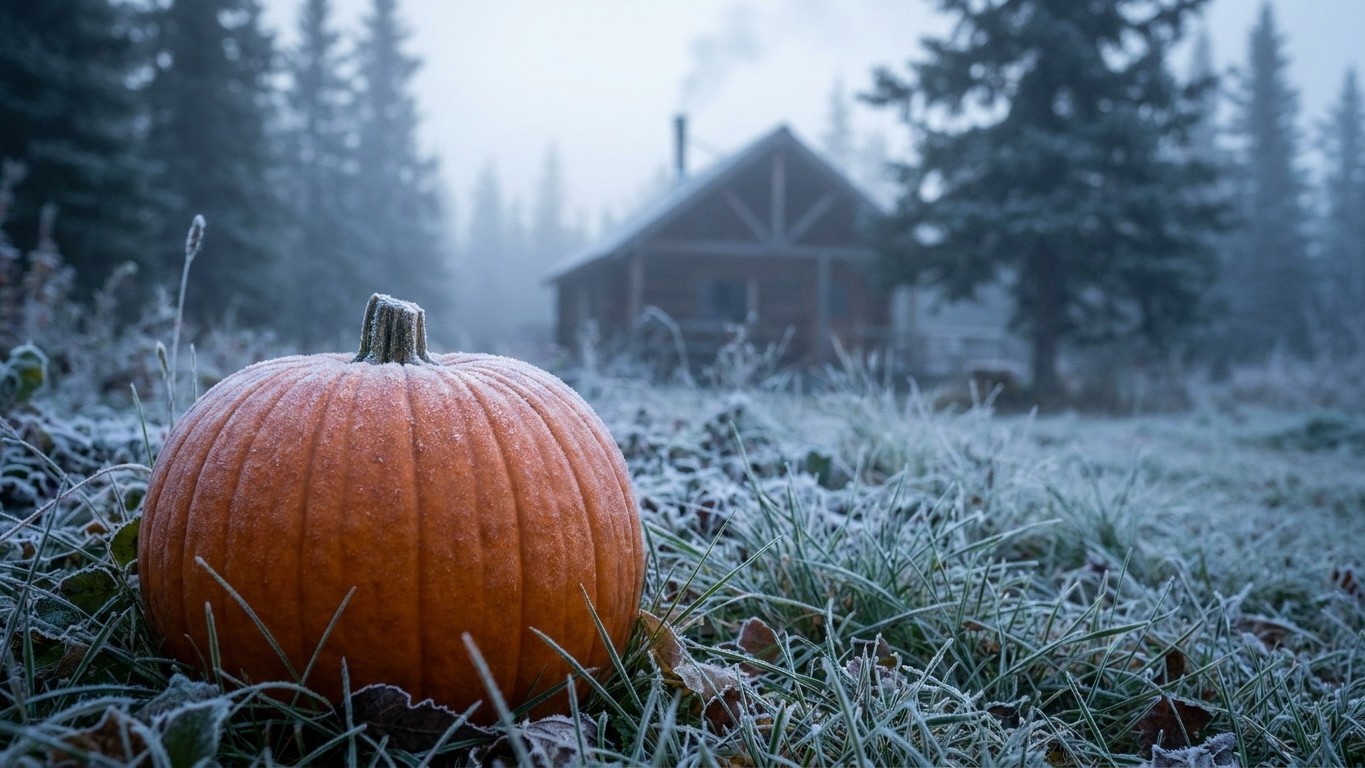

Frost, mostly. Squash bugs and cucumber beetles get the blame, and they do real damage, but in New Hampshire the biggest loss to a pumpkin crop is usually the calendar. A fruit needs 45 to 55 days of growing time after its flower opens, and some years the season doesn’t leave that many. This page does the counting so you know which flowers are worth waiting on. For the full growing guide, start with Growing Pumpkins in New Hampshire.
The short answer
The first fall freeze window for the reference-city airport station is October 13 to October 26. That comes from NOAA NCEI’s U.S. Climate Normals, specifically the 32F freeze probabilities in the 30-70% band (NOAA NCEI data file). Now work backward. Utah State University Extension says pumpkins take 45 to 55 days to mature after flowering. Subtract 55 days from October 13 and you land on August 19. Subtract 45 days from October 26 and you land on September 11.
So the latest a flower can open and still give a ripe pumpkin is roughly August 19 to September 11. It is a window, not a deadline. The early end applies when frost arrives early and the fruit is slow. The late end applies when frost holds off and the fruit is quick.
Everything runs from the flower. The 45 to 55 days do not start at seeding, and they do not start when a transplant goes into the ground. A vine can be vigorous, sprawling and green in July and still have a clock that hasn’t started, because no flower has opened yet. Most miscounts come from treating the packet’s “days to harvest” as if it were the whole story. Nine varieties are commonly mentioned in extension material, but no days, sizes or colors are attached to them in the figures used here, so this page makes no variety-by-variety promises.
One caution matters a lot in a state with this much terrain. Those frost dates describe a single airport weather station, not every yard in New Hampshire. Suburban and rural gardens typically see the first fall frost one to two weeks earlier, and more than that at elevation. Pull both ends of the flower window earlier by a week or two, and check your own county’s frost dates before you trust any of the numbers above. The airport figure is a starting point.
The same logic explains why a vine that looks perfect in September can still produce a disappointing pile of green fruit in October. The late ones were never going to make it. For the ripening side of the story, see Will Pumpkins Ripen Before Frost in New Hampshire? The rule for picking is simple: harvest with the stem attached, before frost.
When to sow here
Sowing is a separate calculation, and it starts from a different gate. Pumpkins go in when the soil reaches 65 F, not when the last frost passes. The reference-city window for the last spring frost is April 16 to April 27, again from NOAA NCEI’s normals, again an airport figure. Gardens outside town typically see that last frost later, often by a week or two.
- Find your last frost window. The reference figure is April 16 to April 27. Push it later by a week or two if you garden in a suburb, a rural valley or on a hillside.
- Treat 65 F soil as its own date. Soil lags the air by weeks, so 65 F arrives well after the last frost, not on the same day. The figures used here don’t publish a calendar date for it. A soil thermometer in your own bed answers the question better than any chart.
- Add the row cover bonus. A row cover warms the soil under it and buys about two weeks. The arithmetic goes like this: if bare ground in your yard needs four weeks after the last frost to reach 65 F, covered ground needs about two. Those four weeks are an example, not a published number.
- Remember the clock hasn’t started. Sowing, even on the best day, only gets the plant growing. The 45 to 55 days begin when a flower opens, and the figures here don’t say how long a sown seed takes to get there. When to Sow Pumpkins in New Hampshire covers the calendar side.
- Check the result against the back count. If flowers are opening by mid-August, you are comfortably inside the window. If your first flower arrives in early September, you are betting on a late frost.
The trap is equating the two dates. Sowing the week after the last frost puts seed into ground that hasn’t warmed enough to give it a good start. Waiting for the soil costs days on the calendar, but the clock that actually decides the harvest starts later and runs against October.
What goes wrong here
A short season fails in specific, predictable ways. Three of them account for most of the disappointing harvests, and a fourth catches people after they have already won.
- A late flower that never colors. A flower that opens after the window, roughly August 19 to September 11 at the reference station and earlier in many gardens, will give a fruit that stays green. Remedy: tag each fruit with the date its flower opened and count 45 to 55 days forward. Fruit that can’t make it is a bonus, not part of the crop plan. Next year, sow earlier under a row cover.
- A fruit caught by frost. The first freeze can arrive anywhere from October 13 to October 26 at the reference station, and earlier in many yards. Remedy: harvest with the stem attached before frost, and watch the forecast from the first week of October. A stem left on is the handle, and the fruit keeps better with it.
- A vine that dies back before the skin hardens. Insects, disease or cold can end a vine early. Squash bugs and cucumber beetles, which have their own pages on this site, are common suspects. Remedy: when the vine collapses, cut the fruit with its stem and keep it where it will not freeze. My judgment is to use those pumpkins first, since a soft skin is a poor candidate for months of storage.
- A good pumpkin stored in the wrong place. University of Illinois Extension says a whole pumpkin keeps three to six months in a cool, dark spot between 45 and 50 F. It also says to keep it away from ripening fruit such as apples, potatoes and tomatoes, which give off a gas that ages the pumpkin. Remedy: the porch next to the apple crate is the worst spot. That temperature range is for a whole pumpkin only and says nothing about a carved one.
Common questions
What is the latest a pumpkin flower can open in New Hampshire?
At the reference-city airport station, roughly August 19 to September 11. That is the first fall freeze window of October 13 to October 26, counted back 45 to 55 days. Many suburban and rural gardens freeze a week or two earlier, so move the window earlier to match your county.
Do the 45 to 55 days start when I sow?
No. They start when the flower opens. Sowing only starts the plant, and the vine needs time to grow and bloom before the fruit clock begins.
Is 65 F soil the same as the last frost date?
No. The last spring frost window at the reference station is April 16 to April 27, and soil at 65 F comes weeks after that. Row covers can pull your sowing date about two weeks earlier than bare ground allows.
How long does a whole pumpkin keep after harvest?
Three to six months in a cool, dark location between 45 and 50 F, away from apples, potatoes and tomatoes. Utah State University Extension, our source for the maturity clock, says only to keep pumpkins where they will not freeze, so the temperature range comes from University of Illinois Extension. Neither source gives a storage time for a carved pumpkin.