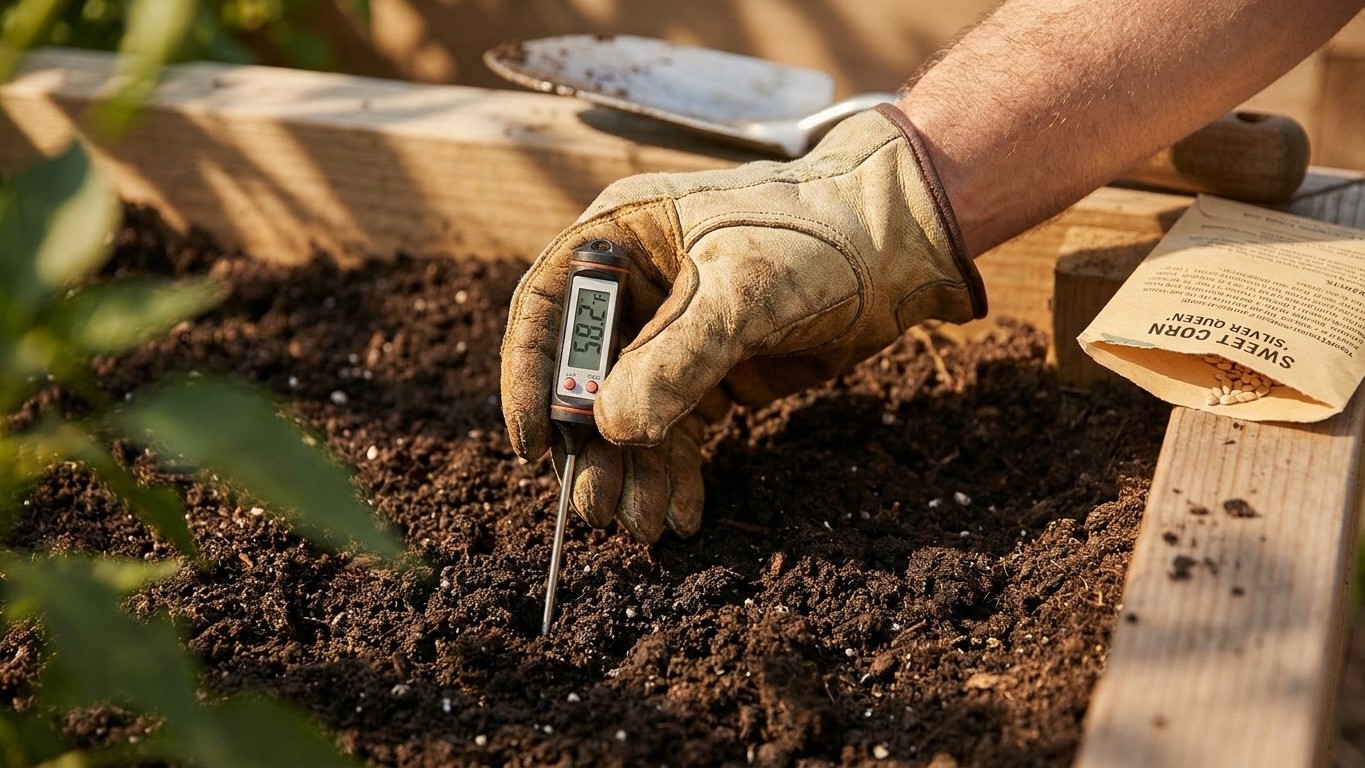

Sweet corn goes into New Hampshire ground once soil, not air, reads 60°F, which for most of the state lands well into May and sometimes early June, not right after the last frost. From that planting date, a 60 to 90 day variety needs to finish before the first fall frost, and in this state that window is real but not generous everywhere.
The short answer
At the reference weather station (Manchester airport, NOAA NCEI 1991-2020 normals), the last spring frost falls somewhere between April 16 and April 27. That date tells you when frost risk drops off. It does not tell you when to plant corn. Soil six inches down warms far slower than the air above it, and Utah State University Extension’s benchmark for sweet corn is a soil temperature above 60°F, a threshold that typically doesn’t arrive until several weeks after that last frost window closes. For many home gardens, that pushes the realistic planting date into mid-to-late May, and in shaded yards, north-facing slopes, or low-lying spots where cold air pools, it can stretch into early June.
That gap between frost-free and soil-warm is the single most common planting mistake in this state. Seed dropped into 50°F soil doesn’t just sit dormant, it often rots before it germinates. A soil thermometer, pushed a few inches down and checked over several mornings, is a better guide than any date on a seed packet.
On the other end of the season, the first fall frost at the reference station arrives between October 13 and October 26. Suburban and rural gardens, especially those away from pavement and at any elevation, commonly see that first frost one to two weeks earlier than the airport reading, and the last spring frost one to two weeks later. So the safe planting-to-harvest window for many New Hampshire yards is narrower than the reference dates alone suggest.
Run the numbers and there’s still real room to work with. Even in a cooler pocket where soil doesn’t clear 60°F until mid-June and frost returns by late September, that’s roughly fifteen weeks, more than enough for the 60 to 90 day range sweet corn needs. In a milder yard where soil warms by mid-May and frost holds off until late October, the season stretches past five months. Heat isn’t the limiting factor here either: the reference station averages just 10.9 days a year at 90°F or above, a modest load that rarely stresses a warm-season crop like corn. Season length, driven by soil warming, is what actually decides the planting date.
Does a late variety fit here?
A 60-day variety
A fast-maturing type built around the 60-day end of Utah State University Extension’s 60 to 90 day range has plenty of cushion in New Hampshire, even in a tight year. Take the least favorable case: soil doesn’t reach 60°F until mid-June, and frost returns to a rural garden by late September. That still leaves around 100 days before frost, and the crop only needs 60. In a milder yard where soil warms by mid-May, there’s enough spare time to put in a second planting three or four weeks later and stretch the fresh-corn harvest into September. A 60-day type is the low-risk choice statewide, from the Seacoast to the higher hill towns.
A 90-day one
A full-season, 90-day type is a closer call. At the reference station, with soil at 60°F around mid-May and frost holding off until late October, the window runs about 23 weeks, comfortable. But stack the rural adjustments the other way: soil not warm enough until early-to-mid June, and frost arriving by late September in a cooler valley or at elevation. That leaves something like 105 to 115 days, still technically above the 90-day mark, but with a slim buffer. Day counts for sweet corn assume steady warm conditions from planting to harvest; a cool, cloudy stretch in a marginal garden can push actual maturity past the printed number, and there’s little room left to absorb that in the coldest pockets. In those spots, a 90-day variety is a genuine gamble against an early frost catching the crop before the kernels fill out. Gardeners in New Hampshire’s colder inland and higher-elevation areas are better served sticking to something in the 60 to 75 day range, and saving full 90-day types for warmer, lower-elevation gardens closer to the coast or the lower river valleys.
| Variety length | Typical NH fit | Buffer in a cool, rural pocket |
|---|---|---|
| 60-day type | Fits statewide | Roughly 40+ days to spare |
| 90-day type | Fits in most gardens | Roughly 15-25 days to spare, thin in cold pockets |
What goes wrong here
- Soil sown too cold. Seed goes in right after the last frost date, before soil has actually crossed 60°F, and it rots or germinates unevenly instead of growing. The fix is simple: check soil temperature directly with a thermometer rather than counting days off the frost date, and hold off until it reads consistently above 60°F, even if that means waiting into late May or early June.
- A variety too late for the season. A 90-day type gets planted in a cooler, rural, or higher-elevation garden where the real frost-to-frost window runs closer to 15 weeks than 23. The ears are still filling when frost hits. The remedy is matching maturity to the site: use the shorter end of the 60 to 90 day range unless the garden sits in a reliably warmer valley or coastal location.
- Sweetness lost to a neighbor, not the weather. Sweet corn types (standard su, sugar-enhanced se, and supersweet sh2) lose their sweetness and turn starchy or tough when different types tassel and pollinate at the same time, since corn is wind-pollinated and cross-pollination changes the kernel. This has nothing to do with New Hampshire’s climate; it happens anywhere two types shed pollen together. The remedy is timing, not distance: stagger planting dates so the types tassel weeks apart, or grow just one type in a given season, and plant in blocks of three or more rows rather than single rows so pollination itself stays reliable.
Common questions
What month should sweet corn go in the ground in New Hampshire?
Most gardens land in mid-to-late May once soil clears 60°F, though cooler, shaded, or low-lying yards may not be ready until early June. There’s no single statewide date; the soil reading is the real signal.
Why does soil temperature matter more than the frost date?
The last frost date, April 16 to April 27 at the reference station, marks when freezing air becomes unlikely. Soil warms on its own slower schedule, and seed planted in cold soil before it reaches 60°F is prone to rot rather than sprout, regardless of whether frost risk has passed.
Should gardens in colder inland or hill areas treat these dates differently?
Yes. Suburban and rural gardens commonly see the last spring frost run later and the first fall frost run earlier than the reference station’s April 16 to April 27 and October 13 to October 26 range, often by one to two weeks and more at elevation. That shortens the usable season, which is exactly why a 90-day variety is riskier there than a 60-day one.
Is the 60 to 90 day count from planting the same as the time to pick?
No, and mixing the two up causes confusion. The 60 to 90 day figure runs from planting and tells you whether a variety fits New Hampshire’s season at all. A separate, shorter count runs from when silks first appear on the ear to harvest, and it answers a different question, which week to actually pick. Judging ripeness itself relies on three signs checked together: dry, browned silks, husks that are still moist and green, and milky juice from a punctured kernel, not any one of those alone.