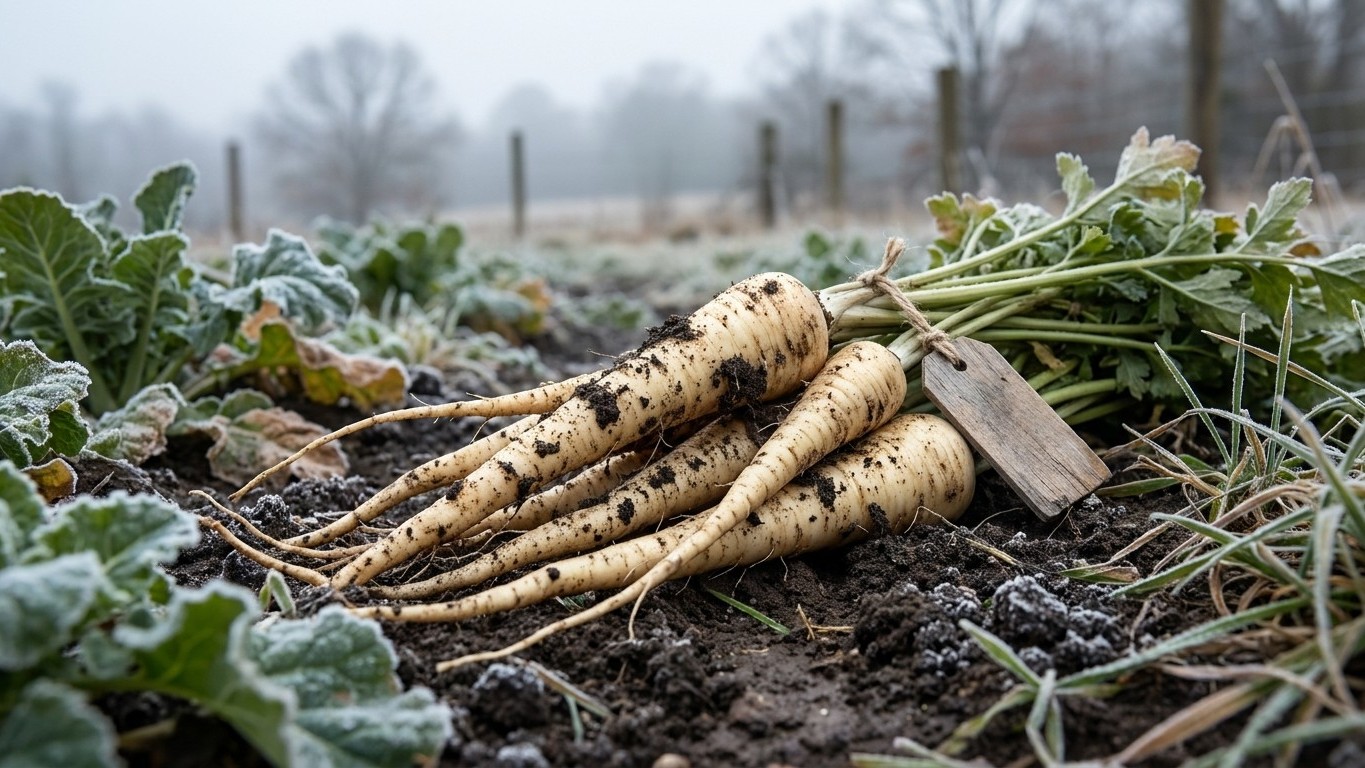

Yes. New Jersey’s winters deliver a mean minimum of 25.5°F in the coldest month, well below freezing for weeks at a stretch. That’s the kind of sustained cold exposure parsnips need to convert their stored starch into sugar. A parsnip left in New Jersey ground through late fall won’t just survive the season, it will sweeten. The growing calendar also lines up well enough that the crop has time to mature before that cold arrives. Here’s how the numbers actually work.
The short answer
The question that decides everything for parsnips isn’t how cold it gets on the worst night of the year. It’s whether the cold sticks around long enough, week after week, to do the chemical work of turning starch into sugar. That’s frost exposure, not hardiness zone, and the two get confused constantly. A hardiness zone tells you what a perennial plant can survive over winter. It says nothing about how many frosty weeks a root vegetable sitting in the soil will actually experience before you dig it up.
For New Jersey, using Newark as the reference station, NOAA’s 1991-2020 Climate Normals put the mean daily minimum for the coldest month at 25.5°F. That’s not a record low or a freak cold snap. That’s the average low temperature you can expect on a typical night during the coldest stretch of winter, and it sits more than six degrees below freezing. A single frost can nick the sugar conversion process, but a mean minimum this far under 32°F points to something more useful: repeated, sustained freezing over multiple weeks, which is exactly what Utah State University Extension identifies as the trigger for sweetening.
That distinction matters because plenty of gardeners in milder states get a fine-looking parsnip crop that never develops the flavor they were promised. Their winters dip below freezing occasionally, then bounce back to 40s and 50s, and the starch never fully converts. New Jersey doesn’t have that problem. The state’s winters are cold enough, consistently enough, that a parsnip crop timed correctly and left in the ground into late fall or early winter will go through the frosty stretch it needs.
None of this means every parsnip grown in New Jersey automatically tastes sweet. Timing still matters, soil still matters, and pulling the crop too early erases the advantage the climate gives you. But the climate itself isn’t the limiting factor here. If a New Jersey parsnip crop fails to sweeten, the cause is almost always something the gardener did or didn’t do, not a shortage of cold weather. That’s a rare position to be in, and it’s worth building the rest of the growing plan around it.
Does the season fit?
Parsnips need 100 to 120 days from seeding to reach a harvestable size, according to Utah State University Extension, and they’re sown directly in place rather than transplanted. That number starts the clock at the seed going into the soil, not at germination, and germination itself is slow: 14 to 21 days before you’ll see any sprouts. Skip that detail and it’s easy to assume the seeds failed and dig up soil that’s actually doing exactly what it should.
Here’s how that timeline lays out against New Jersey’s frost calendar, using Newark’s 1991-2020 Climate Normals as the reference point.
- Sowing window: Seeds go in the ground 2 to 3 weeks before the last spring frost. Newark’s last spring frost falls between March 29 and April 6, which puts the sowing window in mid-to-late March.
- Germination lag: Add 14 to 21 days before sprouts appear. A sowing in mid-March won’t show visible growth until early-to-mid April.
- Maturity window: From the sowing date, add the full 100 to 120 days needed to reach harvestable roots. A mid-to-late March sowing reaches maturity somewhere around mid-July through early August.
- Frost arrival: Newark’s first fall frost lands between November 4 and November 16. That leaves roughly three to four months between a mature crop and the first hard cold of autumn.
- Sweetening period: Parsnips can stay in the ground well past maturity, so that three-to-four-month gap isn’t wasted time. It’s a buffer that lets the roots sit through repeated frosts in October and November, exactly the exposure that triggers the starch-to-sugar conversion.
Add it up and New Jersey’s season fits comfortably, not tightly. There’s enough room between a realistic sowing date and the first frost that a late start, a slow germination stretch, or a stretch of poor early growth won’t push the harvest past the point of no return. That slack is worth remembering: gardens outside Newark, especially inland or at higher elevation, tend to see frost arrive a week or two earlier and linger a week or two later in spring, according to the same NOAA dataset. Even with that adjustment, the math still leaves breathing room most states don’t get.
What goes wrong here
New Jersey’s climate isn’t the obstacle. The soil and the gardener’s own timing choices are where most parsnip crops actually run into trouble.
- Forked or split roots from heavy or stony ground. Parsnips send a single taproot straight down, and anything solid in its path, compacted clay, rocks, old root systems, splits that root into two or three legs. Utah State University Extension recommends deep, sandy soil for parsnips, and where the ground is heavier, double digging the bed before sowing so the root has loose soil to push through for at least a foot or more.
- Forked roots from overwatering. This is a separate cause from heavy soil, and it’s easy to blame the wrong one. Soil that’s kept too wet encourages the root to branch as it searches for air pockets, even in a bed that was properly loosened. Water parsnips consistently, but let the top inch or two of soil dry between waterings rather than keeping the bed saturated.
- Sowing too late and running out of days. New Jersey’s window has slack built in, but that slack disappears fast if seeds go in the ground in May instead of late March. Counting backward from the 100-to-120-day maturity window, plus the 14-to-21-day germination lag, shows quickly whether there’s still enough runway before the first fall frost between November 4 and 16.
- Harvesting before the frost does its work. A parsnip pulled in September or early October, right at the 100-to-120-day mark, will be fully grown but starchy rather than sweet. The fix isn’t more growing time, it’s more cold exposure: leave mature roots in the ground through several weeks of frost before digging them, which the season’s length in New Jersey easily allows.
- Giving up during the germination lag. Parsnip seed germinates slowly and unevenly. Bare-looking soil at day 10 is normal, not a failed sowing. Digging in to check or resowing early just doubles the crowding once the original seeds do sprout.
Common questions
Do parsnips need a hard freeze to sweeten, or does any frost work?
The sweetening comes from sustained exposure to cold over several weeks, not from a single frost event. New Jersey’s mean minimum of 25.5°F in the coldest month reflects that kind of repeated, extended cold, which is what actually converts the starch to sugar, according to Utah State University Extension.
Can I sow parsnips earlier than mid-March to get a head start?
Sowing is tied to the last spring frost, not a fixed calendar date. Since Newark’s last spring frost falls between March 29 and April 6, the recommended 2-to-3-week window before that puts sowing in mid-to-late March. Gardens outside Newark, especially at elevation or further inland, often see a later last frost and should adjust sowing accordingly.
How long can parsnips stay in the ground after they mature?
The sources here don’t publish an exact outer limit, but New Jersey’s calendar leaves roughly three to four months between a typical maturity date and the first fall frost, and additional weeks after that frost before the ground freezes solid. That’s ample room to let roots sit through the frosty stretch that triggers sweetening.
Why do my parsnips look fine but taste bland?
In New Jersey, bland parsnips almost always mean the crop was pulled too early, before it had several weeks of frost exposure. Since the region’s coldest-month mean minimum sits well below freezing, the climate isn’t the limiting factor; the harvest timing is.