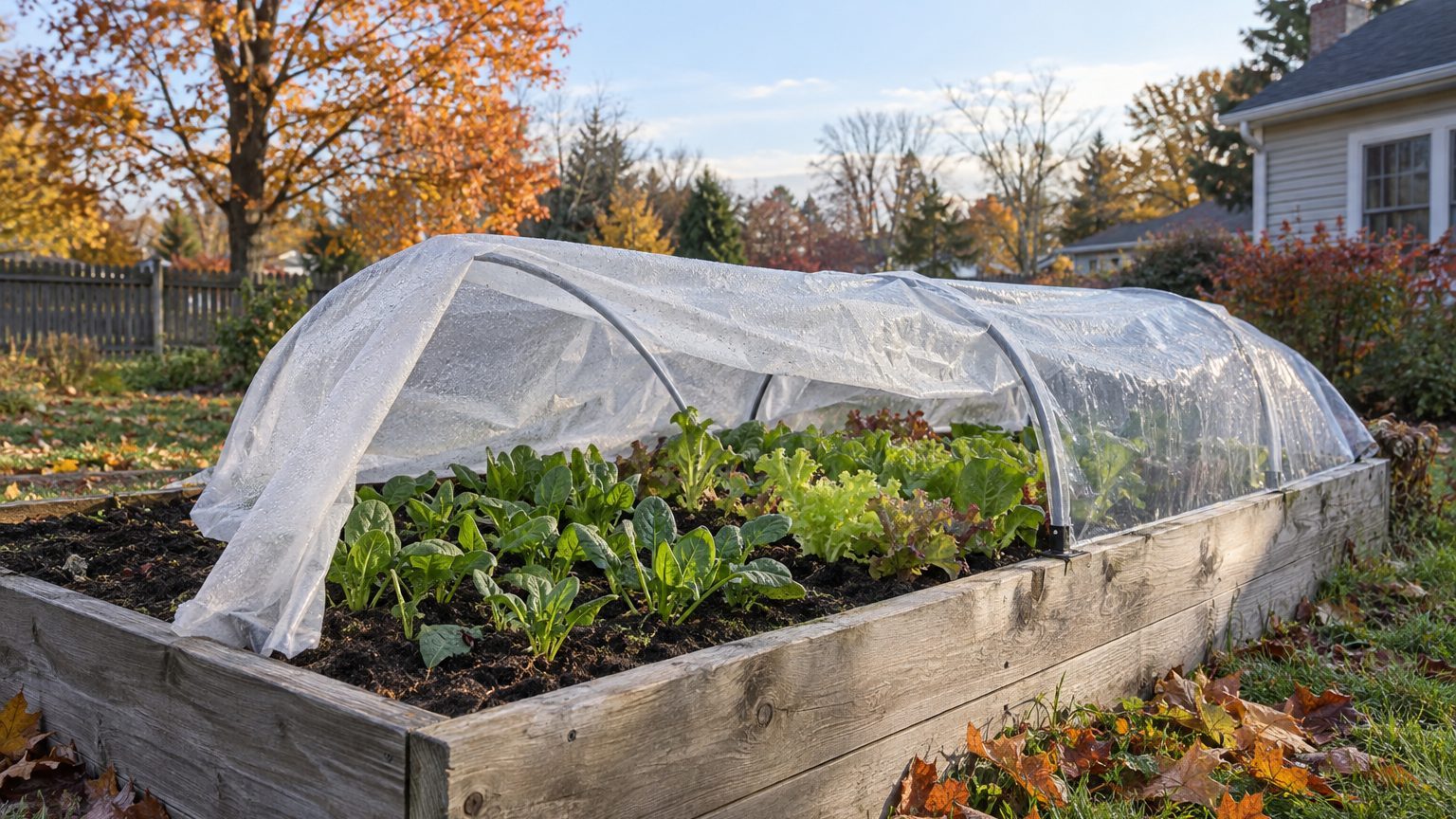

Growing season-extension in New Jersey works at both ends of the calendar. Covers let hardy crops start weeks ahead of spring and keep producing well into fall. They cannot beat cold soil in March or short daylight in December. The dates below come from the Newark station, so adjust them for your county. The general rules for covers are in Extending the Season: What a Cover Buys, and What It Cannot.
When the soil is warm enough in New Jersey
The question most gardeners start with is the date. At the Newark station, NOAA’s 1991-2020 U.S. Climate Normals put the last spring freeze (32°F) between March 29 and April 6, in the 30-70% probability band. That band marks the middle of the odds, so a freeze after April 6 still happens in some years.
Those dates describe an airport surrounded by pavement and buildings. Suburban and rural gardens typically see the last spring frost one to two weeks later, and higher ground sees it later still. Your county extension office can tell you how far your own ground sits from the Newark numbers.
The frost date is also only the first gate. Season extension waits for warm soil, and soil warms after frost risk ends. Ground that spent the winter cold holds that cold for weeks, because water in the soil takes a lot of sun to warm. Wet, heavy soil warms slowest. Seed sown into cold ground sits, and sometimes rots, long before the air feels like spring.
A cover works on the soil as much as on the air. Sun warms the ground by day. A fabric, plastic or glass layer traps some of that heat and holds the air still, so the soil’s warmth radiates into the enclosed space overnight instead of escaping. A second layer, such as fabric inside a tunnel, adds another pocket of still air. The gain is real, but it varies with the material, the night, the wind and whether the ground was warm to begin with. A cover shifts the limit and does not remove it. On a clear, calm night with a hard freeze, an unprotected crop under a single light layer can still be lost.
How do you know the soil is ready?
Use a soil thermometer at planting depth, read in the morning when the ground is at its coldest. Seed packets list a minimum soil temperature for germination, and that number is a better guide than the calendar. Peas, spinach, radishes and similar hardy crops germinate in cool ground. Tomatoes, peppers, squash and beans want the soil clearly warm and the frost risk behind them.
You can pre-warm a bed by laying the cover over it a couple of weeks before sowing. Any closed structure needs ventilation from the first sunny day. A closed cold frame in spring sun can cook its contents in an hour, even when the air outside is cold. Prop the lid open in the morning on any sunny day and close it again before the sun drops. Everything here is passive: sun and soil do the work, and nothing inside needs to be plugged in or lit.
How long the season lasts here
The Newark station has a growing season that runs from the last spring frost (March 29 to April 6) to the first fall frost (November 4 to November 16), and your own county may differ. That is a long window by northern standards. A garden that sees frost one to two weeks later in spring and one to two weeks earlier in fall can lose a month of it, so count on a shorter window if you garden outside the city.
A window this long allows a second sowing. Lettuce, radishes, bush beans, carrots and beets can be sown more than once, and a spring crop can be followed by a summer or fall crop in the same bed. The succession sowing guide on this site shows how to space those plantings so harvests arrive in steady waves instead of one glut.
Is there time for a second planting?
Usually yes, and the calculation runs backward from fall. Take the first fall frost window, then subtract the days to maturity on the packet. For direct-sown crops such as carrots, beets, lettuce and radishes, those days count from sowing, not from emergence. Then add extra time, because growth slows in the shortening days of autumn. A crop that needs 50 days in July can take noticeably longer in October.
The window also changes whether transplanting is worth it. With this much season, quick crops can go in as seed, and skipping transplanting spares the roots the disturbance of being moved. Transplants earn their place with slow, heat-loving crops that need a head start indoors to ripen before fall. A cover pushes both ends of the window outward. Hardy crops can start earlier under fabric, and a fall planting can stay harvestable after the first frost.
Heat and water in New Jersey
Heat does not decide how far you can extend the season. Summers are warm and humid, with enough hot afternoons that lettuce bolts, spinach quits and cool-season crops stall until September. That matters for planning a second sowing. It has little to do with choosing a cover, which is mostly a spring and fall tool.
Humidity matters more. Warm nights, frequent summer storms and dense foliage keep leaves wet, and that favors powdery and downy mildew, leaf spots and blight. Under a cover the problem grows, because still air holds moisture. Plastic also blocks rain, so a covered bed needs hand watering at the soil line, while open fabric lets rain through. Slow ripening is the other cost, especially late in the year when fruit sits in cool, damp air.
How do latitude and winter cold limit covered crops?
Newark sits at 40.68 degrees north, and that latitude sets how fast daylight shrinks in fall. Past a certain point in autumn, leafy crops stop adding much new growth no matter how warm the cover keeps them. After that, a cover holds a crop alive rather than growing it. The practical plan is to bring fall crops close to full size before the days get short, then treat the cover as a way to store them in the ground and harvest as needed. Gardeners near the northern or southern edge of the state sit at a different latitude and will see that point arrive a little earlier or later.
The coldest month decides how much structure you need. At Newark, the mean daily minimum of the coldest month is 25.5°F (NOAA NCEI Climate Normals 1991-2020). That is an average, so colder nights come regularly. Light fabric is usually enough in fall and early spring, when nights dip just below freezing. In deep winter, a framed structure with a second layer inside it gives hardy greens a far better chance. Even then, the coldest nights can still damage plants.
The USDA Plant Hardiness Zone Map (2023) places the state across zones 6a to 7b. That system rests on one variable, the average annual extreme minimum, so it tells you which perennials survive winter but says nothing about how a cover will perform on a given night. Higher ground in the northwest runs colder than Newark and the coast runs milder. Gardeners farther north face a harsher version of the same trade-off, as described in Extending the Growing Season in Alberta.
Which season extension suit New Jersey
Choose by type of cover and type of crop. The climate points in a clear direction. The window is long enough that you do not need the fastest-maturing types for most summer crops, but spring and fall depend on hardy ones. Hot afternoons favor crops that can take airflow and shade at the root, such as a mulched bed with the cover vented or lifted by midday. Humid weather makes disease resistance the first thing to look for in any crop you grow under cover.
| Type of cover | Best use here | Ventilation |
|---|---|---|
| Floating fabric laid over crops or hoops | Early spring sowings, light frost nights in fall | Lets air and rain through, but lift it on hot days |
| Low tunnel on hoops | Hardy greens and roots stretched into winter | Open the ends on sunny days |
| Cold frame | Seedlings, hardening off, winter salad | Must be vented every sunny day |
| High tunnel | Tender crops started early, winter harvest of hardy ones | Roll up sides or open doors daily |
Within each crop, pick types bred or sold for early maturity in spring plantings, and types with good mildew and blight resistance for anything grown under still air. I am not naming a variety, and the reason is practical. A cultivar that thrives in one part of the state can fail in another, and only local trials separate the two. Rutgers New Jersey Agricultural Experiment Station and its county extension offices publish what has done well in the state’s soils and humidity, and that recommendation is the one worth following.
Before you buy, look at your own plot. A low spot collects cold air and frosts later into spring. A south-facing wall or fence gives a warmer edge. Gardeners in the northern counties may also find Extending the Growing Season in New York useful for a neighboring climate. Whatever you choose, the cover shifts the limit and does not erase it, so keep an eye on the forecast on clear, calm nights.
Common questions
Can I plant before the last frost date if I use a cover?
Hardy crops, yes. Peas, spinach, lettuce, radishes and similar crops tolerate cold soil and light frost, and a cover adds a margin. Tender crops such as tomatoes, peppers and squash should wait until the frost risk has passed, because one clear night with a hard freeze can take the whole bed.
How much warmer is it under a cover?
It depends. The gain varies with the material, the wind, how clear the night is and how warm the soil was when the cover went on. A tight cover on warm, moist soil on a calm night does best. A loose cover on cold ground in wind does little.
Do I need to open a cold frame on cold days?
Yes, whenever the sun is out. A closed frame in spring sun can overheat its contents within an hour, even when the air outside is cold. Prop the lid in the morning and close it again before evening.
Are the Newark frost dates right for my garden?
They are a starting point. Suburban and rural gardens typically see the last spring frost one to two weeks later and the first fall frost one to two weeks earlier, and elevation adds to that. Check with your county extension office for the nearest local figures.