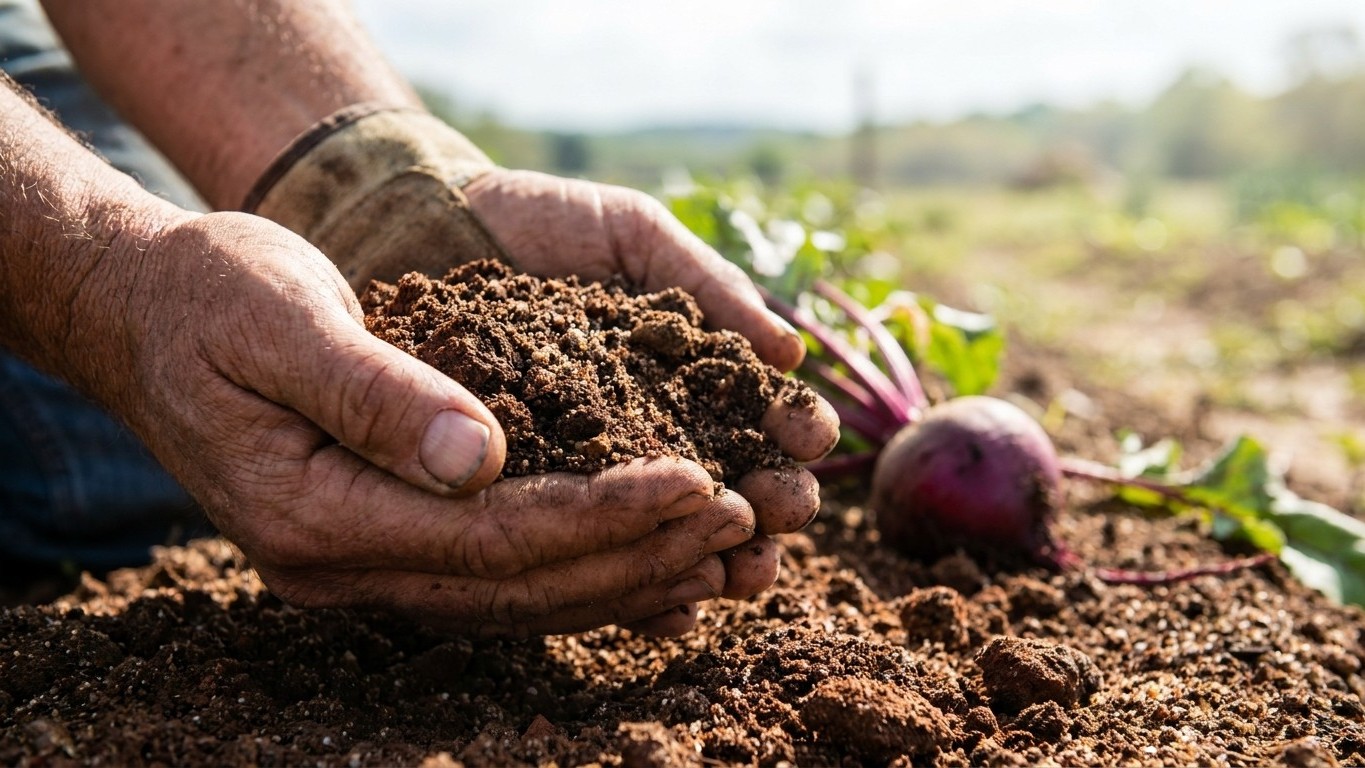

New York’s representative soil, the Honeoye series, is a well-drained silt loam sitting at a mildly acid pH of 6.3. That’s closer to beet-friendly than most people expect from a state better known for its clay flats and rocky hillsides. But “representative” is doing a lot of work in that sentence, and what a beet root actually meets in the ground depends on details this soil profile can’t answer for you.
The short answer
Start with the numbers. The Honeoye series, an Alfisol formed under forest cover, runs 26 percent sand, 19 percent clay, and 55 percent silt at the surface, with organic matter around 3.0 percent and a well-drained classification. That texture puts Honeoye in silt loam territory rather than the sandy loam beets actually prefer. Utah State University Extension is specific on this point: beets want deep, sandy, well-drained ground rich in organic matter. Honeoye clears the drainage and fertility bars reasonably well, its organic matter sits in a normal cultivated range, and its pH is mild enough not to lock up nutrients. What it doesn’t hand you for free is looseness. A silt fraction above half the profile can seal into a crust after a hard rain, which matters a great deal to a beet seed that needs to push through the top inch of ground within a couple of weeks of sowing.
On heat, the published figures here don’t include a day count above 90 F for any New York city. What Utah State does specify is a threshold of 85 F: once temperatures climb past that mark while the plant is also short on water, the root turns woody. That’s a lower bar than 90 F, and it’s the one worth tracking through a New York summer, upstate or down, rather than waiting for a headline heat wave.
None of this is a verdict on any one garden. New York spans hundreds of mapped soil series, from river-bottom silt near the Mohawk to shallow, stony ground in the Catskills to fill dirt behind a subdivision built in the last few decades. Honeoye is simply the series USDA’s State Soils program lists as representative of New York, and it’s a starting point for guessing at drainage and pH tendencies, not a stand-in for a soil test pulled from an actual bed. Anyone serious about a beet crop should still send a sample in and get their own pH and texture numbers back before amending anything.
The six weeks that decide it here
Beets go in the ground 2 to 3 weeks before the last frost, and that timing anchors the first six weeks of the plant’s life to a fairly specific stretch of the New York calendar. For New York City, the last spring freeze falls between March 23 and April 3, based on 1991-2020 climate normals from NOAA’s National Centers for Environmental Information. Sowing ahead of that window means germination and early root development happen mostly in March into April for downstate growers. Upstate and in the Adirondacks, frost lingers weeks longer into spring, which shifts that same six-week window later in the season for anyone gardening north of the city.
This is exactly the window Utah State flags as the danger zone for bolting: water stress during these first six weeks pushes beets to flower prematurely instead of building a root worth eating. New York’s early spring is a mix of snowmelt saturation and sudden dry, windy stretches as the ground warms, and that swing is the real hazard on a well-drained soil like Honeoye. A silt loam that drains well doesn’t hold surface moisture long once the weather turns dry and breezy, even if the subsoil underneath is still damp. A seedbed can look and feel wet at planting and then dry out at the surface within days, right when young beet roots are most sensitive to a dry stretch.
The practical takeaway isn’t complicated, just easy to miss: don’t assume a wet March means the soil will stay wet through April. Check the top inch of soil directly, especially after a run of sunny, windy days, and water before that surface layer cracks or crusts. That’s a different problem from summer heat stress, which shows up later and causes a different failure entirely.
What goes wrong here
- Surface crusting after spring rain. Honeoye’s 55 percent silt content can seal into a hard crust once heavy rain compacts the surface and it dries. Seedlings can’t push through it and germination drops. Break up the top inch with a rake before sowing and cover seed lightly rather than pressing it down hard.
- Bolting from a dry snap in the first six weeks. Well-drained ground sheds moisture fast once the weather turns dry and windy in March or April, and Utah State ties that early water stress directly to premature flowering. Check soil moisture at the surface every few days during any dry stretch and water rather than waiting for visible wilting.
- Forked or stubby roots from a dense subsoil. Honeoye developed under forest cover and can carry denser layers below the surface horizon that a shovel doesn’t always reach. Loosen the bed to 12 to 15 inches before sowing so the taproot has a clear path down.
- Woody roots from a hot, dry stretch later on. Once temperatures pass 85 F, any accompanying water stress toughens the root’s texture, according to Utah State. This is separate from early bolting and shows up closer to harvest, so keep watering consistent through the full 60 to 80 days from seeding, not just the first six weeks.
- Over-amending a soil that’s already close to fertile. With organic matter already around 3.0 percent in Honeoye’s surface horizon, piling on compost can throw off the balance. Utah State’s own guidance caps composted organic matter at 1 inch per 100 square feet, worked in rather than left on top.
Common questions
How long does it take beets to mature from seed in New York?
Utah State University Extension puts beets at 60 to 80 days from seeding to harvest, and that clock starts when the seed goes into the ground, not when a seedling is transplanted, since beets are direct-sown. Where that window lands on the calendar in New York depends on the local last frost date, since planting happens 2 to 3 weeks ahead of it.
What is New York’s official state soil?
USDA’s State Soils program lists the Honeoye series as representative of New York, though the designation isn’t tied to any state legislation. It’s a well-drained Alfisol, a silt loam with a surface pH around 6.3, formed under forest cover.
Is Honeoye soil good for beets?
It has real strengths for beets: good drainage, mild acidity, and organic matter in a normal range. Its weak point is texture. At 55 percent silt, it’s heavier and more prone to surface crusting than the sandy loam Utah State recommends, so loosening the bed deeply before sowing matters more here than it would on truly sandy ground.
When should beets go in the ground in New York to avoid bolting?
The general rule is 2 to 3 weeks before the last spring frost. In New York City, that frost date falls between March 23 and April 3 based on NOAA’s 1991-2020 climate normals. Upstate and mountain regions freeze later into spring, so that planting window shifts back accordingly, and gardeners there should use their own local frost date rather than the city’s figure.