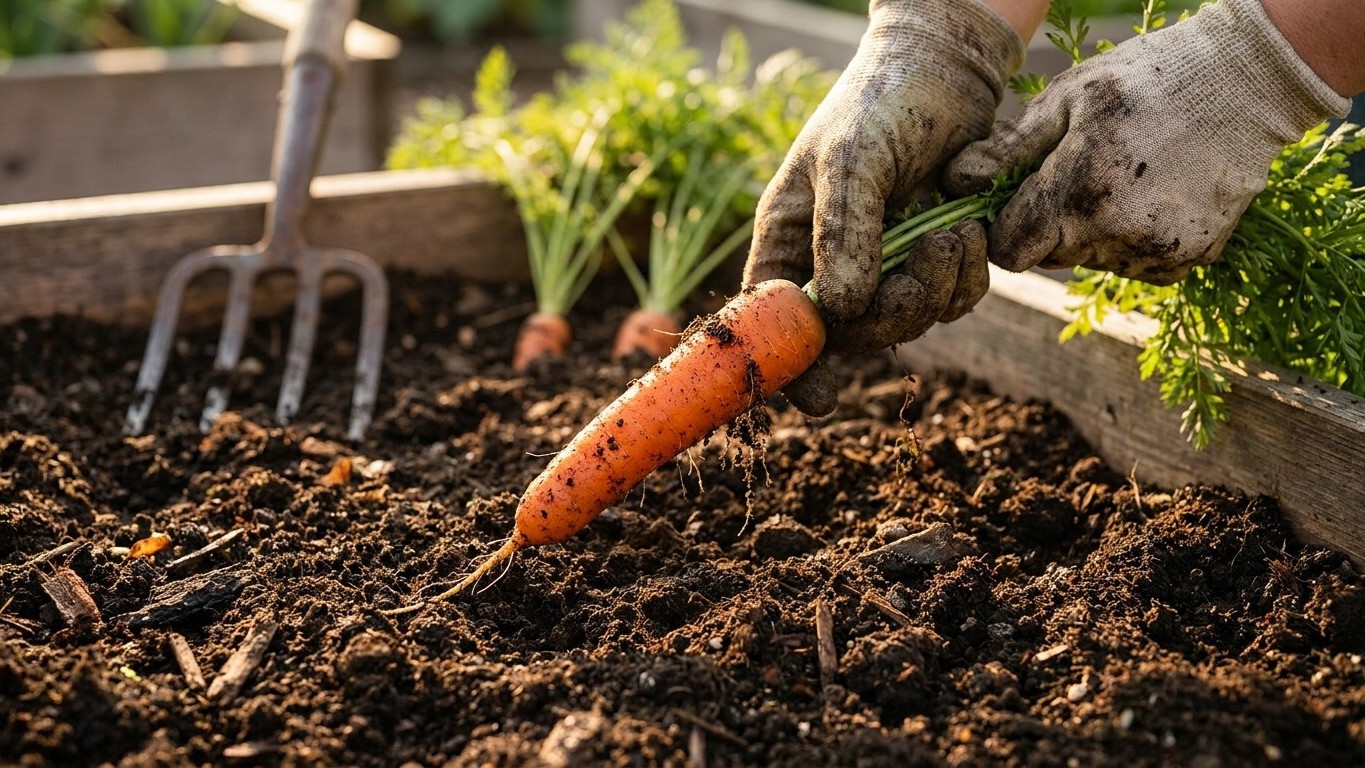

New York’s representative soil, the Honeoye series, sits on the favorable end of the spectrum for carrots: well drained, moderately fertile, and closer to loam than clay. That’s a decent starting point, but the state stretches from Long Island sand to Adirondack till, so the real answer to whether your carrots will fork lives in your own garden bed, not in a soil survey.
The short answer
The Honeoye series, the soil the USDA lists as representative of New York, is an Alfisol, a forest-derived soil built up under hardwoods and generally decent at holding onto nutrients. Its surface layer runs about 26 percent sand, 19 percent clay, and 55 percent silt, which puts it in loam-to-silt territory rather than heavy clay. The surface pH sits around 6.3, slightly acid, and organic matter measures about 3.0 percent. Drainage is classed as well drained.
For carrots, that mix is workable but not automatically ideal. Carrots want deep, sandy, well-drained soil rich in organic matter, according to Utah State University Extension, and that same source is blunt about the failure mode: heavy or rocky soil makes the root fork. Honeoye’s 19 percent clay isn’t the kind of dense, sticky clay that guarantees forked roots, but its silt-heavy texture can still compact under foot traffic or heavy rain, and 3.0 percent organic matter is respectable, not generous. In practice, that means most New York gardens sitting on soil like this will grow reasonably straight carrots if you loosen the bed and work in compost before sowing. Gardens with more clay, more compaction, or a shallow topsoil layer over hardpan need the fix Utah State names directly: plenty of compost worked in, and double digging to break up the layer below the reach of a hoe. Where digging deep isn’t realistic, a raised bed filled with a loose, sandy mix sidesteps the problem entirely. For a deeper look at exactly how local conditions affect root shape, see Will Carrots Fork in New York Soil?
Here’s the catch worth sitting with before you grab a trowel: New York contains hundreds of distinct soil series, from beach sand on the South Shore to heavy lakebed clay near the Finger Lakes to thin, rocky soil in the Catskills. Honeoye is the series USDA uses to represent the state as a whole, and it happens to be a favorable one for carrots, but it’s not a diagnosis of your backyard. Think of it as the regional forecast, not the reading off your own thermometer. The next section is how you get that actual reading.
The test that settles it in your own garden
A soil survey tells you what’s typical for the county. It doesn’t tell you what a builder scraped off your lot forty years ago, or whether your raised bed sits on native soil or trucked-in fill. The only way to know is to look, feel, and time your own dirt.
- Dig a test hole at least a foot deep where you plan to sow. Carrots need loose ground the full length of the root, so note where the soil changes color or gets noticeably harder. A hard layer a few inches down will bend or fork a carrot just as reliably as a rock will.
- Check for stones and debris as you dig. Pull out anything larger than a pebble along the planting row; a carrot tip that meets a stone splits into two roots trying to grow around it.
- Feel the texture. Grab a moist handful and squeeze. Sandy soil falls apart. Clay-heavy soil holds a ribbon shape when you push it between your thumb and finger. Loam does a bit of both, crumbling into loose clumps.
- Watch how water moves through it. Fill your test hole with water and let it drain, then fill it again and watch the second round. Water that lingers for a long stretch signals poor drainage and a soil that will need amending or a raised bed. Water that vanishes almost immediately points to a sandy soil that will need more frequent watering to avoid the stress that splits roots.
None of this requires a lab. It requires a shovel, a bucket of water, and twenty minutes before you decide whether to sow straight into the ground or build up a bed first.
When to sow here
Carrot seed doesn’t wait for warm weather the way tomato transplants do. It goes into the ground while the soil is still cool, and the timing math runs backward from your last frost date, not forward from any transplant date, since carrots are sown directly and never moved.
- Start with your last spring frost window. For New York City, NOAA’s 1991-2020 climate normals put the last spring freeze between March 23 and April 3. That’s the Central Park figure specifically; anywhere upstate, in the Southern Tier, or in the Adirondacks will run later, sometimes considerably later, since Central Park sits in a dense urban heat pocket that thaws earlier than the surrounding region.
- Count back two to three weeks from that date. Carrots go in the ground before the last frost, not after it, so for a Central Park-area frost window of late March to early April, that puts sowing somewhere in the first half of March.
- Check the soil itself before you sow. Soil temperature needs to reach at least 40 F for carrot seed to have any chance of sprouting. A calendar date means nothing if a cold snap has kept the ground frozen or waterlogged; wait for the dirt itself to clear that threshold.
- Aim for the 55 to 65 F range for best germination. Seed will germinate at the 40 F floor, but slowly and unevenly. Sowing a little later, once soil temperatures climb into the mid-50s to mid-60s, usually means a faster, more uniform stand of seedlings, even if it costs you a week or two of calendar time.
Upstate gardeners working with a later frost date should shift this whole sequence later by however many weeks their own local frost data show, rather than borrowing the New York City window wholesale.
What goes wrong here
- Forking in heavy or compacted ground. Even a moderately clay-rich soil like the state’s representative Honeoye series, at 19 percent clay, can compact enough under rain or foot traffic to bend a taproot into two. The fix is the one Utah State University Extension gives for heavy soil generally: work in plenty of compost and double dig the bed, or skip the native soil altogether and grow in a raised bed filled with loose, sandy mix.
- Poor germination during a hot spell. Carrot seed germinates best between 55 and 65 F. A sudden warm stretch that pushes surface soil well above that range can slow sprouting or dry out the seed bed before the seedlings emerge. Keep the row consistently moist through germination and consider sowing a little earlier in the recommended window rather than later, so the seed is in the ground before the season’s first heat spike.
- Splitting from uneven watering. Carrots that go dry and then get soaked, whether from a missed week of watering followed by a heavy storm or from an inconsistent irrigation schedule, tend to split as the root expands unevenly. A steady watering routine and a layer of mulch to even out soil moisture solve most of this.
Checking this against your own county
A statewide soil series and a New York City frost date are useful benchmarks, not local certainties. For soil test results specific to your property, planting calendars adjusted to your county’s actual frost pattern, and variety recommendations suited to your growing conditions, contact Cornell Cooperative Extension. Local extension offices work from county-level data rather than a single statewide figure, which matters given how much New York’s soil and frost timing shift between Long Island, the Hudson Valley, the Finger Lakes, and the North Country.
Common questions
Can I grow carrots in clay soil in New York?
Yes, but expect forking unless you amend it. Utah State University Extension recommends working in plenty of compost and double digging heavy soil before sowing, or building a raised bed filled with a looser, sandier mix if the native ground is consistently dense.
How early can I sow carrot seed in New York?
That depends on your local frost date and, more importantly, on your actual soil temperature. Seed can be sown once soil hits at least 40 F, generally two to three weeks before your area’s last spring frost. In the New York City area, where NOAA’s 1991-2020 normals put that frost between March 23 and April 3, sowing typically falls in early to mid-March. Upstate gardens should count back from their own later frost date instead.
Why did my carrots come up patchy this year?
Uneven or delayed germination is often a soil temperature problem. Carrot seed germinates best between 55 and 65 F; a cold snap or a sudden heat spike outside that range, combined with an inconsistently moist seed bed, tends to produce gaps in the row.
Does New York’s state soil mean my garden will grow good carrots?
Not on its own. The Honeoye series is simply the soil USDA uses to represent New York overall, and its texture (well drained, loam to silt, moderate clay) tends to favor carrots more than heavy clay would. But a state spans hundreds of soil series, and your own yard could easily differ. Dig a test hole and check the texture and drainage yourself before assuming your soil matches the state’s profile.