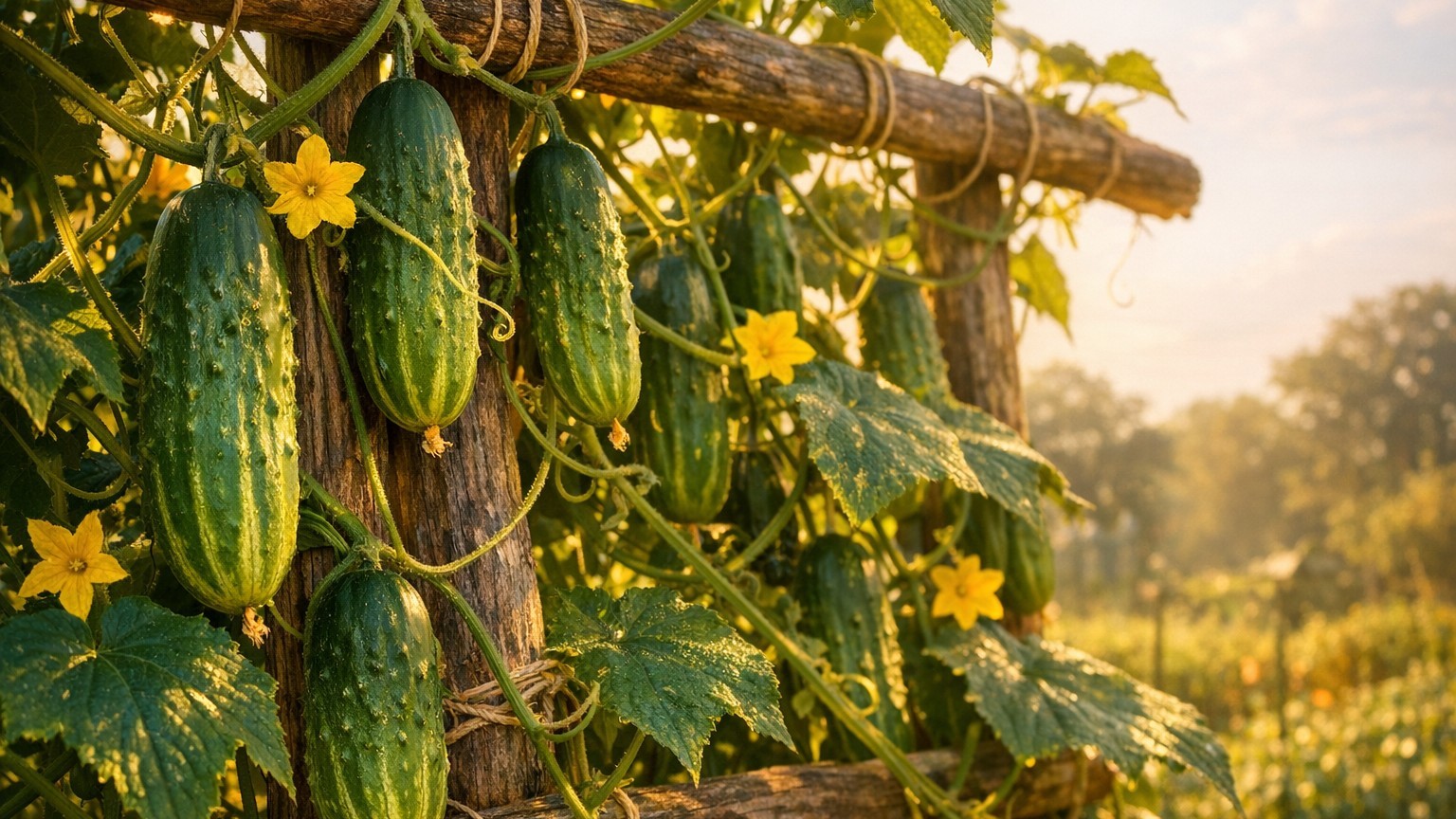

New York’s cucumber answer depends on where in the state a garden sits: the frost-free window in New York City runs roughly eight months, while the North Country and the Adirondacks lose weeks on both ends of that calendar. Pickling and bush types suit the shorter season upstate; vining slicers and burpless types have room to mature downstate. Trellising matters everywhere, given how wet a New York summer gets.
The short answer for New York
Start with the two numbers that actually decide this: the New York City reference station sees its last spring frost between March 23 and April 3, and its first fall frost between November 14 and November 27. That’s a season stretching seven and a half months in the city itself. Upstate and in the Adirondacks, both ends of that window close in, sometimes by a month or more on each side, which is the single biggest reason a variety choice that works in Brooklyn can fail in Saranac Lake.
Given that spread, the decision by type looks like this: in the shorter-season parts of the state, bush types and pickling types are the safer bet. They tend to reach maturity faster than large vining slicers, and a compact bush habit suits gardeners working with a shorter window who can’t afford a plant that spends its first six weeks just building vine. Where the season runs long, as it does across the city and much of the Hudson Valley and Long Island, vining slicers and burpless or parthenocarpic types (the seedless, self-pollinating kinds often grown under cover or on a trellis) have the time and the heat to fill out properly.
Heat load itself is a secondary factor here, not the main one. The city reference station averages just 12.2 days a year at 90F or above, which is a moderate heat load rather than an extreme one. That means heat stress isn’t the primary threat to a cucumber crop in most of New York the way it would be further south. The season’s length and the state’s humidity are what should drive the type decision, not a fear of scorching.
On the humidity side, the reference station logs about 13.7 inches of rain across June, July and August, with June (4.54 inches), July (4.6) and August (4.56) landing within a tenth of an inch of each other. That’s a consistently damp summer, and it argues for training vines up a trellis or a fence rather than letting them sprawl on the ground, since airflow around the leaves matters more here than it would in a dry climate. Ask a local Cornell Cooperative Extension office which specific cultivars, within those types, have performed well in trials for the county in question.
What will not work here
Long-season, heat-hungry types are the clearest failure mode upstate and at higher elevations. If a variety needs a long stretch of warm days to fill out, and the local frost calendar only allows a shorter window than New York City’s, that plant runs out of season before it runs out of potential. The Adirondacks and the North Country, sitting in the cooler end of the state’s 3b-7b hardiness range, are exactly where this mismatch shows up most often: a grower plants a variety bred for a long southern season, and the first fall frost arrives before the harvest does.
Flat, ground-level vining in a humid climate is the second common failure. New York’s summer rainfall, spread evenly at roughly 4.5 inches a month across June through August, keeps foliage and soil surface damp for long stretches. Leaves sitting close to wet soil, with poor airflow around them, are far more prone to the fungal and mildew problems that shorten a cucumber plant’s productive life. A trellis or a simple stake-and-string setup solves most of this by lifting the foliage into moving air and off the wet ground.
Watering on a fixed weekly schedule is the third trap, and it’s a subtler one because the summer rainfall total actually looks adequate on paper. The problem is how that rain arrives. A single afternoon thunderstorm dropping an inch in twenty minutes mostly runs off rather than soaking into the root zone, especially on sandy soil, and the moderate heat load (those 12.2 days above 90F) increases evaporation on the days between storms. A garden watered only when the calendar says to, and not when the soil itself says to, can end up drought-stressed in a month that technically had plenty of rain.
Direct-seeding a long-season type right at the last spring frost date is a fourth mismatch worth naming. Soil needs time to warm past the point where cucumber seed germinates reliably, and a grower working from the bare frost date alone, without checking the soil itself, often sets a long-season plant back by two or three weeks it can’t spare.
What changes across New York
New York is not one garden, and the numbers make that plain. The USDA Plant Hardiness Zone Map, built on average annual extreme minimum temperatures, places the state anywhere from zone 3b to zone 7b. That’s a five-and-a-half-zone spread inside a single state’s borders, among the widest ranges in the Northeast, and it means a blanket recommendation for “New York” is close to meaningless without knowing which part of it a reader is standing in.
| Region character | Season pattern | Type to favor |
|---|---|---|
| New York City and the reference-station area | Longer frost-free window (late March/early April to mid/late November) | Vining slicers, burpless or parthenocarpic types, trellised |
| Hudson Valley, Long Island, Lower Great Lakes shoreline | Moderate season, milder within their local microclimate | Either vining or bush, depending on local frost dates |
| North Country, Adirondacks, higher elevations | Shorter season, earlier fall frost, later spring frost | Bush types, pickling types, faster-maturing choices |
A reader gardening in the cooler end of that range should shift the whole approach, not just the variety type. Starting seed indoors and setting out transplants, rather than direct-seeding, buys back some of the weeks a shorter season takes away. Row cover at planting time, and again as fall frost approaches, extends the usable window on both ends. None of that changes what the plant is; it changes how much of the season the plant actually gets to use.
The USDA’s map is built for that exact question, down to a resolution finer than county lines in many areas, and it’s the right tool to check before assuming this article’s New York City figures apply to a garden two hours north.
Where to check this for your own county
Cornell Cooperative Extension is the land-grant extension service for New York, and its statewide directory sits at cals.cornell.edu/cornell-cooperative-extension. From there, the path to useful information runs through the local county office, not the state homepage.
Two things are worth looking for once there. First, the local planting calendar for the specific county, which will reflect actual local frost dates rather than the New York City station figures. A county two hours upstate can have a last frost date weeks later than the city’s March 23 to April 3 window, and its office will say so plainly. Second, and more useful for the exact question this article is answering, the list of cucumber cultivars that Cornell’s trial programs or the county’s master gardener volunteers have actually grown and evaluated in that county’s conditions. That’s the level of detail this state-wide page cannot responsibly provide, because a cultivar that performs well on Long Island’s sandy soil and long season is not automatically the right pick for clay soil in the Finger Lakes.
A county recommendation beats a state one every time, for the simple reason that it’s built on data closer to the actual garden. A single reference station’s climate normals and a statewide hardiness zone range are broad; a county extension office works from local soil surveys, local frost records going back decades, and trial plots planted a short drive from the reader’s own property. Treat this article as the framework, the county office as the fine print.
Checking this against your own garden
Every date and average is a regional starting point, and a reader’s own garden will confirm or contradict it faster than any calendar can. Three signs are worth watching before trusting a planting date over what’s actually happening in the soil.
Soil warmth, checked by feel rather than any gauge, is the first and most direct signal. Cucumber seed sits and sulks in cold soil no matter what the calendar says, and a grower who can push a finger a few inches into the bed and feel it’s genuinely warmed through, not just sun-warmed on the surface, has a better predictor than the frost date alone. Soil that still feels cool and damp deep down is telling the gardener to wait, regardless of what the last spring frost window suggests.
The first flush of male flowers is the second sign, and it shows up before the female flowers that actually set fruit. Cucumber plants typically produce several male blooms first; seeing that first flush confirms the plant has moved past establishment and into its reproductive stage, which is a more reliable marker of “on track” than counting days since planting.
The appearance of the first true leaves, the serrated leaves that follow the plant’s rounded seed leaves, is the third marker. Their timing and size say a lot about whether the plant is finding enough warmth and light in that specific spot. A slow, small first true leaf in a spot that gets partial shade for part of the day is a sign that particular corner of the yard is running its own microclimate, cooler or shadier than the rest of the garden, and worth noting for next year’s layout.