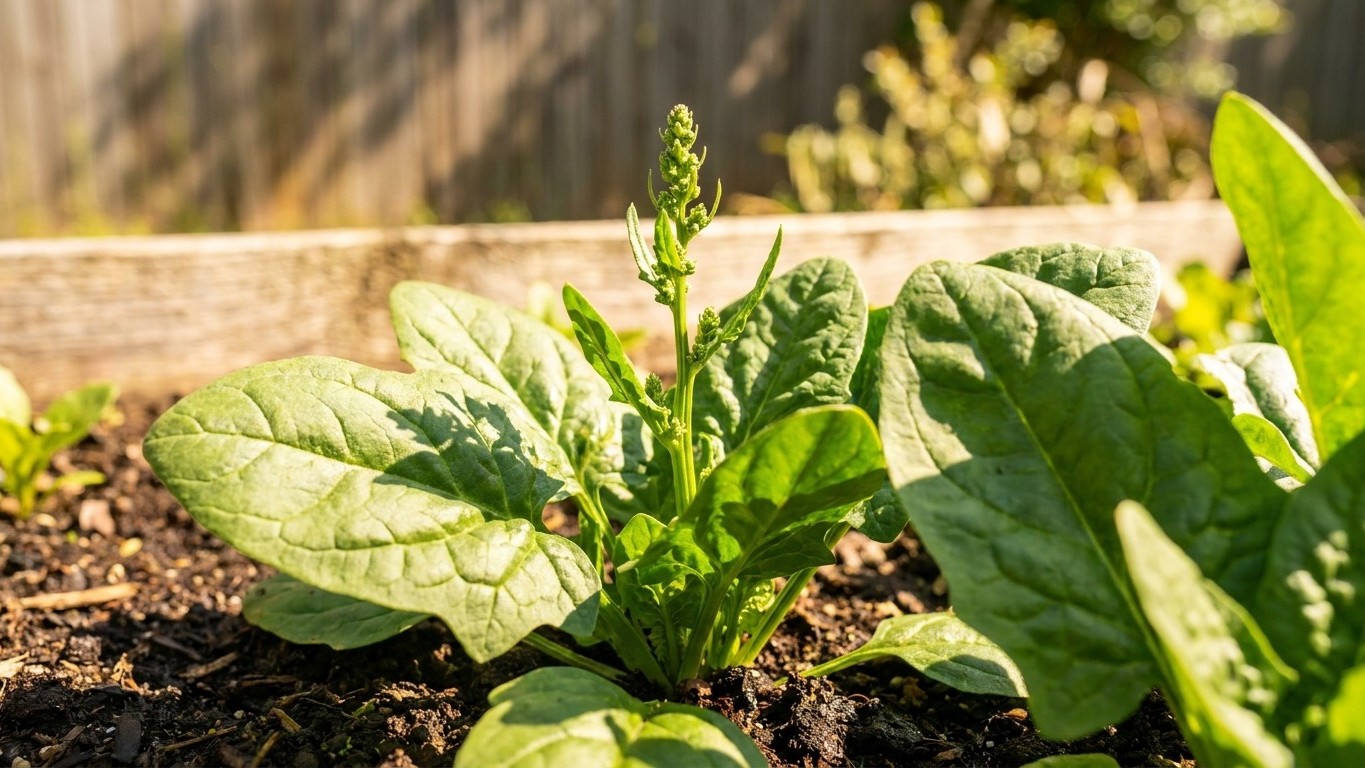

Spinach bolts early in New York because the trigger is day length, not summer heat. New York City’s longest day delivers 14 hours and 56 minutes of daylight, well past the point where spinach starts flowering regardless of how mild the season feels. Add the region’s 12.2 days a year at 90°F or above, and both mechanisms push the plant toward seed at once. A cool summer here does not buy extra weeks.
The short answer
New York City’s summer solstice brings 14 hours and 56 minutes of daylight, and that number alone explains most of what happens to spinach planted too late. Spinach flowers in response to long days as much as to warmth, so once the calendar approaches the solstice, the plant is genetically cued to bolt whether the thermometer reads 68°F or 88°F. This is the part gardeners misjudge most often: they wait for a heat wave to blame, when the real signal arrived weeks earlier in the form of longer afternoons.
That does not mean heat is irrelevant. New York City averages 12.2 days a year at 90°F or higher, and spinach growth quality declines once temperatures climb above 75°F. So the honest answer is both: day length sets the deadline, and heat makes the deadline arrive faster and makes the last harvests taste worse. A stretch of 80°F afternoons in late May will not by itself make spinach bolt, but it accelerates a process the lengthening days already started, and it pushes leaf flavor toward bitterness before the plant even sends up a flower stalk.
The distinction matters for how you plan the season. If heat were the only culprit, a shady spot or a cool microclimate near the Hudson or up in the Catskills would solve the problem. It helps, but it does not fix it, because the sun rises and sets on the same schedule everywhere in the state at a given latitude. Coastal Long Island and the Adirondacks see nearly identical day lengths on the summer solstice; what differs between them is how many of those 12.2 average days above 90°F actually land locally, and how early or late the frost dates fall on either end of the season.
Practically, this means the New York spinach grower is working two short windows, not one long summer. Spring planting has to get in the ground early enough to mature before the days get too long and the heat starts climbing past that 75°F growth ceiling. Fall planting has to wait for soil to cool enough to germinate, then race the clock before frost ends things. Neither window is generous, and neither is rescued by a cool July.
How long the spring window really is
Utah State University Extension recommends sowing spinach two to three weeks before the last expected spring frost, and treats 75°F as the point where growth quality drops off. Applying those two facts to New York City’s climate normals lays out the spring calendar in a fairly narrow band.
- New York City’s last spring frost falls between March 23 and April 3, based on NOAA’s 1991-2020 climate normals for the region.
- Counting back two to three weeks from that range puts seed in the ground somewhere between the first days of March and roughly the third week of March.
- From that sowing point, the plant has a limited stretch before two things converge: daylight lengthening toward the June solstice’s 14 hours and 56 minutes, and afternoon temperatures beginning to cross the 75°F ceiling that slows good growth and encourages bitterness.
- New York City’s 12.2 average days a year at 90°F or higher mostly land in June, July, and August, not in spring, so the spring window rarely closes because of a sudden heat spike. It closes because the days themselves have grown too long.
- The realistic result is an outdoor spinach season of roughly two months in spring, seed going in during early to mid-March, harvest wrapping up by mid- to late May, before the approaching solstice forces the plant toward flowering.
Four spinach varieties commonly discussed in extension guidance, Bloomsdale, Melody, Teton, and Olympia, are named in that USU material without any published data on days to maturity or comparative bolt resistance. No days-to-maturity figure is published in that source for spinach at all, and none should be invented or borrowed from another crop. What is published is the rule of thumb: sow two to three weeks ahead of the last frost, and expect the growing quality to fall once temperatures pass 75°F. That is enough to plan the spring crop responsibly, even without a maturity number to count against a calendar.
Gardeners in the Hudson Valley or upstate should treat the Central Park-based frost dates as a city figure, not a statewide one. Colder inland and northern locations see later last-spring frosts and earlier first-fall frosts, which compresses both ends of the spinach season further than what the city experiences.
The autumn crop, and when the soil lets you sow
Fall Spinach in New York faces two separate obstacles, and they sit at opposite ends of the calendar. One blocks the seed from germinating at all. The other ends the harvest outright.
Soil still too warm to germinate
Utah State University Extension notes that spinach seed germination drops once soil temperature rises above 80°F. Late summer soil in New York City, warmed by a season that includes an average 12.2 days at 90°F air temperature or higher, often sits above that threshold well into early September. Sowing too early, while the ground is still holding that summer heat, means poor or spotty germination regardless of how carefully the seed is planted. The practical fix is patience: wait until soil has cooled from its late-summer peak before putting fall seed in the ground, rather than sowing by a fixed date on the calendar.
Racing the first fall frost
The other constraint comes from the opposite direction. New York City’s first fall frost falls between November 14 and November 27, based on the same NOAA climate normals used for the spring date. Utah State University Extension advises counting back 50 to 75 days from the date you want to harvest for a fall crop, since no specific days-to-maturity figure is published for spinach.
Working from a harvest target in the first half of November, ahead of that November 14 to 27 frost window, the 50-to-75-day count places fall sowing somewhere between early September and late September. That window lines up well with the point where soil has typically cooled below the 80°F germination threshold, which is what makes early-to-mid September the practical sweet spot for New York fall spinach: late enough that the seed will actually sprout, early enough that the crop has time to reach harvest before frost shuts it down.
As with the spring dates, this fall math shifts earlier the farther inland or north you garden. Areas with earlier first frosts than the Central Park normal need to move both the soil-cooling wait and the sowing date earlier to keep the same 50-to-75-day cushion before frost arrives.
| Constraint | What triggers it | New York City figure |
|---|---|---|
| Bolting | Long days, worsened by heat | 14 h 56 min daylight at summer solstice |
| Growth quality / bitterness | Temperatures above 75°F | 12.2 days a year at 90°F or higher |
| Spring sowing | 2-3 weeks before last frost | Last frost March 23 to April 3 |
| Fall germination | Soil above 80°F blocks sprouting | Not numerically dated here; tied to late-summer soil cooling |
| Fall harvest cutoff | First frost | November 14 to November 27 |
Common questions
Does shade slow down bolting in New York?
Shade can lower leaf temperature and delay the growth-quality decline tied to the 75°F ceiling, but it does not change day length, which is the primary bolting trigger. A shaded spinach bed still receives the same 14 hours and 56 minutes of daylight on the solstice as one in full sun.
Can I sow spinach in New York in high summer?
It is not recommended. Midsummer combines the longest days of the year with the bulk of the region’s 12.2 average days above 90°F, the worst possible overlap for a crop that bolts under both conditions.
Why do the frost dates matter more upstate than in New York City?
The published frost dates come from a Central Park station, a dense urban site that runs warmer than surrounding rural and upstate areas. Gardeners in the Adirondacks or Hudson Valley should expect an earlier first fall frost and a later last spring frost than the city figures show, shrinking both growing windows.
Is there a spinach variety that resists bolting better in New York’s climate?
Bloomsdale, Melody, Teton, and Olympia are the varieties named in Utah State University Extension’s spinach guidance, but that source publishes no comparative data on bolt resistance or days to maturity for any of them, so no variety can be recommended over another based on that material.