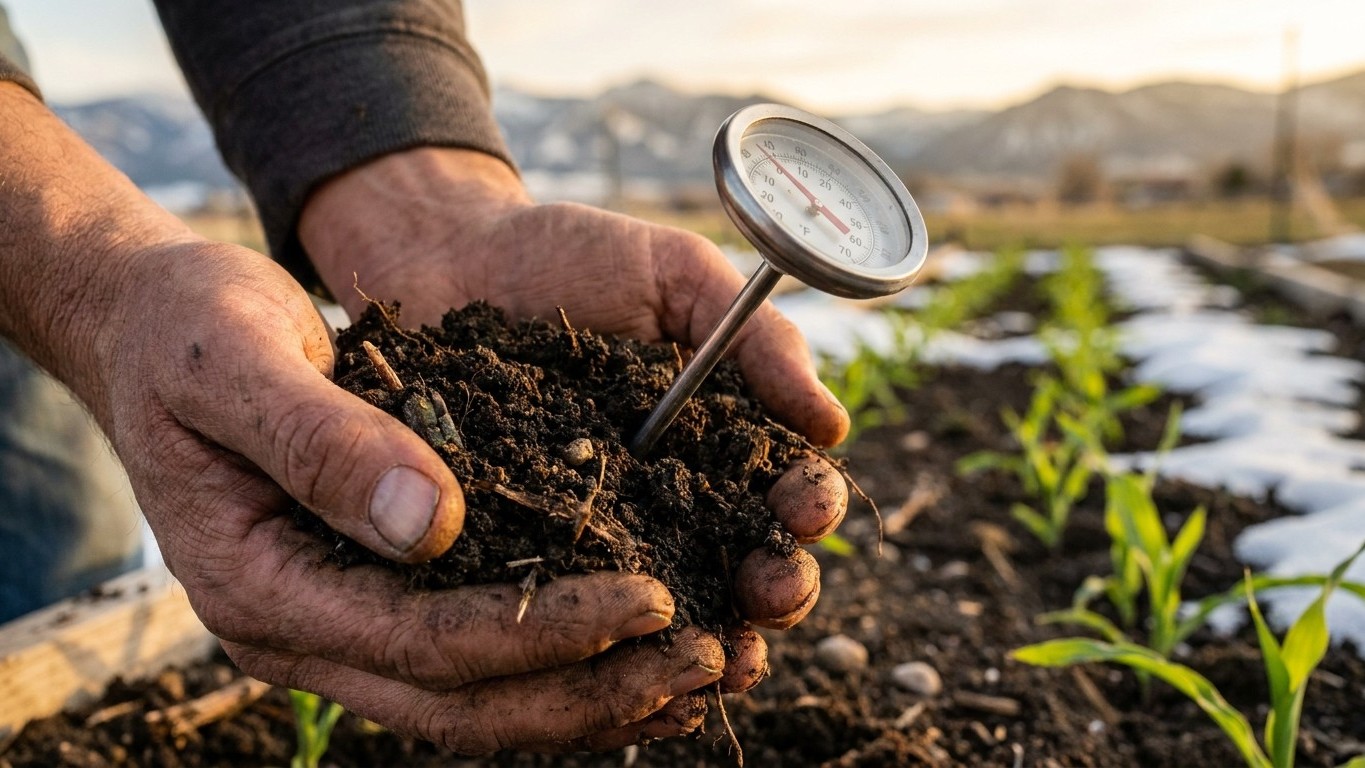

Sweet corn can ripen in New York, but only if you stop counting from the last frost. Corn seed rots in cold, wet soil no matter what the calendar says, and the real starting gun is soil temperature, not air temperature. Near New York City, that gun typically fires weeks after the frost risk has already passed, which changes how much of the season you actually have left to work with.
The short answer
Around New York City, the last spring frost lands somewhere between March 23 and April 3, according to NOAA’s 1991-2020 climate normals for that reference station. That sounds like an early start. It isn’t, not for corn. Sweet corn seed needs soil above 60 F to germinate reliably, and soil doesn’t warm at the same pace as the air. A frost-free morning in late March or early April can still sit over soil in the low 40s, especially if the ground is shaded, heavy, or still holding winter moisture. Growers who plant the day frost danger clears are usually planting into soil that isn’t ready, and the seed simply sits there. Knowing exactly When to Sow Sweet Corn in New York means tracking soil temperature rather than the frost date alone.
The 60 F soil threshold typically arrives some weeks after that last frost date, once the sun has had time to work on the topsoil. That later start is what actually opens the sweet corn clock: from the day soil crosses 60 F, the crop needs 60 to 90 days to mature, depending on variety. So the real question isn’t “can I beat the frost,” it’s whether Will Sweet Corn Ripen in New York? given 60 to 90 days from whenever your soil hits 60 F still fits before the first fall frost.
Near New York City, the first fall frost arrives between November 14 and November 27, again per NOAA’s normals. That’s a long fall runway. Even allowing several weeks after the spring frost date for soil to warm, there’s still a wide gap running into November before the season closes. For a 60 to 90 day crop, that gap is generous in the city and the immediate metro area.
It is not the same story everywhere in the state. NOAA’s reference site for these dates is a dense urban location, and the agency itself notes that upstate New York and the Adirondacks freeze far earlier in fall and thaw far later in spring. That means the soil-to-frost window this article is describing is a New York City figure, not a statewide one. The same corn planted on the same calendar date in a colder valley or a northern county could be running against a much tighter clock, sometimes tight enough that a long-season variety doesn’t finish at all.
One more number worth holding onto: the New York City area averages 12.2 days a year at 90 F or hotter. That’s not a heat wave count, it’s a proxy for how much summer push the crop gets once it’s up and growing. More hot days generally means faster growth once soil and air are both warm, which matters when you’re deciding how much cushion to build into a planting date.
Does a late variety fit here?
Variety length is where the season either works or doesn’t, and the answer changes depending on where in New York you’re standing.
A 60-day variety
A short-season, roughly 60-day sweet corn is the safe bet almost anywhere in the state. Even accounting for soil needing to reach 60 F well after the last spring frost, and even in a region where the frost-free season runs shorter than New York City’s, 60 days is rarely the limiting factor. Plant once the soil is genuinely warm, not just once frost risk has passed, and a 60-day type has room to mature before fall closes in, whether that closing date is in mid-November near the coast or considerably earlier upstate. This is the variety length to lean on if you’re not certain how long your local season actually runs, or if you want a second planting later in the summer to stagger the harvest.
A 90-day variety
A 90-day, later-maturing sweet corn is a tighter fit, and its success depends heavily on which part of New York you’re gardening in. Near New York City, where the first fall frost doesn’t typically show up until mid-to-late November, a 90-day variety planted once soil is properly warm still has a reasonable amount of runway. But NOAA is explicit that this frost timing is a city figure, not a state one, and that upstate New York and the Adirondacks see frost arrive markedly earlier in the fall and linger later in spring. In those colder regions, a 90-day variety planted after the soil has finally warmed up may run out of season before it fully matures. Stated plainly: the long-season variety that works in the city is not a safe assumption upstate, and in the coldest pockets of the state it likely does not fit at all. That’s not a climate quirk to guess around, it’s exactly the kind of local detail your own county’s frost and soil data will settle.
What goes wrong here
- Soil sown too cold. Planting the week frost clears, before soil has actually reached 60 F, is the single most common failure. Seed sits in cold, damp ground and rots before it ever germinates, or comes up weak and uneven. The fix is patience and a soil thermometer: wait for the soil itself to cross 60 F, not just for the frost date on a calendar, before you plant.
- A variety too late for the season. Choosing a 90-day type in a part of the state where fall frost arrives early is a mismatch between the seed packet and the ground it’s planted in. The remedy is matching variety length to your actual frost window rather than to what grew well somewhere else in the state, and defaulting to a shorter-season type if you’re at all unsure how long your local frost-free stretch really runs.
- Sweetness lost to a neighbor, not to weather. This one has nothing to do with soil temperature or frost dates. Sweet corn comes in different genetic types (commonly labeled su, se, and sh2), and if two different types tassel at the same time near each other, cross-pollination flattens the sweetness and texture of both. The remedy is timing, not distance: stagger planting dates so the types don’t tassel together, or grow only one type per season in a given garden. Corn should also be planted in blocks of three or more rows rather than a single thin row, which is a matter of pollination shape, not calendar timing, and helps ears fill out properly regardless of variety.
Checking this against your own county
Everything above is built on New York City’s climate data, and the frost dates in particular don’t hold for the rest of the state. Upstate counties and the Adirondacks run a shorter, colder season on both ends, which can rule out a 90-day variety even where the city version of this same math works fine.
Before committing to a planting date or a variety length, check with Cornell Cooperative Extension, the land-grant extension service for New York, through cals.cornell.edu/cornell-cooperative-extension. Your county’s local office can confirm frost timing and typical soil warming for your specific area, which is the only way to know for certain whether a longer-season variety is realistic where you garden.
Common questions
Does last frost date tell me when to plant sweet corn?
No. Last frost only tells you when air temperature risk drops. Corn seed needs soil above 60 F, which is reached some weeks after that frost date, and planting before then usually means rot rather than a head start.
How do I know when sweet corn is actually ripe?
Check for three signs together: dry, browned silks at the tip of the ear, husks that are still moist and green, and milky (not clear, not thick) juice from a punctured kernel. Any one sign alone isn’t a reliable call.
Can I grow two types of sweet corn in the same garden?
Yes, as long as they don’t tassel at the same time. If two types release pollen in the same window, cross-pollination can dull the sweetness of both. Stagger planting dates so tasseling doesn’t overlap.
Is a 90-day variety ever a bad idea in New York?
It can be, depending on where you are. Near New York City the fall frost typically holds off until mid-to-late November, giving a 90-day type enough room. Upstate and in the Adirondacks, where frost arrives earlier, a 90-day variety may not mature in time, so a shorter-season type is the safer choice.