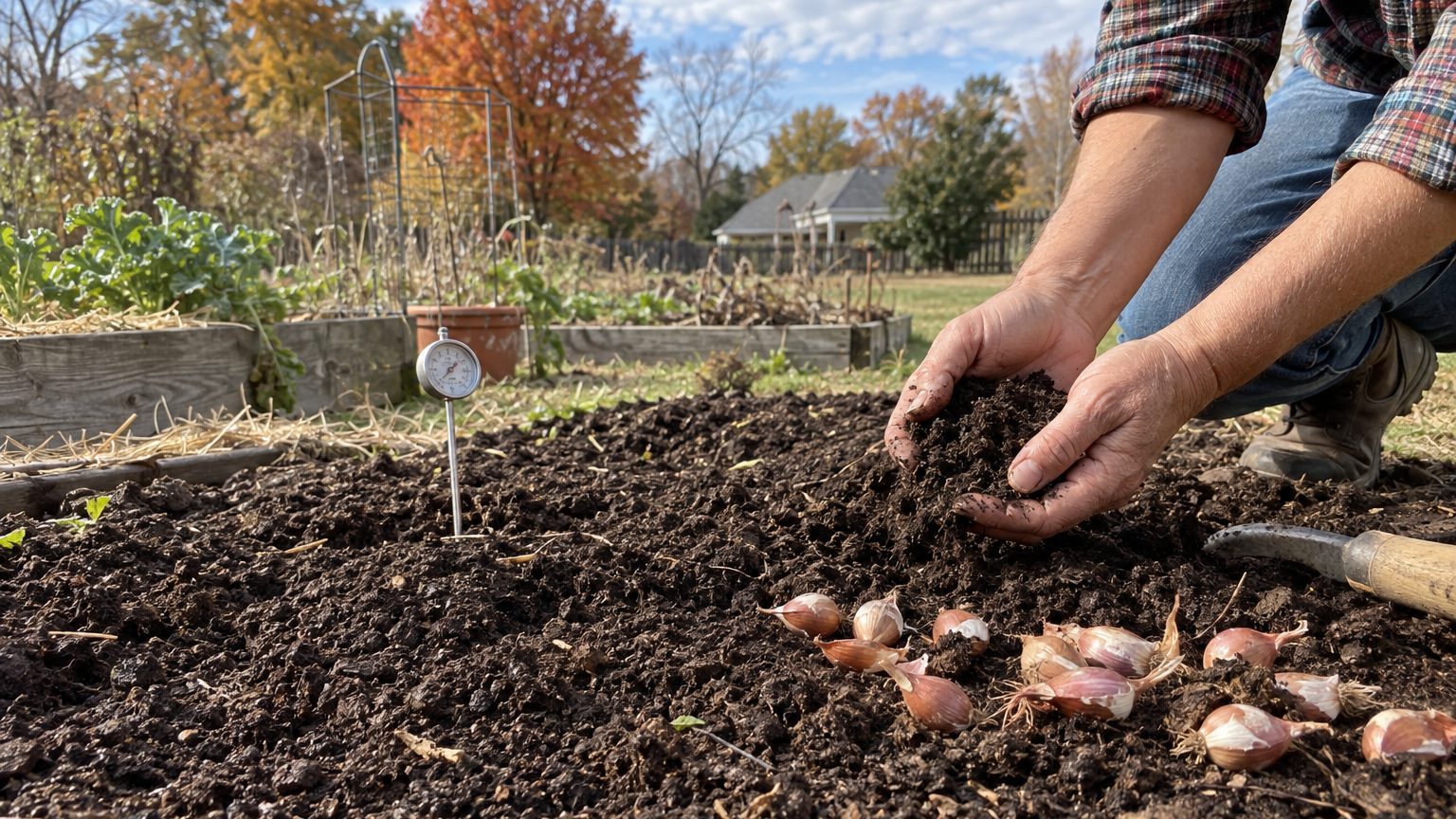

Shallots in North Carolina go in during two windows: late October through November for autumn sets, or late winter to early spring for spring sets, once the soil drains and crumbles. Charlotte’s last 32°F freeze falls between March 23 and April 5, but the soil sets the real planting date. Where you live matters too, since the coast, Piedmont and mountains run weeks apart.
When the soil is warm enough in North Carolina
When is the last spring frost in North Carolina?
For Charlotte, the NOAA U.S. Climate Normals for 1991-2020 put the last spring 32°F freeze between March 23 and April 5 (the 30 to 70 percent probability band). Any single year can fall outside that window. Charlotte sits in the Piedmont, so the Blue Ridge mountains to the west run several weeks later and the coastal plain earlier.
A frost date tells you when tender new growth is safe from a hard freeze. It says little about the ground. Soil lags the air in both directions: it is still cold and often waterlogged in early March, and it warms only after the freeze risk has passed. Shallot sets will push roots into cool soil, and a light frost on green tops does them little harm. They still sulk in ground that is saturated or clotted.
How do you know the soil is ready for shallot sets?
Use your hands before a calendar. Grab a handful from a few inches down. If it holds a squeezed shape and then breaks apart when you poke it, it is ready. If it smears or drips, wait. Working wet clay compacts it, and shallots grown in compacted ground make small, misshapen bulbs. A cheap soil thermometer helps, and your county NC State Extension office can tell you the planting thresholds that suit your area.
Set the bulbs pointy end up, with the tip just at or below the surface. Birds and frost heaving both pull shallow sets out of the ground, so check them after the first few cold snaps and press back any that have lifted.
Do autumn and spring planting follow the same rules?
Mostly they do. Autumn planting works on the same logic as garlic: roots form in cool soil, tops stay small, and growth takes off in spring. The planting depth, site preparation and mulching advice carries over almost unchanged. Shallots differ in two ways. They are smaller and shallower, so they heave more easily. And they are grown for a bulb cluster rather than a single head, so spacing matters more than depth.
Autumn sets go in from around the first fall freeze, which Charlotte’s normals place between October 30 and November 8, into November. Mountain growers plant earlier, because winter arrives sooner. Coastal growers can plant later. The goal is roots without much top growth before the ground cools down.
For a broader look at the crop itself, Growing Shallots: One Bulb In, a Handful Out covers how a single set multiplies into a cluster.
How long the season lasts here
How many frost-free days do shallots get?
Between the March 23 to April 5 spring window and the October 30 to November 8 fall window, the Charlotte reference station has roughly seven months without a 32°F freeze. That is a generous stretch for a crop that finishes in early summer.
What does a long window allow?
A long window leaves room for more than one planting. In the Piedmont and on the coastal plain you can plant sets in autumn and add a second batch in late winter. If the autumn bulbs rot or heave, you have a backup. If they do well, the spring planting stretches the harvest into a second round rather than a single glut.
What does a short window change?
At higher elevations in the Blue Ridge, the season is compressed at both ends. Spring planting waits several weeks longer than in Charlotte, and the fall freeze arrives sooner. There the first planting is usually the only one. Transplants are harder to justify, because every week spent healing from root damage is a week taken from a short growing period, and most growers do better with sets. A hard-won rule applies across the state: shallots need their leaves to grow big before the longest days trigger bulbing, so planting late shortens the leaf stage and shrinks the bulb.
Early planting has one risk to manage. A warm spell in March can wake sets quickly, and a late freeze then catches soft tops. Shallot tops tolerate a light frost, but a hard freeze on tall growth can burn the tips. Keep a sheet of row cover handy for the nights the forecast drops well below freezing.
Heat and water in North Carolina
Does autumn or spring planting work better?
The deciding factor is winter. Charlotte’s coldest month has a mean daily minimum of 31.8°F, so nights hover just around freezing and the ground freezes only briefly and shallowly. That is mild for an allium. Sets planted in autumn establish roots all winter and start spring ahead of the weather, which gives the larger, earlier bulbs that autumn planting is grown for. Heaving is rare where the ground thaws daily.
That reasoning stops working as you move west and up. The USDA Plant Hardiness Zone Map 2023 (built on the average annual extreme minimum temperature) runs from zone 5b to zone 8b across the state, so the mountains endure winters that Charlotte never sees. Where the ground freezes hard and stays wet, autumn-planted sets rot or heave out of the soil, and spring planting is the safer call. In the mildest coastal zones, autumn planting is the norm.
| Region | Spring frost timing | Usual better call |
|---|---|---|
| Coastal plain | Earlier than Charlotte | Autumn planting, with attention to drainage |
| Piedmont (Charlotte reference) | March 23 to April 5 | Autumn planting, with spring as a backup |
| Blue Ridge and high mountains | Several weeks later than Charlotte | Spring planting, or early autumn with mulch |
How do summer heat and humidity affect shallots?
Summers across most of the state are hot and humid, and rain often arrives as heavy thunderstorms. Shallots do not like either condition. The bulbs must size up before the heat arrives, which is why autumn plantings do well: they finish earlier, ahead of the worst of the muggy weather. A spring planting races the summer. If the tops fall over and the bulbs are still small, the extra weeks spent in hot, wet soil are the riskiest of the season.
Wet soil in warm weather invites rot. Humid air invites fungal diseases on the leaves, such as downy mildew, and leaves that stay damp for long stretches are the first sign. White rot, a soil fungus that persists for years once it takes hold, is the one that keeps careful growers rotating beds. Shallots share this problem with garlic, so the rotation guidance in the garlic section applies here too: keep alliums out of the same bed for several years, and do not move soil or tools from an affected bed to a clean one.
Plant shallots on raised rows or in well-drained beds, space them so air can move through the foliage, and water in the morning rather than the evening. Heavy clay, common in the Piedmont, benefits from compost worked in ahead of planting. A light mulch holds moisture in a dry spell but should be pulled back as the tops begin to fall.
Which shallots suit North Carolina
What type of shallot should you choose?
Choose by type, and put disease resistance first. A humid climate rewards types with healthy, upright foliage that dries quickly after rain. Look for those that are described as vigorous and tolerant of leaf diseases rather than those prized only for flavor. Next comes earliness. The earlier a type matures, the more of its growth happens before summer heat. In the mountains, where the season is short, an early type is the only sensible choice. In the Piedmont and on the coast, a mix of early and mid-season types spreads both the harvest and the risk.
Planting stock matters as much as type. Sets (small bulbs) give faster, more reliable results than seed-grown shallots for most home gardeners. Always start with clean, firm stock from a reputable source. A bulb with a soft spot or a mold-stained base brings disease into your bed, and that disease will outlast the crop.
Why not name a specific variety?
Because the only recommendation that means anything is one that has been trialled in your own conditions. A variety that performs well on a coastal sandy loam can fail on mountain clay, and cultivar names recycle across catalogs in ways that make blind picks risky. NC State Extension and your county office can point you to the varieties that have been tested and tracked locally.
How should you handle and store the harvest?
Harvest when the tops have yellowed and fallen over. Lift the bulbs gently and let them cure in a shaded, airy place until the necks are dry and the outer skins are papery. Humid weather slows curing, so give the bulbs plenty of airflow and bring them under cover if rain threatens. Curing and storage follow the same principles as garlic.
Inspect every bulb before you store it. Press the neck: if it is soft or damp, the bulb is not sound, and the same goes for any bulb with a moldy base. That bulb should be used right away or thrown out, never stored. Check regularly through storage and remove any that soften, sprout or show mold, before they affect their neighbors. Do not assume that any set number of weeks or months applies to your bulbs. The conditions you cured and stored them in decide how long they last.
Common questions
When should I plant shallots in North Carolina?
For autumn planting, aim for the weeks around the first fall freeze into November, which falls between October 30 and November 8 in Charlotte. For spring planting, go as soon as the soil is workable in late winter. Both dates shift by region, and the mountains run behind the coast.
Can shallots survive winter in the mountains?
They can in many places, but the risk of rot and heaving rises where the ground freezes hard and stays wet. If you try autumn planting in the Blue Ridge, plant early, mulch lightly and keep the bed drained. Spring planting is the more reliable choice at higher elevations.
Do shallots need full sun?
Yes. Full sun and well-drained soil give the best bulbs. Where summers are hot, a little afternoon relief matters less than airflow around the plants, since crowded or damp foliage is what invites disease.
How do I know when shallots are ready to harvest?
The tops yellow and fall over, and the bulbs feel firm with their skins loosening. Lift one to check before you pull the whole row. Cure the bulbs afterward, and discard any with a soft neck or a moldy base.