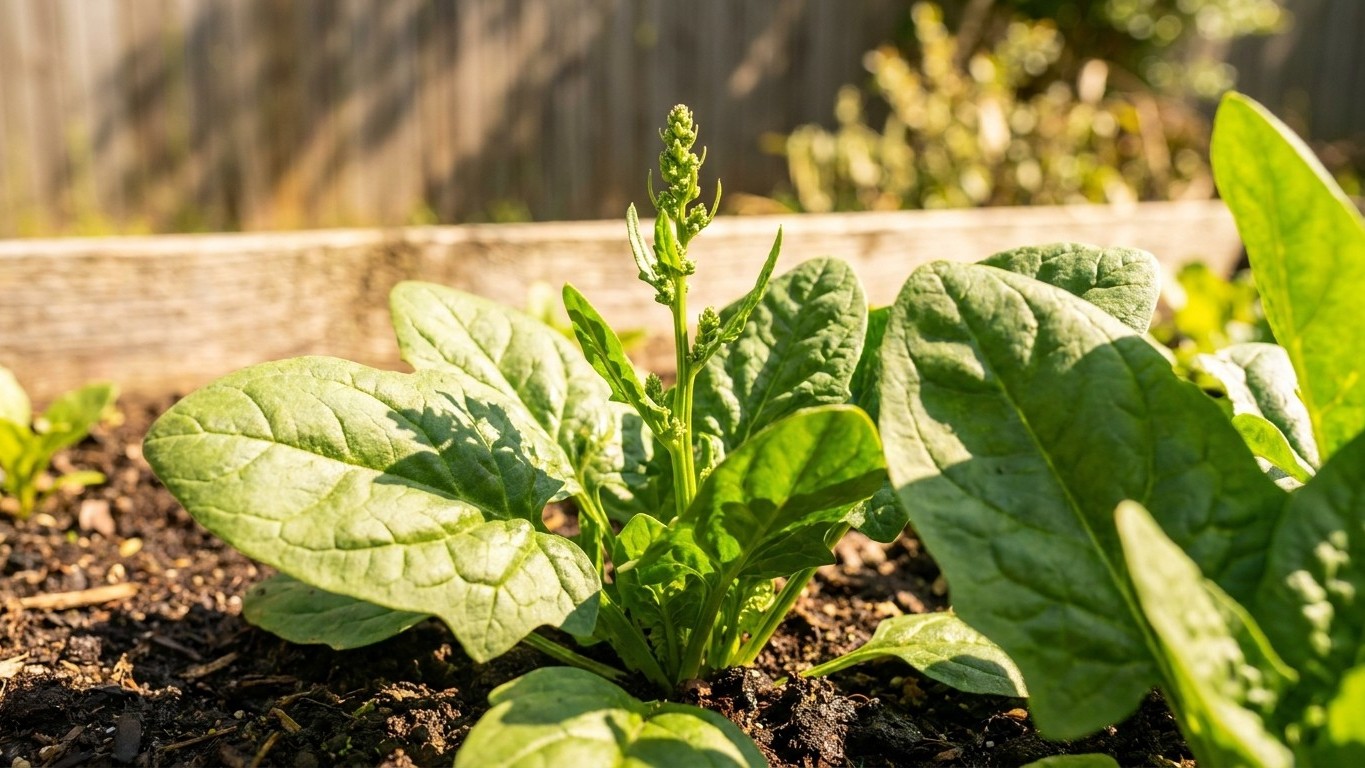

Spinach bolts early almost everywhere in the North Carolina Piedmont, and Charlotte’s climate makes the problem worse than it looks on paper. The trigger isn’t just heat. Long summer days push spinach toward flowering on their own, and this region’s day length climbs high enough, fast enough, that a mild spring doesn’t buy the extra weeks a gardener might expect.
The short answer
On the longest day of the year, Charlotte gets 14 hours and 23 minutes of daylight. That number matters more than most gardeners realize, because spinach reads day length the way a clock reads time: once the days stretch out, the plant shifts its energy from leaves to a seed stalk, whether the thermometer cooperates or not. This is the opposite of what happens with onions in the same soil a few beds over, where long days are the whole point. For spinach, long days are the enemy.
Here’s where it gets harder for a Piedmont grower specifically. Day length alone would be a slow-building pressure, something that catches up with the crop by early summer. But Charlotte also averages 35 days a year at 90 degrees Fahrenheit or hotter, and spinach starts losing quality well below that mark. Growth stops being good once temperatures climb past 75 F, and that ceiling arrives on the calendar long before the 90-degree days do. So the two pressures stack: rising day length pushes the plant toward flowering, and rising heat pushes it there faster and makes the leaves bitter on the way.
That’s the honest answer to whether the limit here is day length or heat. It’s both, and they arrive close enough together that a Piedmont garden gets one workable window in spring and a second, more forgiving one in fall. A cool, cloudy June doesn’t rescue the crop the way it might for a plant that bolts on heat alone. The day length keeps climbing no matter what the sky is doing, and Charlotte’s early arrival at 90-degree heat closes the gap even tighter.
What this means practically: treat spinach here as a spring-and-fall crop only, never a summer one. Cooperative Extension programs list several standard varieties for home gardens, including Bloomsdale, Melody, Teton, and Olympia, but no maturity-date data for any of them is published in the source used for this guide. Choosing among them comes down to what’s locally available rather than a documented speed advantage, since none of the four has a public timeline to compare against Charlotte’s tight windows.
How long the spring window really is
Piedmont gardeners can work out their own spring window using two fixed points: the last frost and the 75-degree growth ceiling. Here’s how that math actually plays out in Charlotte.
- Sowing date: Spinach goes in the ground 2 to 3 weeks before the last spring frost. With Charlotte’s last frost falling between March 23 and April 5, that puts sowing somewhere in the first half of March for most years, sometimes as early as the first week.
- Early growth: Cool March and early April weather favors leaf production. This is the good stretch, the weeks the plant is actually built for.
- Day length starts climbing fast: Through April and into May, daylight lengthens quickly on the way toward that 14-hour-23-minute peak in June. This is also when the pressure toward bolting starts building, regardless of how the temperature behaves.
- Heat arrives ahead of the solstice: Charlotte’s pattern of 35 days a year above 90 F is concentrated in the summer months, but afternoons well into the 80s show up earlier than that, often in May. Once spring highs start brushing against the 75-degree ceiling, growth quality drops and bitterness sets in even before outright bolting.
- Practical closing date: Between the day-length climb and the early heat, the reliable harvest window in the Piedmont typically closes by mid-to-late May. Counting from an early-to-mid-March sowing, that leaves roughly eight to nine usable weeks, sometimes fewer in a warm spring.
That’s a narrower window than gardeners in cooler, higher-latitude states get, not because Charlotte is colder in spring, but because both pressures on spinach (day length and heat) show up early here and stack on top of each other.
The autumn crop, and when the soil lets you sow
Fall spinach in the Piedmont runs into a different kind of obstacle than spring spinach does, and it’s one gardeners often get backwards. The season isn’t blocked by cold. It’s blocked by soil that’s still too warm.
Waiting Out the Warm Soil
Spinach seed germination drops once soil temperatures climb above 80 F, and Charlotte’s summer heat load, that 35-day average above 90 F in the air, keeps soil running hot well into late summer. Soil temperature lags behind air temperature, which means a string of 90-degree afternoons in July and August leaves the ground too warm for reliable spinach germination for weeks after the air itself has started to cool. In practice, Piedmont soil doesn’t typically fall back under that 80-degree mark until early September. Sowing earlier than that, even if the calendar says “fall planting season,” usually means a poor stand and gaps in the row.
Racing the Frost
The other boundary is the first fall frost, which lands in Charlotte between October 30 and November 8. Utah State University Extension’s guidance for fall spinach is to sow 50 to 75 days before the date you want to harvest, not a fixed calendar date, since it depends on when a gardener actually wants to start cutting leaves. Counting back 50 to 75 days from that late-October-to-early-November frost window points to a sowing range of roughly mid-August through mid-September.
The two constraints overlap in a narrow strip. Soil doesn’t reliably cool below 80 F until early September, but sowing that late leaves less than the full 75-day cushion before frost arrives. The realistic sweet spot for Charlotte gardeners sits in the first half of September, sown as soon as soil temperature allows, aiming for a harvest in the back half of October before the frost window opens. It’s tighter than the spring window in terms of margin for error, but it avoids the day-length problem entirely, since day length is falling through September and October instead of climbing.
Variety choice for fall doesn’t change any of this math. Bloomsdale, Melody, Teton, and Olympia are the names that show up in Cooperative Extension guidance, but none come with published days-to-maturity figures here, so timing the sowing date correctly matters more than which packet ends up in the ground.
Common questions
Does shade slow down bolting in a Piedmont garden?
Shade can lower the leaf and soil temperature a spinach plant experiences, which helps with the heat side of the problem. It does nothing about day length, since the plant is still tracking how many hours of light fall in a 24-hour period regardless of intensity.
Is the coastal plain or the mountains different from Charlotte’s timing?
Yes, and meaningfully so. Charlotte sits in the Piedmont; the coastal plain to the east typically sees frost dates arrive earlier in fall and end earlier in spring, while the Blue Ridge Mountains to the west run several weeks later on both ends of the frost calendar. Anyone gardening outside the Piedmont should shift these windows accordingly rather than using Charlotte’s dates directly.
Can spinach survive light frost in the fall crop?
The source used for this guide addresses germination and heat thresholds but doesn’t publish separate light-frost and hard-freeze data for spinach, so no specific cold tolerance figure is given here. The safest approach is planning the harvest to land before the first fall frost window rather than counting on the crop pushing past it.
Why do the same four varieties show up in every fall and spring planting guide?
Bloomsdale, Melody, Teton, and Olympia are the varieties named in Cooperative Extension home garden guidance, but no comparative maturity or bolt-resistance data for them is published in the source behind this guide. Their repeated mention reflects availability and general suitability for home gardens, not a documented performance edge for Piedmont conditions.