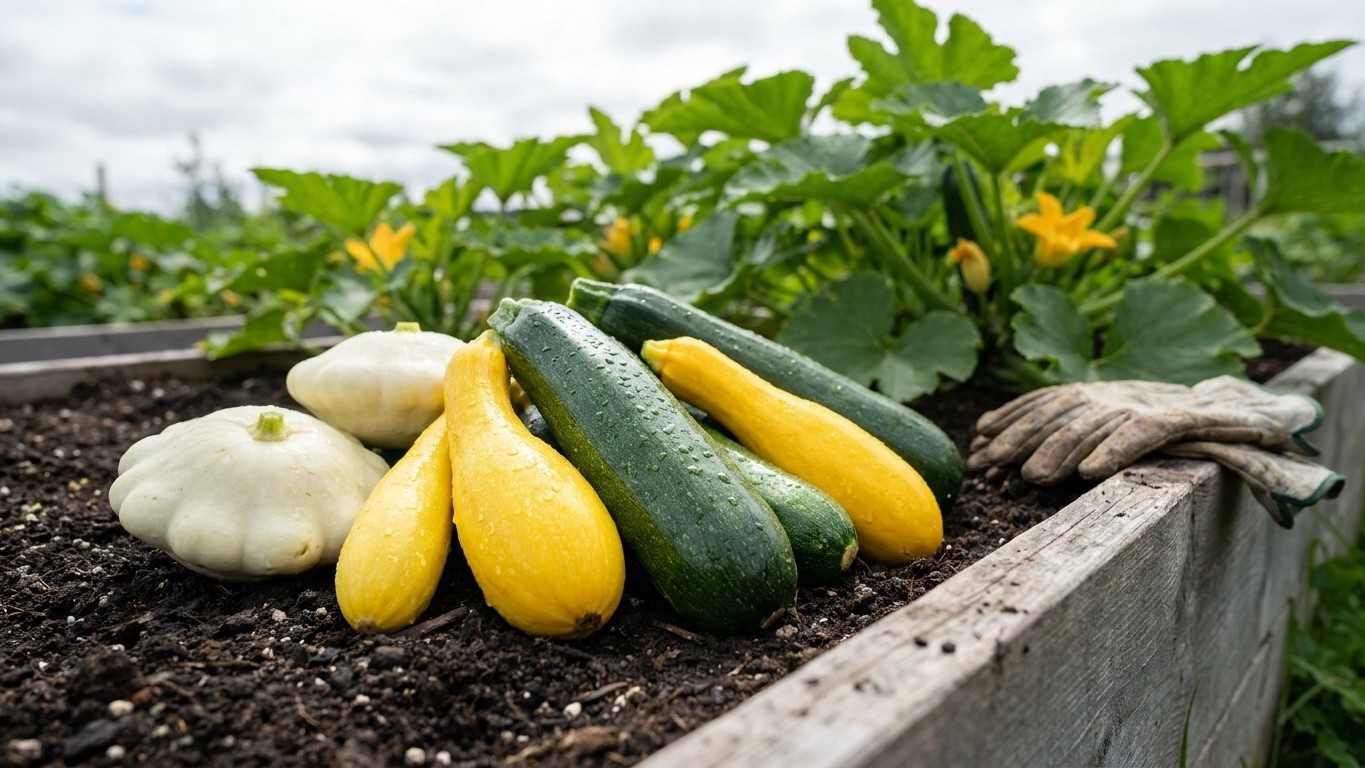

Bush-type summer squash, not vining types, is the safer default for Ohio: yellow crookneck, straightneck and bush zucchini varieties bred for airflow handle the state’s humid summers better than sprawling vines. The reason has less to do with frost dates than with what happens between them.
The short answer for Ohio
Start with the season itself. Last spring frost in the zone 6a reference window runs May 5 to May 15, and first fall frost arrives October 5 to October 15. That gives a frost-free stretch of roughly 143 to 163 days, depending on where in that window your own spring and fall land. Summer squash needs 40 to 65 days from transplant to first harvest for most varieties, which means Ohio’s season length is not the limiting factor. Almost any type, fast or slow, bush or vining, has time to mature and keep producing well past its first picking.
That changes the question. If season length isn’t the constraint, the decision comes down to heat and humidity, and Ohio’s numbers point in a specific direction. Columbus, the reference station for these normals, averages 15.3 days a year at or above 90°F. That’s a moderate heat load, nowhere near the 60 or more such days a Deep South garden might see. Summer squash doesn’t need heat-tolerant, drought-bred varieties here the way a Georgia or Texas garden might. What it needs is resistance to the fungal pressure that builds under Ohio’s summer rainfall pattern: about 12.7 inches across June, July and August, arriving mostly as June and July showers (4.33 and 4.67 inches) before August turns drier at 3.74 inches.
Put those two facts together and the type decision writes itself. Bush habit varieties with open growth, good air circulation, and some listed tolerance to powdery mildew are the better fit than dense, trailing vines that hold moisture against their own leaves. Yellow crookneck, straightneck, and compact bush zucchini all fit this profile and are widely available from seed suppliers serving the Midwest. Pattypan types in a bush form work too, for gardeners who want variety on the plate rather than a different growing strategy.
None of this rules out vining types outright. A gardener with wide spacing, good morning sun exposure to dry the foliage fast, and a willingness to prune for airflow can grow a vining summer squash successfully in Ohio. But for most home gardens, especially smaller raised beds where plants sit closer together, bush types are the lower-maintenance choice given what the humidity numbers already predict.
What will not work here
Tight spacing is the first failure point, and it’s a humidity problem more than a heat problem. With 12.7 inches of rain landing across June and July in particular, foliage stays wet longer after each shower than it would in a drier state, and squash planted shoulder to shoulder traps that moisture against the leaves. Powdery mildew and downy mildew both thrive in exactly that condition. A planting spaced for a drier climate’s rulebook, six inches closer than the seed packet suggests, is a common way home gardens in Ohio lose a squash patch to mildew by late July.
Weekly watering schedules are the second failure point, and this one runs the opposite direction. August, the driest summer month at 3.74 inches, overlaps with the tail end of the state’s 15.3 annual days above 90°F. A plant watered on a fixed weekly schedule through June and July, when rain does most of the work, often gets caught short in August when both rainfall drops and evaporation from heat picks up. The fix isn’t more water everywhere; it’s shifting attention to August specifically, when the summer’s own rainfall pattern stops carrying the load.
Season length is, not where Ohio gardens fail with summer squash. With 143 to 163 frost-free days available, there’s no need to chase the fastest-maturing variety out of fear of running out of season, the way a gardener in a true short-season territory might. Slower vining types, or successive plantings staggered every few weeks for continuous harvest, both fit comfortably inside that window. If a squash crop fails in Ohio, the postmortem points to fungal pressure or an August dry spell far more often than it points to frost arriving early.
Dense mulching pushed right up against the stem base, borrowed from advice written for hotter, drier states, can also backfire here. In a climate with less summer rain, thick mulch conserves scarce moisture. In Ohio’s wetter June and July, the same mulch against the stem can hold dampness and invite stem rot, particularly on varieties already prone to it. A gap of an inch or two around the base, with mulch starting beyond that, works better under this particular rainfall pattern.
What changes across Ohio
Ohio spans USDA hardiness zones 5b to 6b, which is a real spread inside one state’s borders, not a rounding error. That range, built on the USDA Plant Hardiness Zone Map’s single variable of average annual extreme minimum temperature, means the northern part of the state and higher-elevation pockets sit a full zone or more colder than the warmer stretches further south and along the Ohio River. There is no single answer to “when does my last frost hit” for the whole state; the reference window of May 5 to May 15 cited here applies to the zone 6a portion, and a garden sitting in 5b territory should expect that window to run later, while a warmer 6b pocket can expect it earlier.
That spread matters more for summer squash timing than for variety choice. The bush-versus-vining logic in the sections above holds statewide, since it’s driven by summer rainfall and heat load figures measured at the Columbus reference station and broadly representative of the state’s humid continental climate. But the calendar shifts. A gardener in a colder pocket transplanting on the same date as someone in a warmer one risks setting squash out into soil that hasn’t warmed enough, which stalls growth regardless of variety.
The practical shift for a reader in a cooler part of the state, or at higher elevation, is to lean toward the later end of any planting window rather than the earlier end, and to expect first fall frost to arrive closer to October 5 than October 15. That shortens the harvest tail by a week or two, which barely matters given how much slack the season already has, but it does mean succession plantings started too late in summer may not finish their run before frost. This page describes the state as a whole; it can’t place an individual garden inside that 5b to 6b range.
Where to check this for your own county
The Ohio State University Extension, at extension.osu.edu, is where a state-level answer like this one turns into a county-level one. Every county in Ohio has its own extension office, and county-level guidance accounts for local microclimate factors this page can’t: proximity to Lake Erie, valley versus ridge siting, urban heat effects near a city center, or a particularly sandy or clay-heavy local soil type that changes how far that summer rainfall actually reaches plant roots.
Two things are worth looking for specifically once there. First, the local planting calendar for the county, which will narrow the May 5 to May 15 frost window cited here down to a date range specific to that location, rather than the zone 6a range used as this article’s reference point. Second, any variety trial results OSU Extension or a county master gardener program has published for summer squash performance in that specific county, since disease pressure and mildew resistance can vary locally even within the same general climate.
A county recommendation beats a state one every time, for the simple reason that it’s built on data closer to an actual garden. This page works from statewide and single-station normals, useful for understanding the mechanics behind a decision, like why bush habit matters more than heat tolerance in Ohio, but not built to replace the local specificity a county extension office can offer. Treat this article as the reasoning, and the county office as the confirmation before seed goes in the ground.
Checking this against your own garden
No calendar substitutes for what the plant itself is doing, and three signs matter more than any date on this page. First, soil warmth by feel: press a bare hand a few inches into the planting bed in mid-morning. If it still feels cool rather than mild, squash seed or transplants will sit and sulk regardless of what the frost-date window says, since squash roots stall in cold soil even after air temperatures have warmed.
Second, watch for the first flush of male flowers, the ones on long thin stems without a small squash forming behind them. They typically appear before the female flowers that actually set fruit, and their timing is a rough signal of how the plant is reading its own local conditions, heat and day length included, rather than the average conditions this article describes.
Third, track how fast true leaves develop after the first seed leaves. A slow stretch between seed leaves and the first true leaves, especially paired with pale color, often points to soil that’s colder or wetter than ideal for that particular spot, a microclimate detail no state-level frost date can capture. Taken together, these three observations tell a gardener more about their own patch of ground in a single week than any regional average can, and they’re the signals worth trusting when they disagree with the calendar.