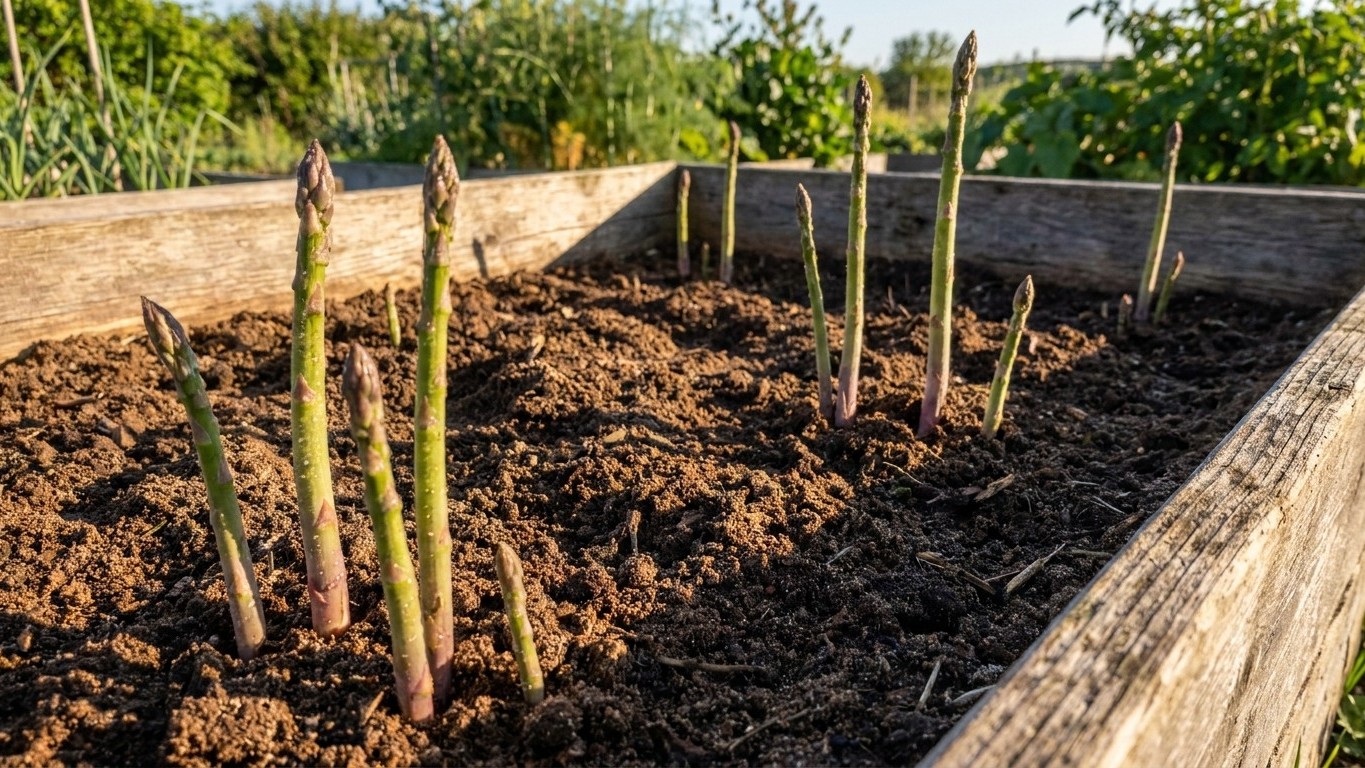

Stop cutting when most of the spears coming up are thinner than a pencil. That is a test you run in the bed, not a date on the calendar. In Oklahoma the rule sits on top of a longer schedule: no cutting at all until the third year, then four weeks, then six, then eight. Once spears are in the kitchen, they keep best at 32 to 35°F with their cut ends standing in water.
The short answer
Oklahoma’s state soil is the Port series, a Mollisol, the deep, dark prairie ground that built the Corn Belt. Its surface runs 12 percent sand, 19 percent clay and 69 percent silt, with about 2.0 percent organic matter, and USDA lists it as well drained. That matters more for asparagus than for any other vegetable here, because a bed lasts 10 to 15 years and the only soil requirement Utah State University Extension gives is that the ground drain. Most soils will do if they do. A Port-type loam clears that one bar. A bad tomato spot costs you a season. A bad asparagus spot costs you fifteen years.
The state soil is a starting point, not a diagnosis. USDA’s figures are representative surface values for the series as mapped, not a measurement of your worked bed. River bottoms, hill country and any lot a builder scraped or filled can behave nothing like it. Dig a hole where the bed will go, fill it with water, and see how long it stands. If it lingers, either pick another spot or build the bed up above the old grade. Then get a soil test for your own numbers. Our piece on Will Oklahoma Soil Hold an Asparagus Bed for Fifteen Years? goes deeper on that decision.
Where the cutting stops
Crowns go into an 8-inch furrow, and nothing is harvested until year 3. That is not softened by a few “test” spears in year 2. The first cutting season lasts 4 weeks, the next 6, and from there 8. Within any season, the bed tells you when to quit. Spears from a crown that has given what it can come up thin, and once most of them are thinner than a pencil, you put the knife away.
This page will not turn that into a week number, because it isn’t one. A warm spring and a cool one move the whole season, and so does a bed’s age. Whatever you leave uncut grows into ferns, which is how the crown recharges for next year. If something starts chewing on those ferns, What Eats Asparagus in Oklahoma, and When covers who shows up and when.
Keeping the spears
Asparagus gives you a narrow window after the cut, and both edges bite. UC Davis Postharvest puts the optimum at 32 to 35.6°F with 95 to 100 percent relative humidity. Above 50°F, spears toughen rapidly, within hours on a warm counter. At 30.9°F or lower, freezing injury sets in: a water-soaked look, then extreme softening. Aim for 32 to 35°F and near-saturated air.
In a home kitchen, the practical translation of 95 percent humidity is water. Stand the butts upright in a jar with an inch or so of water, or wrap the cut ends in a damp towel, and put the whole thing in the refrigerator. The cut end loses moisture faster than any other part of the spear, and the source warns that drying out is the main hazard.
Will the summer here water it for you?
Mostly, on paper. The guidance for a new bed is 1 to 2 inches every other week for the first two years, then every three weeks after that. NOAA’s 1991-2020 normals for the reference station show about 11.7 inches of rain across June, July and August (36.4 inches over the whole year). June brings 4.49 inches, July 3.59 and August 3.6. July is the driest of the three, and even it works out to a little over 1.5 inches per two weeks if the rain fell evenly. It never does, so here is how to work out what you actually owe the bed:
- Put a rain gauge in the bed. A straight-sided can works if you check it with a ruler. The normals describe a reference station, and a slope, a city or a pocket of shade changes what your plot receives.
- Add up what fell over the past two weeks. If it reached 1 inch or more and soaked in rather than ran off, skip the hose.
- If the gauge shows less, make up the difference to land between 1 and 2 inches. One slow, deep soaking beats several light sprinklings.
- Discount any single storm. A summer thunderstorm that dumps 2 inches in an hour mostly runs off, and hot days at or above 90°F pull water back out of the soil fast. Count it at half value if your ground is sloped or crusted.
- After the second year, stretch the interval to every three weeks and keep using the gauge to decide.
So how much must you add? In a normal Oklahoma summer, not a lot, and the average hides a lot of swings. The Port series’ mix of silt and a modest share of clay holds moisture rather than shedding it the way sand would, which is in your favor if your yard resembles it. If your soil is sandier, the same rain leaves faster and you’ll be out with the hose more often. Treat the 11.7 inches as what the region can usually expect, not a forecast. The gauge settles it.
When to put the crowns in
Crowns go in during early spring. For the reference city, the last spring frost falls around March 28 to April 10, based on NOAA’s 1991-2020 freeze probabilities at 32°F (the 30 to 70 percent band). That is an average, not a promise, and it describes an airport weather station. Suburban and rural gardens typically see the last frost one to two weeks later, more at elevation, so a country plot may be looking at mid to late April. Check your own county’s date before you dig.
Dig the furrow 8 inches deep, set the crowns in, and cover them lightly. Then fill the trench gradually across the year, about 2 inches every other month, rather than all at once. The goal is for the plant to climb up through the fill as it grows. Dumping the full 8 inches on top at planting is the usual way to bury a young crown.
Seed is the alternative to crowns. Utah State’s guidance carries no sowing dates for it, so follow your seed packet and expect to wait longer for a bed than crowns would give you. If you buy crowns, you will meet four varieties named in the source, and the source tells us only their sex:
- Jersey Giant: all-male
- Jersey Knight: all-male
- UC 157 F1: male and female
- Purple Passion: male and female
Nothing is published there about flavor, yield or any reason to prefer one over another, so don’t let a catalog’s adjectives do your choosing for you. For the full picture of beds, spacing and care, start with Growing Asparagus in Oklahoma.
Common questions
Can I cut a few spears in the second year?
No. Nothing is harvested until year 3. After that, the schedule is 4 weeks, then 6, then 8, and the pencil rule ends any season early if the spears say so.
My refrigerator may run warm. Does it matter?
It does. The target is 32 to 35°F, and spears toughen fast above 50°F. Put a thermometer in the produce drawer and keep the butts in water or wrapped in a damp towel so the spears don’t dry out.
Is the pencil rule the same as a calendar date?
No. Count by the spears: when most of them are thinner than a pencil, stop. No week number is published for this, and a date would only be a guess from a different year’s weather.
Does the state soil mean my bed will drain?
Not necessarily. The Port series is well drained, but it represents the state, not your yard. A fill-and-watch test in the hole and a soil test will tell you more than any state map, and a scraped or filled lot is the most likely place to find an exception.