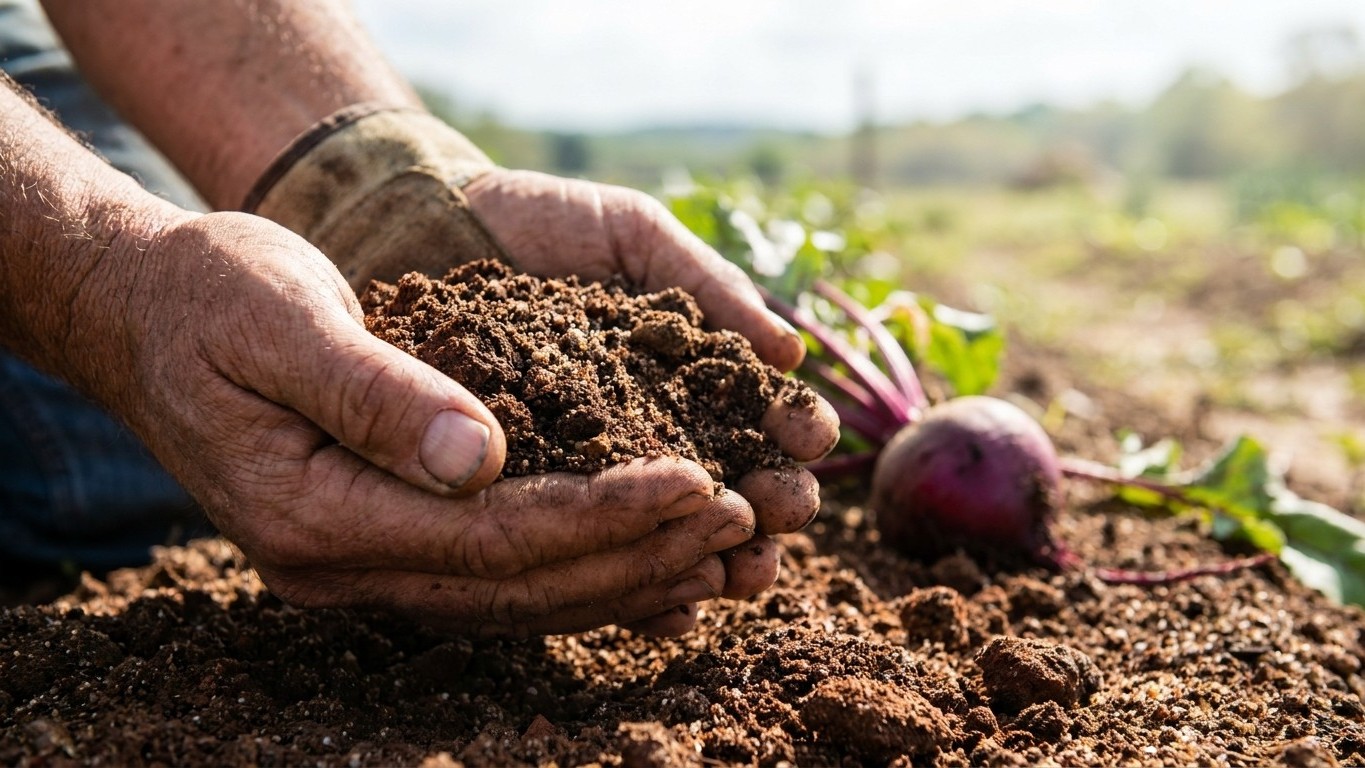

Oklahoma’s state soil, the Port series, is well drained, near neutral, and silty rather than sandy, which covers half of what a beet root asks for. The other half is climate: sowing lands the six-week root-forming window inside a spring that swings between dry spells and downpours, and the state’s heat arrives early enough to turn a stressed root woody before summer even settles in.
The short answer
Start with what’s actually mapped. The Port series, named Oklahoma’s official state soil by state law, is a Mollisol, the deep, dark, organic-rich kind of prairie ground that also underlies the Corn Belt. USDA’s Soil Survey Geographic Database puts its surface horizon at 12 percent sand, 19 percent clay, and 69 percent silt, a texture better described as silt loam than the sandy loam beets prefer. Surface pH runs about 7.0, right in the neutral range beets tolerate well, and drainage is classed as well drained, which matters more for a root crop than almost anything else in the soil report. Organic matter sits around 2.0 percent, a workable but unremarkable figure that most vegetable beds benefit from raising.
Set against Utah State University Extension’s guidance that beets want deep, sandy, well-drained soil rich in organic matter, the Port series is a partial match. The drainage and the pH check out. The texture doesn’t: 69 percent silt behaves nothing like sand once it gets wet, holding moisture longer and compacting more readily under foot traffic or a heavy rain. That’s not a disqualifier for beets, but it means a grower working ground like this should lean harder on loosening the topsoil before sowing and adding organic matter, up to the 1 inch per 100 square feet Utah State recommends, rather than assuming the state soil’s good drainage rating does all the work.
Heat is the piece the soil map can’t tell you. Utah State’s research is specific on this point: heat above 85 F combined with water stress is what makes a beet root turn woody and fibrous, a separate failure from the early bolting caused by dry conditions in the first six weeks. Oklahoma’s summers arrive fast and stay hot, and while the exact count of days the reference weather station spends above 90 F in a typical year isn’t part of the sourced data on this page, the general pattern of early, sustained heat is well known to anyone who has gardened through an Oklahoma July. The practical takeaway is to get beets sown and rooting well before that heat sets in, not to fight it later.
None of this describes any single backyard. Oklahoma spans hundreds of mapped soil series, and river-bottom ground, hill country, and anything a builder has cut, filled, or graded will differ from the Port series in ways a soil test, not a state fact sheet, will catch. Treat this as the starting assumption, then test your own bed.
The six weeks that decide it here
Beets are direct-sown, never transplanted, and the 60 to 80 days to harvest that Utah State cites run from the day seed goes into the ground. Sowing 2 to 3 weeks before the last spring frost, which NOAA’s 1991-2020 Climate Normals put between March 28 and April 10 at the Oklahoma City reference station, means the first six weeks of root development play out roughly from mid-March into early May. That’s a specific, knowable slice of the Oklahoma calendar, and it has a reputation.
Oklahoma spring doesn’t hold steady. The state sits in the transition zone between the arid Southwest and the humid Southeast, and that geography shows up as swings rather than a settled pattern: a dry stretch that hardens the topsoil crust, followed by a band of heavy rain and severe weather that can leave a bed waterlogged for days, then a return to wind and dryness that pulls moisture back out fast. Any one of those swings, taken alone, wouldn’t be a problem. Taken in sequence over six weeks, they’re exactly the kind of water stress Utah State identifies as the trigger for premature flowering, or bolting, in beets. A bolted beet stops building a usable root and puts its energy into a seed stalk instead, and there’s no fixing it once it starts.
The frost dates themselves carry a caveat worth repeating. The March 28 to April 10 window comes from an airport weather station, and gardens outside that immediate area, especially suburban lots on the edge of town or rural ground with more open exposure, typically see their own last frost run one to two weeks later, sometimes more at higher elevation. Sowing by the airport’s calendar and ignoring a colder microclimate is a common way to lose an early planting to a frost the regional average never predicted.
The fix isn’t complicated, but it does require watching the ground rather than the calendar. Keeping the seed row evenly moist through that six-week window, checking soil moisture by hand rather than by memory of the last rain, and mulching lightly to buffer both the dry spells and the crusting after a downpour all address the same underlying risk: a beet that experiences a real dry stretch in its first six weeks is a beet that’s already decided to bolt, regardless of what happens afterward.
What goes wrong here
- Bolting from an early dry spell: A week or two of dry wind during the first six weeks after sowing is enough to trigger premature flowering, especially on the Port series’ silty surface, which sheds surface moisture faster than its clay content suggests once a crust forms. Water evenly and check the top 2 inches of soil by hand rather than relying on rainfall totals.
- Woody roots from summer heat plus stress: Once temperatures push past 85 F, any water stress at all turns the root fibrous and unpleasant, a separate problem from bolting and one that shows up later in the season. Get beets sown early enough that most root development happens before the hottest stretch, and don’t let the bed dry out once heat sets in.
- Compaction after heavy rain: Silt-heavy ground like the Port series compacts under a hard rain in a way sandier soil doesn’t, crusting the surface and making it harder for germinating seedlings to push through. Loosen the top few inches before sowing and avoid working the bed while it’s still wet.
- Low organic matter limiting root size: At roughly 2.0 percent organic matter, the mapped surface horizon is workable but not rich. Adding up to 1 inch of composted organic matter per 100 square feet, per Utah State’s guidance, gives the root more to grow into without overdoing it.
- Sowing by the wrong frost date: Using the airport’s March 28 to April 10 window for a garden with a noticeably colder microclimate risks an early planting getting hit by a late frost the regional average didn’t flag. Check local conditions rather than the reference station alone.
Common questions
Does Oklahoma’s state soil mean my garden has the same texture?
No. The Port series describes the surface horizon of major components mapped across the state, not any individual yard. Builders’ cuts and fills, river-bottom ground, and hill soils can all differ completely. A soil test is the only way to know your own numbers.
Can I fix silty soil to make it more like the sandy loam beets prefer?
You can improve it without changing its basic texture. Working in compost loosens silt and clay, improves drainage, and raises organic matter, moving conditions closer to what beets want even if the underlying soil stays silt-dominant.
What’s the actual difference between bolting and a woody root?
Bolting happens early, triggered by water stress in the first six weeks after sowing, and stops root formation by sending the plant into flower. Woodiness happens later, when heat above 85 F combines with water stress on a root that’s already forming. They’re separate failures with separate timing, not the same problem described two ways.
Are there beet varieties better suited to Oklahoma conditions?
Gardeners commonly grow varieties including Detroit Dark Red, Early Wonder, Golden, Ruby Queen, and Cylindra, but no published data compares how these perform against Oklahoma’s specific soil and heat pattern. Local trial-and-error, or a conversation with a county extension office, will tell you more than a variety name alone.