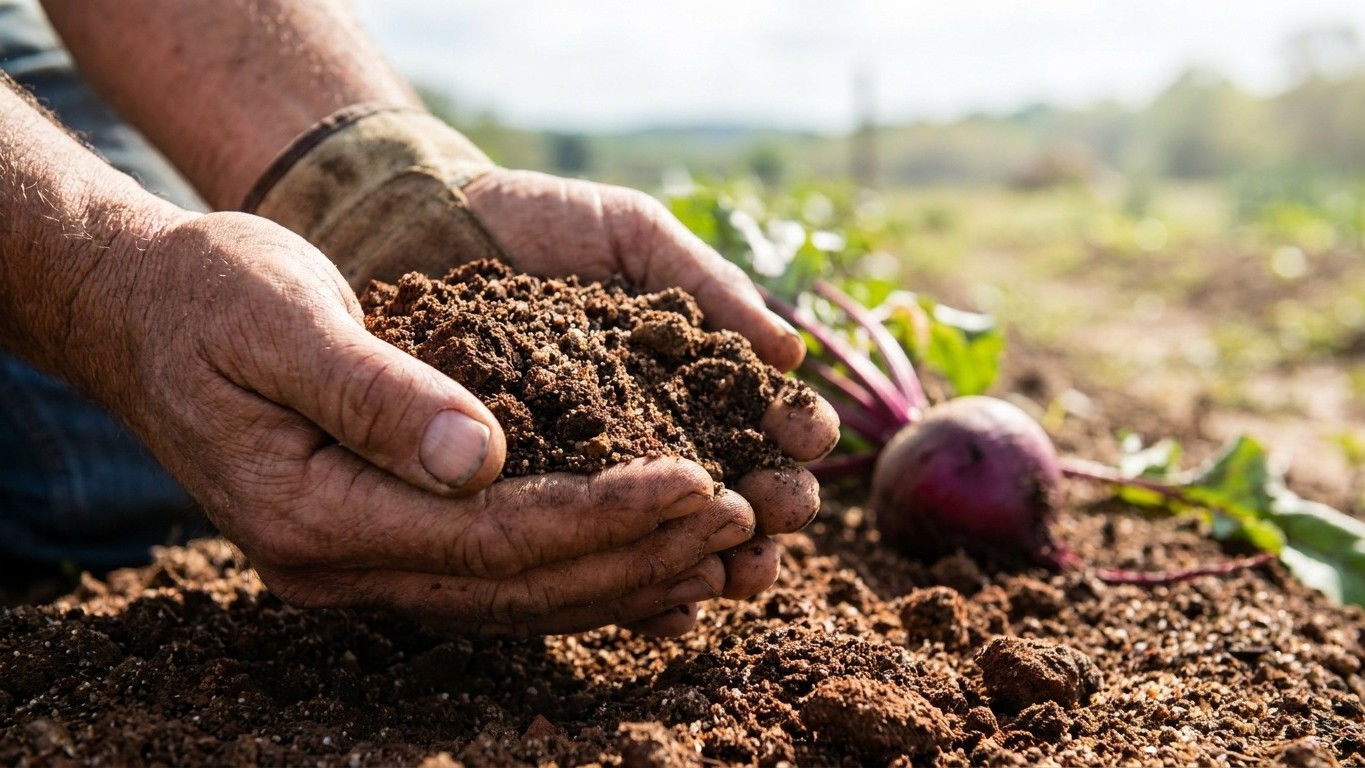

Sow a beet seed into Ontario’s typical farmland soil and it meets a loam, not sand or clay. That loam drains well, runs slightly acid, and carries a healthy dose of organic matter. The first six weeks after sowing, timed 2 to 3 weeks before the province’s mean last frost, is when this soil and this climate decide whether that seed becomes a smooth, sweet root or a woody, forked disappointment.
The short answer
The dominant soil across Ontario’s mapped agricultural surface is a Luvisol, a forest-derived profile where clay has washed down out of the topsoil and settled into a denser layer below. Measured across 846 mapped soil components, the surface texture comes out to roughly 43 percent sand, 17 percent clay and 41 percent silt, a loam to silt loam blend, with a median surface pH near 6.5 and organic matter around 4.3 percent. Drainage is classed as well drained. That’s a decent starting point for a beet: the surface layer is loose enough for a taproot to push down without much resistance, the pH sits close to what beets tolerate well, and the organic matter level is healthy without being excessive.
But that denser clay layer sitting below the surface is worth watching. It’s the reason the soil is classified well drained rather than rapidly drained, meaning water moves through but not instantly, and a heavy spring rain can leave the surface layer wetter for longer than a sandier soil would. For beets, which want deep, sandy, well-drained ground rich in organic matter according to Utah State University Extension, that’s a soil that mostly cooperates but doesn’t hand a gardener a free pass.
On the heat side, the number of days a year the region climbs past 90 F isn’t published on this page, so no figure gets guessed here. What matters more than any single day count is the mechanism: Utah State University Extension is specific that heat above 85 F combined with water stress is what turns a beet root woody, not heat alone. Southern Ontario summers do produce stretches above that threshold, and a well-drained loam that has already shed its spring moisture gives a beet less buffer against them.
None of this describes any one garden exactly. Ontario spans hundreds of individual soil series, and the figures above are a median drawn from the province’s mapped agricultural regions, not the far north, not river bottoms, not any lot a builder has scraped and refilled. A home soil test remains the only way to know what a specific backyard is actually working with.
The six weeks that decide it here
Environment and Climate Change Canada’s normals put the mean last spring frost at the Toronto Lester B. Pearson station at April 30. Sowing beets 2 to 3 weeks ahead of that date, the standard recommendation, lands the seed in the ground in the first half of April across much of the same agricultural belt the soil figures above describe. That mean date is exactly that, a mean: in roughly half the years on record, frost has arrived later than April 30, so a gardener sowing on schedule is planting into a window that can still turn cold well after the seed goes in.
Southern Ontario’s spring, shaped heavily by the Great Lakes sitting on nearly every side of it, tends to swing rather than settle. Cool, damp stretches can give way within days to a sudden warm, dry run, then swing back. That variability matters more than any single average temperature, because it’s the swings, not the mean, that put young beet seedlings under stress.
This is where the loam texture described above becomes relevant to timing rather than just structure. A well-drained soil with 43 percent sand doesn’t hold a large reserve of moisture near the surface. During a dry stretch inside those first six weeks, that top layer can dry out faster than a heavier clay soil would, right when a beet seedling’s root system is shallow and has no depth to draw on. Utah State University Extension’s warning about water stress in the first six weeks causing premature flowering, bolting, is written for exactly this kind of soil-climate pairing: a soil that sheds water efficiently paired with a spring that alternates between wet and dry rather than staying evenly damp.
The bolting risk here, then, sits less in any single week and more in the gaps between Ontario’s spring swings, the days after a dry spell has had time to pull moisture out of that top sandy loam layer before the next rain arrives. A gardener who sows on the standard schedule and then treats the following six weeks as a fixed, low-risk window is missing where the actual threat sits.
What goes wrong here
- Bolting from a dry spring stretch. The region’s well-drained, sandy-leaning loam loses surface moisture quickly once a dry run sets in during the first six weeks after sowing, and Utah State University Extension is clear that water stress in that window triggers premature flowering. The remedy is steady, consistent watering through those six weeks rather than watering only when the surface looks dry, plus a light mulch layer to slow evaporation from that same sandy surface.
- Woody roots from a summer heat spell. This is a separate failure from bolting, tied to later heat rather than early dryness. Once temperatures climb past 85 F, Utah State University Extension notes that water stress at that point is what makes the root turn woody, not the heat by itself. The fix is watching soil moisture specifically during hot stretches later in the season and watering deeply enough to reach the root zone.
- Perched water after a heavy rain. The denser clay layer that gives this soil its Luvisol classification sits below the surface, and after a big rain it can slow drainage enough to leave roots sitting in saturated soil longer than they should. Raised beds or raised rows reduce this risk on ground where that layer sits close to the surface.
- Forked or misshapen roots from over-amending. Utah State University Extension caps compost amendment at no more than 1 inch of composted organic matter per 100 square feet. Given that the region’s soil already averages around 4.3 percent organic matter, piling on more compost than that recommendation is a common way to push a beet root into forking around pockets of loose material instead of growing straight down.
- A pH that’s off from the regional median. The 6.5 figure is a median across hundreds of mapped soil components, not a guarantee for any one yard. A soil that runs noticeably more acidic than that median can slow beet growth even where the texture and drainage look ideal on paper, which is why a home soil test matters more than the regional number.
Common questions
What kind of soil does Ontario have for growing beets?
Across the province’s mapped agricultural surface, the most common soil is a Luvisol, a loam to silt loam texture running about 43 percent sand, 17 percent clay and 41 percent silt, well drained, with a median pH near 6.5 and organic matter around 4.3 percent. That’s a reasonable match for beets, which want deep, sandy, well-drained ground, though it’s a provincial median, not a guarantee for any individual garden.
When should beets be sown in Ontario?
The standard guidance is 2 to 3 weeks before the last spring frost. Environment and Climate Change Canada’s normals put the mean last frost at April 30 for the Toronto area, but that’s a mean date, meaning frost has landed later than April 30 in roughly half the recorded years, so treat it as the midpoint of a window rather than a firm planting deadline.
Why do beets bolt before forming a root?
Bolting comes from water stress in the first six weeks after sowing, according to Utah State University Extension, not from heat later in the season. In this region, that risk concentrates around dry stretches within Ontario’s swinging spring pattern, when the area’s sandy-leaning loam loses surface moisture faster than a heavier soil would.
How much compost should go into the soil before planting beets?
No more than 1 inch of composted organic matter per 100 square feet, per Utah State University Extension. Since the regional soil already averages roughly 4.3 percent organic matter, adding compost beyond that guideline raises the risk of forked or misshapen roots rather than improving growth.