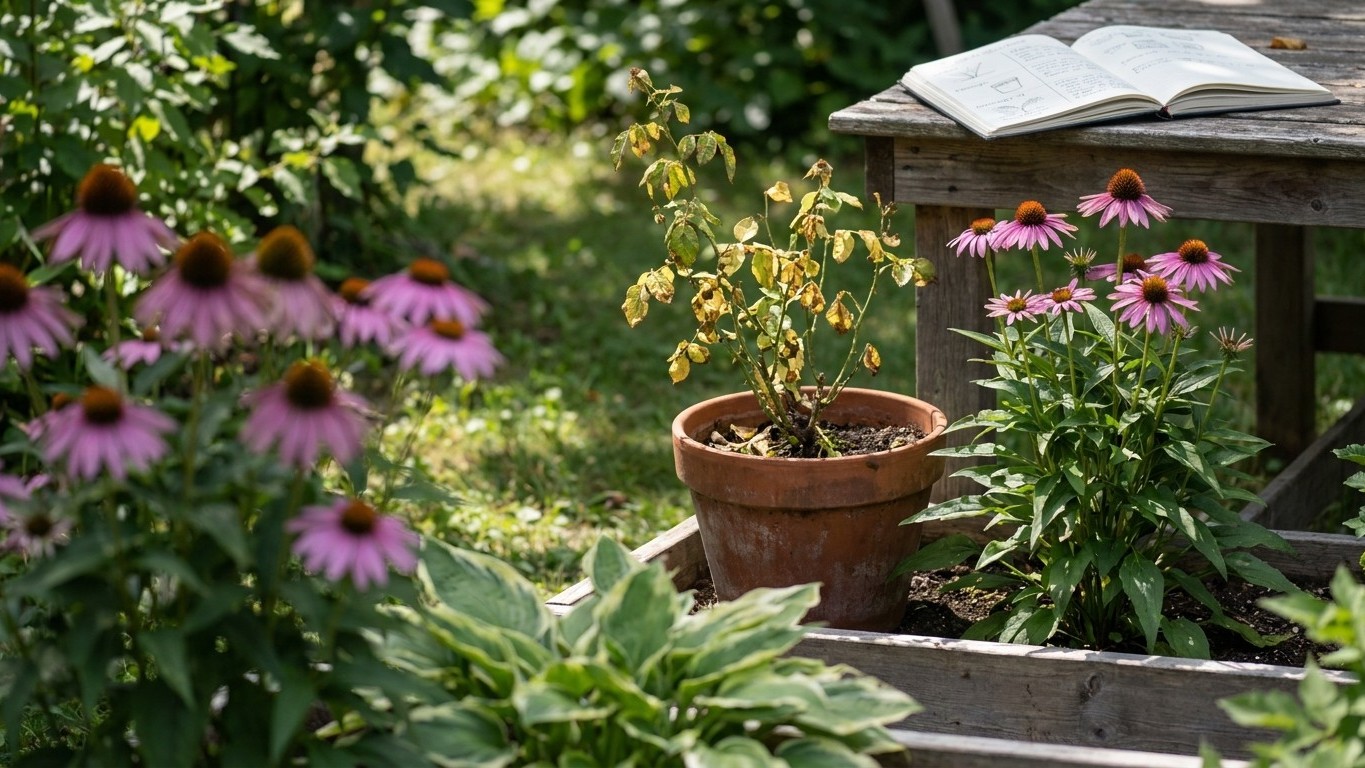

Lavender shows up on nearly every garden centre bench in Ontario each spring, tagged hardy and perennial. Plenty of it is dead by the following June anyway, not from cold but from wet clay that never drains between winter thaws. The flowers that hold up longest here are the ones bred for a short, humid summer stacked on top of a freeze-thaw winter, not the ones that merely survive cold on a label. Start a border with plants proven on that combination, peonies, coneflower and garden phlox among them, and treat lavender as a gamble you only take on a raised, gritty bed.
Putting a border together
A border works in layers because each tier needs a different amount of light and root room, and because the plants at the back have to get through the same winter as the ones at the front. Natural Resources Canada’s plant hardiness normals for 1991-2020 put Toronto in Canadian zone 7a, and Environment and Climate Change Canada’s 1981-2010 climate normals for the same city put the mean minimum of the coldest month at -10.2°C, recorded at Toronto Pearson. That single figure is what actually sorts a garden centre bench into what comes back next spring and what needs to be dug up and stored, whatever the plastic tag claims about hardiness. Note that this is a Toronto reading. Gardens in Ottawa, Sudbury or along the Georgian Bay shoreline run colder and the same border needs adjusting for it.
Layering by height
At the back, peonies (Paeonia hybrids) and tall garden phlox such as Phlox paniculata ‘David’, a mildew-resistant white-flowering cultivar, both shrug off winters well past what Toronto’s coldest month delivers. Mid-border, Echinacea purpurea ‘Magnus’ and Rudbeckia fulgida ‘Goldsturm’ do the same, and both rebloom for weeks rather than putting on one flush and quitting. At the front edge, catmint (Nepeta ‘Walker’s Low’) and creeping sedums fill the gap between the taller stuff and bare soil, and catmint in particular will rebloom through the season if you shear it back hard after the first flush fades.
Succession of bloom across the season
The frost-free stretch here runs, on average, from around April 30 to around October 16, both mean dates from ECCC’s Toronto Pearson normals. That’s a window of roughly five and a half months, but it’s a mean, not a guarantee. In one year out of two the last spring frost lands later than April 30, and the same goes for the fall date, so treat both as the middle of a range rather than a line on the calendar. Inside that window, plan bloom in three waves: peonies and Siberian iris carry May and June, coneflower, bee balm (Monarda ‘Jacob Cline’) and phlox carry July and August, and asters (Symphyotrichum novae-angliae ‘Purple Dome’) along with sedum ‘Autumn Joy’ close out September and October. Toronto Pearson logs an average of just 6.08 days a year above 32°C and 15.8 above 30°C, so scorching extremes are rare. That doesn’t limit heat-loving annuals like zinnias and cosmos, because what decides their success is the length of the frost-free season, not how many days hit an extreme.
Repeating color and leaving room
Pick two or three colors and repeat them at intervals down the border rather than letting each plant do its own thing. A run of purple coneflower echoed by a clump of Nepeta further along reads as a plan, where the same two plants used once each just looks scattered. At planting, leave at least a third of each plant’s mature spread as bare soil. A border that looks complete in May from small nursery pots will be a shoving match by its third summer if you crowd it now, and thinning an overgrown perennial bed later is slower and messier than spacing it right the first time.
Flowers that struggle here
Dahlias and gladiolus are tender tubers and corms, not hardy perennials, whatever the display bins at the garden centre suggest. Toronto’s mean coldest-month minimum of -10.2°C is well past what either one tolerates in the ground, so they need to be lifted after the first fall frost and stored dry over winter if you want them back. Hybrid tea roses often lose most of their canes back to the snowline over a Toronto winter and need mounding or a rose cone for real protection, where shrub roses bred for prairie winters shrug off the same cold with no fuss. Delphiniums fight a second battle on top of cold: Ontario’s humid summers push powdery mildew onto their foliage most years, and staking against wind adds a third chore most border owners eventually drop.
- Blackened, mushy stems at the crown after an otherwise mild winter
- No new basal shoots showing by early June
- Leaves stippled or coated white by midsummer despite regular watering
- Bloom that gets sparser or more one-sided each year instead of fuller
Gardeners in Prince Edward Island deal with an even shorter shoulder season, squeezed further by the surrounding water, and lean on much the same short list of reliable perennials for that reason. Wyoming sits at the opposite end of the country’s growing conditions, and the border perennials that thrive in Wyoming’s dry, high-elevation summers need shelter from scorching afternoon sun rather than protection from Ontario’s wet winter clay.
| Plant | Height | Bloom time | Verdict for an Ontario border |
|---|---|---|---|
| Peony (Paeonia hybrids) | 60-90 cm | Late May-June | Thrives, decades in the same spot |
| Garden phlox ‘David’ | ~90 cm | July-August | Thrives, mildew-resistant cultivar |
| Coneflower ‘Magnus’ | 75-90 cm | July-September | Thrives, long rebloom |
| Bee balm ‘Jacob Cline’ | 90-120 cm | July-August | Thrives, resists mildew better than older Monarda |
| Catmint ‘Walker’s Low’ | ~45 cm | June-September, repeats if sheared | Thrives, good front edge |
| Sedum ‘Autumn Joy’ | 45-60 cm | September-October | Thrives, closes the season |
| Aster ‘Purple Dome’ | 45-60 cm | September-October | Thrives |
| Lavender ‘Munstead’ | 30-45 cm | June-July | Struggles in heavy clay, needs a raised bed |
| Delphinium (elatum hybrids) | 120-180 cm | June-July | Struggles with humidity and mildew |
| Dahlia (tender tuber) | 60-150 cm | July-first frost | Struggles unhardy, must be lifted each fall |
Local help
The figures in this article all come from Toronto Pearson, and a border plan built around them can be off by weeks of frost-free season in Muskoka, Renfrew County or along the north shore. The Master Gardeners of Ontario run volunteer plant clinics and advice lines across the province and are worth finding before you commit a whole border to a plan built on someone else’s frost dates. Ontario’s Ministry of Agriculture, Food and Rural Affairs keeps a broader agriculture and food service with regional contacts, and our Ontario guides cover how the same frost calendar plays out for vegetables and other crops.
Common questions
What planting zone is Toronto actually in?
Natural Resources Canada’s 1991-2020 hardiness normals rate Toronto as Canadian zone 7a. That’s the Canadian seven-variable system, not a USDA zone, and the two don’t convert directly onto each other. Areas north of the city, and much of the rest of Ontario, sit in colder zones on the same map.
Can I leave dahlia tubers in the ground over winter here?
No, not reliably. Dahlias are tender tubers, and Toronto’s mean coldest-month minimum of -10.2°C, from ECCC’s 1981-2010 normals, sits well past what an unprotected dahlia tuber survives. Lift them after the first fall frost, usually landing around October 16 on average at Toronto Pearson, and store them dry over winter.
Why does my lavender keep dying even after it made it through winter fine?
Most of the time it’s the soil, not the cold, that finally gets it. Lavender rots at the crown when clay stays saturated through a freeze-thaw cycle, and that damage often shows up in spring after the plant looked fine all winter. A raised bed with gravel or coarse sand worked into the top 20 to 30 cm solves it far more often than moving the plant to a warmer spot does.
When is it actually safe to plant out annuals?
ECCC’s normals put the average last spring frost at Toronto Pearson at April 30, but that’s a mean date, and in one year out of two frost arrives later than that. Gardeners outside Toronto, especially at higher elevation or further north, should push that back further still. Waiting a week or two past the mean date costs you little and saves a full replanting if a late frost hits.
Related guides
- Flowers That Actually Thrive in Manitoba, and the Ones That Struggle
- Flowers That Actually Thrive in Quebec, and the Ones That Struggle
- Flowers That Actually Thrive in Prince Edward Island, and the Ones That Struggle