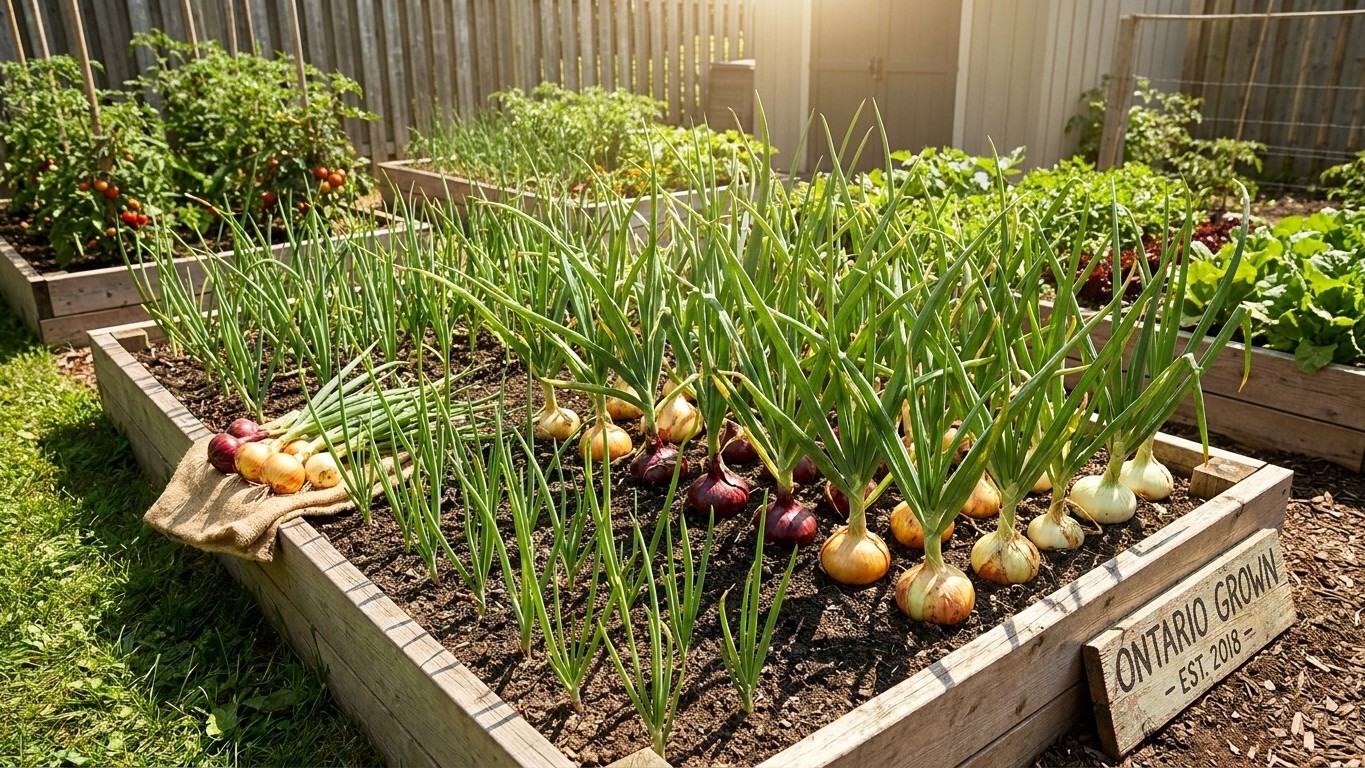

Onions grown in Ontario need to be long-day or intermediate-day varieties, full stop. Toronto sits at 43.86 degrees north, and on the longest day of the year the sun is up for 15 hours and 17 minutes there. That is well past the roughly 12-hour trigger that starts a short-day onion bulbing, and it lands squarely inside the 14-to-16-hour window that long-day types wait for. Twenty-three of the 31 onion varieties documented on this site are bred for exactly this kind of day length.
The short answer for Ontario

Day length, not temperature, is what flips the switch inside an onion plant that tells it to stop growing leaves and start swelling a bulb. In southern Ontario, at the latitude of Toronto Buttonville, the sun delivers 15 hours and 17 minutes of daylight on the summer solstice. That number matters more than any frost date or soil chart, because it decides which group of onions can actually finish the job they were planted to do.
Long-day onions need 14 to 16 hours of daylight before they begin bulbing, and Ontario’s 15-hour-17-minute ceiling covers that range with room to spare. Intermediate-day onions, which trigger somewhere between 12 and 14 hours, also work here, since the province’s daylight sails past that threshold every summer. Fourteen long-day varieties and nine intermediate-day varieties in the documented list carry published latitude ranges that include 43.86N, which puts twenty-three usable varieties on the table for an Ontario garden.
Long-day varieties suited to this latitude
Among the long-day group: Ailsa Craig, Barolo, Blush, Bridger, Frontier, New York Early, Patterson, Powell, Red Carpet, Redwing, Rossa di Milano, Safrane, Talon, and Walla Walla Sweet all list published ranges that stretch across 43.86N. Some, like Redwing (43-65N) and Powell (43-47N), sit right at the southern edge of their own range in Ontario, which is worth flagging rather than glossing over.
Intermediate-day varieties suited to this latitude
The intermediate-day group adds more options: Cabernet, Calibra, Elsye, Expression, Monastrell, Red Long of Florence, Red Long of Tropea, Scout, and Sierra Blanca. Their published ranges max out between 45N and 50N, so an Ontario garden falls comfortably inside the window rather than at the far edge of it.
What will not work here
Short-day onions are built for latitudes where summer daylight barely reaches 12 hours. Plant one in southern Ontario and the plant does not “struggle” in some vague sense, it fails in a predictable, mechanical way. The 12-hour trigger arrives in early spring here, weeks before the plant has had time to build the leaf mass a bulb is made from. The result is a small, undersized bulb at best, or a plant that never bulbs at all and eventually rots in the ground as the season turns cool and wet.
Eight varieties in the documented catalogue carry published ranges that sit entirely below 43.86N, which means none of them belong in an Ontario garden:
- Candy (intermediate-day, 33-40N) — its northern edge stops ten degrees short of Toronto, so it still bulbs too early here
- Gabriella (short-day, 20-35N, no page of its own on this site) — a warm-climate short-day type, far outside Ontario’s range
- Madalyn (short-day, 20-35N, no page of its own on this site) — same short-day ceiling, wrong for a 15-hour summer
- Red Rock (short-day, 30-36N, no page of its own on this site) — bulbs at 12 hours, which arrives here in spring, not summer
- Red Sensation (short-day, 25-35N) — bred for Gulf Coast and Deep South daylight patterns
- Texas Grano 1015Y (short-day, 25-35N) — a classic Southern short-day onion, out of range this far north
- Vidora (short-day, 25-35N) — same story, its trigger fires long before an Ontario plant is grown enough
- White Castle (short-day, 30-38N, no page of its own on this site) — still below 43.86N even at its northern limit
Plant any of these in Ontario and the pattern is the same: leaves all season, a bulb that never sizes up properly, then rot once fall rains and cooler soil set in. This is a variety mismatch, not a feeding, watering, or soil problem, and no amount of fertilizer fixes a plant that got the wrong signal from the sun.
What changes across Ontario
Ontario is not one latitude, and the 43.86N figure belongs specifically to Toronto Buttonville, not to the whole province. The province runs from around 42 degrees north near Point Pelee on Lake Erie, the southernmost point of mainland Canada, up to nearly 57 degrees north along the Hudson Bay coast. That is a spread of roughly 15 degrees, which is enormous by growing-zone standards and shifts both the daylight math and the frost calendar considerably.
| Region | Approximate latitude | What changes |
|---|---|---|
| Southwestern Ontario (Point Pelee area) | ~42N | Slightly shorter summer daylight than Toronto; frost-free season runs longest |
| Toronto / Golden Horseshoe (reference city) | 43.86N | 15h17 on the longest day; long-day and intermediate-day onions both bulb reliably |
| Central Ontario (Muskoka, Thunder Bay area) | ~46-48N | Longer summer daylight, shorter frost-free window; long-day types with wider ranges (Redwing, Ailsa Craig) fit better than narrow-range ones |
| Far northern Ontario (Hudson Bay coast) | ~55-57N | Daylight far exceeds any variety’s requirement, but the growing season is too short and cold for onion bulbs to size up regardless of daylight |
A gardener in Windsor is closer to the southern edge of the long-day and intermediate-day window, while one gardening near Sudbury or Thunder Bay sits well north of the reference city and should lean toward long-day varieties with wide published ranges rather than the ones that barely scrape past 43N, like Powell or Red Carpet. Someone gardening near the Hudson Bay coast is dealing with a different constraint entirely: daylight is not the limiting factor up there, the short frost-free season is.
Checking this against your own garden
The 43.86N figure and the 15-hour-17-minute daylight number both come from Toronto Buttonville, and they describe that location, not necessarily the backyard three counties away. Before ordering seed or sets, it is worth confirming a few things specific to where the onions will actually go in the ground:
- Look up your own latitude if you garden more than an hour or two north or south of Toronto, since a few degrees can shift which variety group fits best
- Check your last spring frost date and first fall frost date through your local Environment and Climate Change Canada climate normals or a nearby weather station
- Contact your regional agricultural extension office or a provincial horticultural society for planting windows specific to your county or district
- Note your site’s microclimate, since a south-facing slope or a low frost pocket a few miles away can shift timing even at the same latitude
- Cross-check any variety’s published range against the 23-variety list above before assuming it will bulb where you garden
A provincial figure is a starting point, not a guarantee. The 12-hour bulbing threshold for short-day onions comes from published Cooperative Extension research (Clemson Cooperative Extension, HGIC), and the same physics applies everywhere daylight is measured, whether the garden sits in downtown Toronto or two counties north of it.