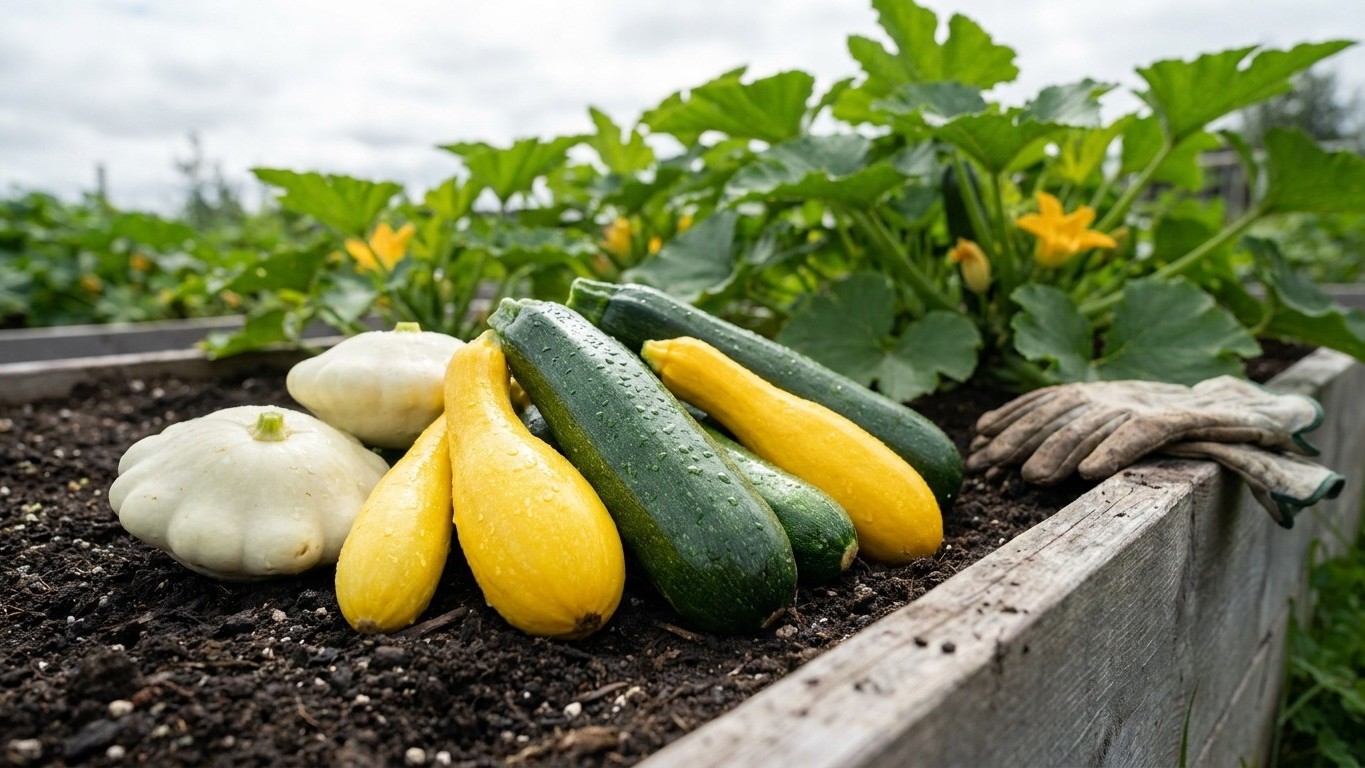

Oregon’s growing conditions favor bush-type summer squash west of the Cascades: zucchini, yellow crookneck, and pattypan varieties bred for 45-to-55-day maturity. The long frost-free window there supports slower vining types too, but the region’s mild summer heat and dry July mean variety choice matters less than water management.
The short answer for Oregon
This answer applies to the reference station used in these facts, which sits west of the Cascades. Central and eastern Oregon’s high desert climate is a different growing world, and this page does not have separate frost or heat data for those areas.
For the western valleys, the last spring frost falls between March 6 and March 21, and the first fall frost arrives between November 11 and November 27. That’s a frost-free stretch that can run nearly eight months in a favorable year. A window that long removes the usual pressure to chase the fastest-maturing squash on the seed rack. Bush zucchini and straightneck varieties, which typically size up in 45 to 55 days, will produce multiple full harvests before frost even becomes a concern. But the season length also opens the door to slower vining types, like tromboncino or costata romanesco, that need 65 to 75 days and more room to sprawl.
Heat is the variable that narrows the field. The reference station averages just 11.9 days a year at or above 90°F. That’s a mild heat load compared to the Southeast or the Southwest, and it matters because some vining Cucurbita moschata types, tromboncino included, were bred in regions with much longer hot stretches. In Oregon’s cooler summers they’ll still produce, but they ripen on a slower clock and reward gardeners who give them the full season rather than expecting a quick turnaround.
The practical decision by type: bush varieties (zucchini, yellow and straightneck squash, scallop/pattypan) are the safer default for anyone who wants steady, predictable harvests without babysitting a heat-hungry vine. Vining and semi-vining types are worth growing if there’s space to let them ramble and patience to wait past mid-summer for the bulk of the crop. Either way, the deciding factor west of the Cascades isn’t whether the season is long enough. It is.
What will not work here
The season length isn’t the trap in western Oregon. The trap is treating this like a hot-summer garden when it isn’t one. Varieties bred and marketed for Southern or desert gardens, ones selected specifically for heat tolerance and rapid fruit set under sustained 90-plus-degree stretches, don’t get the heat units here to perform as advertised. With only 11.9 days a year that even touch 90°F, a squash variety optimized for baking Texas summers will grow, but it won’t hit the vigorous pace its seed packet promises.
Water is the bigger failure point. Summer rainfall totals about 2.7 inches across June, July, and August combined, and July itself averages just 0.51 inches. That’s not enough to sustain a shallow-rooted crop through fruit set, and it catches gardeners who assume Oregon’s reputation for rain extends into summer. It doesn’t. A weekly watering schedule, which might be adequate in a region with regular summer showers, will leave squash stressed and dropping blossoms here. The dry stretch from late June through August needs a deliberate irrigation plan, not a rain-fed one.
There’s also a spacing mistake that travels in from humid-climate advice. Gardeners moving from the Southeast, or reading generic guides written for humid regions, often plant summer squash with tight airflow-focused spacing meant to fight powdery mildew and other fungal pressure. Oregon’s dry summer air doesn’t carry that same disease load, so that cramped spacing just wastes bed space without solving a problem the region doesn’t have as severely.
Finally, timing against the frost window matters more than gardeners expect. Because the last spring frost can land as late as March 21, direct-seeding into cold soil before that date is a common way to lose a planting to seed rot rather than frost damage itself. Squash seed germinates poorly in soil that hasn’t warmed, regardless of air temperature, and an early gamble on the calendar rather than the soil is the single most preventable failure in the region.
What changes across Oregon
Oregon spans USDA Plant Hardiness Zones 4a to 9b, a spread wide enough that there is no single statewide answer to when or what to plant. That range, built on average annual extreme minimum temperatures under the USDA system, stretches from the mild, nearly frost-free pockets near the coast and lower Willamette Valley down to the high, cold basins of central and eastern Oregon.
The frost dates and heat figures cited above come from a reference station west of the Cascades, and they describe that milder end of the range reasonably well. Move east over the mountains, or simply gain elevation, and the growing season compresses fast. Higher-zone areas see later last frosts, earlier first frosts, and colder winter extremes, which together demand faster-maturing squash varieties and a tighter planting window than anything described in the section above.
What should shift for a gardener at altitude or in the state’s eastern half isn’t just the calendar, it’s the whole variety strategy. Slower vining types that make sense in a long, mild western valley season become a liability where the frost-free stretch is shorter and less forgiving. Bush varieties with the shortest maturity times on the seed packet become the safer default, and even those need to go in the ground as soon as the local soil has warmed rather than waiting for a calendar date borrowed from a milder zone.
None of this can be resolved from a state-level page, because the zone spread itself proves there isn’t one answer. The right move is checking the USDA Plant Hardiness Zone Map for the specific location in question rather than assuming the western Oregon figures above apply. This page describes one end of a wide range, not the whole state.
Where to check this for your own county
Oregon State University Extension is the source that fills in what this page can’t: county-specific planting calendars and variety trial results. Their site is extension.oregonstate.edu, and it’s organized by county, which matters given how much the state’s growing conditions vary between the coast, the valleys, the Cascades, and the high desert.
Two things are worth looking for specifically. The first is a local planting calendar, which will reflect the actual frost patterns and soil warming timeline for that county rather than the single reference-station window used in this article. The second is variety trial data, since OSU Extension and its partner research stations regularly test summer squash varieties under local conditions and publish which ones held up against the region’s specific disease pressure, heat pattern, and season length.
A county recommendation will always beat a state-level one, and this page is deliberately the state-level one. It’s built to explain the mechanism: why season length, heat days, and rainfall shape variety choice, and how much those factors can shift across a state as geographically varied as Oregon. But the specific numbers for any one county, especially outside the Willamette Valley reference point used here, need to come from that county’s extension office or from a local master gardener program affiliated with OSU.
Calling or emailing the county extension office directly is often faster than digging through the website, and staff there can usually name the two or three summer squash varieties that have performed best in local trials over recent seasons, information that simply doesn’t exist at the statewide level.
Checking this against your own garden
No planting calendar, including this one, replaces what a gardener’s own soil and plants are already telling them. Three signals outrank every date on this page.
Soil warmth by feel comes first. Squash seed wants soil that’s warmed through, not just air that’s warmed up. Pushing a finger a few inches into the bed on a sunny afternoon gives a rough read: soil that still feels cool and damp at that depth isn’t ready, regardless of what the calendar suggests, and seed planted into it is more likely to rot than sprout.
The first flush of male flowers is the second signal. Summer squash typically produces male blossoms before female ones, and their appearance marks the plant shifting into active growth. A garden that’s slow to show male flowers, even after weeks of warm weather, is often signaling stress, most commonly from uneven watering given how little natural rainfall the region gets through midsummer.
The first true leaves, the ones that emerge after the initial seed leaves and actually look like squash foliage, mark the point where a seedling has moved past its most vulnerable stage. Slow or pale true leaves point toward thin soil fertility or a planting date that was pushed too early for the specific microclimate of that bed, whether that’s a shaded corner, a low spot that holds cold air, or a raised bed that warms faster than the surrounding ground.
Together, these three checks tell a gardener more about their own particular plot than any regional average can, because a backyard’s exposure, soil type, and microclimate can shift the real planting window by weeks in either direction from what the county or state figures suggest.