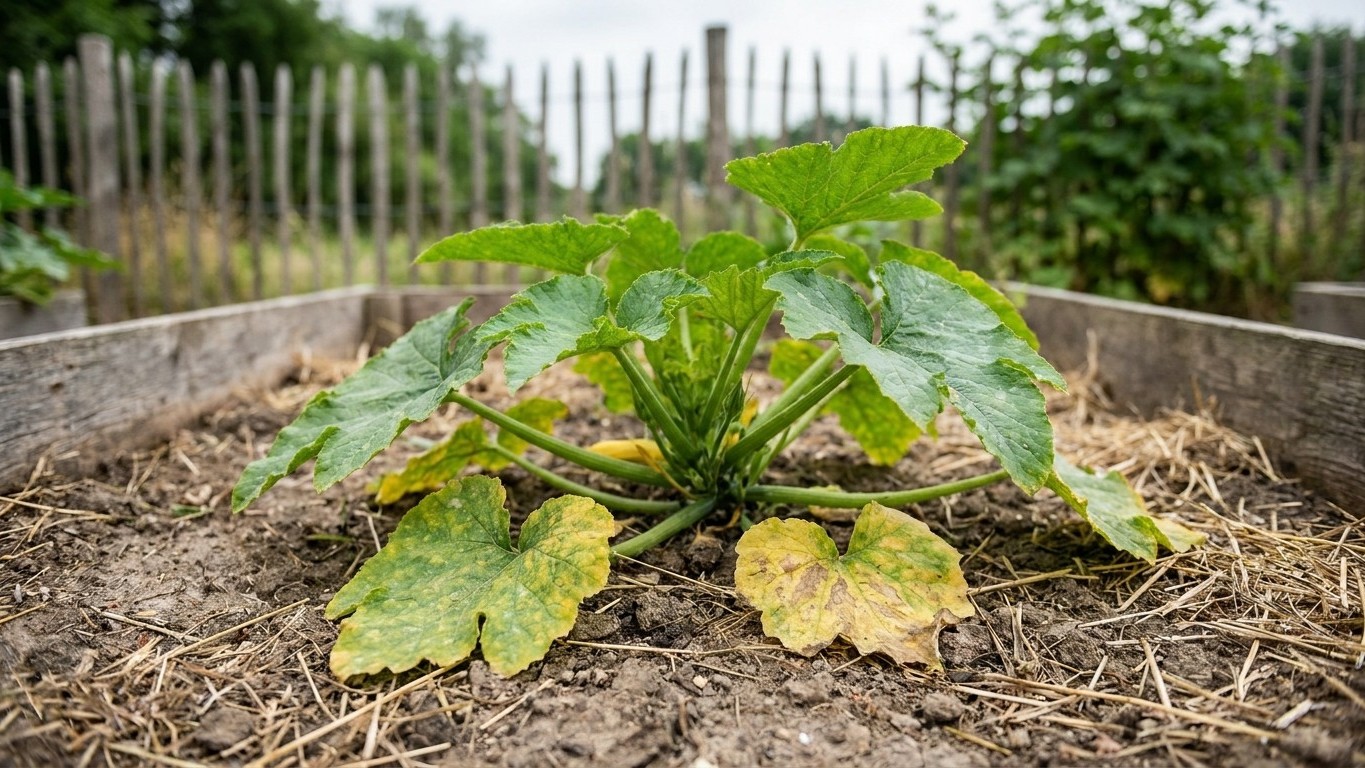

Pennsylvania’s growing season runs long enough at the Philadelphia end of the state for nearly any winter squash, but the northern tier and the Allegheny high country cut that window by weeks. Butternut, delicata, and acorn squash mature reliably almost everywhere in the state. Kabocha and Hubbard, the slowest to ripen, belong in the milder southeastern and south-central counties, not at elevation or near the New York line.
The short answer for Pennsylvania
Pennsylvania’s frost-free season at the reference station in Philadelphia stretches from the tail end of the last-frost window (March 29 to April 6) to the front edge of the first-fall-frost window (November 5 to November 16): call it roughly 210 to 230 days in a typical year at the mildest corner of the state. That’s long enough to finish any winter squash sold in a garden catalog, curing time included. The catch is that this figure describes Philadelphia, not the whole state. The northern tier and the Alleghenies run two to four weeks later in spring, which trims that same season toward 160 to 190 days depending on how far north or how high up you garden.
With that much room at the mild end, days-to-maturity should decide which squash you plant, not fear of frost. Acorn and delicata finish in 85 to 100 days and give the widest safety margin anywhere in the state. Butternut, at 100 to 110 days, fits comfortably within even the shortened northern-tier season most years. Kabocha runs close behind butternut. Hubbard, the slowest common type at 110 to 120 days, is the one that needs the full Philadelphia-length season to mature and cure before frost; it’s a reasonable bet in the southeastern and south-central counties and a risky one anywhere the spring frost date slides toward late April.
| Winter squash type | Typical days to maturity | Best fit in Pennsylvania |
|---|---|---|
| Acorn | 85-100 | Statewide, including northern tier and high elevation |
| Delicata | 85-100 | Statewide |
| Butternut | 100-110 | Statewide in most years; margin tighter in the north |
| Kabocha | 95-110 | Southeastern and south-central counties preferred |
| Hubbard | 110-120 | Southeastern and south-central counties only |
Summer heat is not the limiting factor here. Philadelphia averages 24 days a year at 90°F or hotter, plenty to ripen any of these types without turning the growing season into a heat-stress problem. Season length, not temperature, is what separates a safe choice from a marginal one in this state.
What will not work here
The clearest failure mode in Pennsylvania is planting a 110-to-120-day Hubbard on the same calendar as a gardener outside Philadelphia. In the northern tier and the Alleghenies, where spring frost risk lingers two to four weeks longer, that variety can still be weeks from curing when the first fall frost window opens on November 5. A squash caught by frost before the rind has hardened doesn’t store; it rots within weeks instead of lasting into winter. Anyone gardening near the New York border or well above sea level should treat Hubbard and other 110-plus-day types as a gamble, not a plan, and lean on acorn, delicata, or butternut instead.
Watering on a fixed weekly schedule is another common miscalculation. Summer rainfall across the state averages about 12.7 inches over June, July, and August, with June, the driest of the three, delivering around 4.04 inches. That sounds adequate on paper, but the figure describes a monthly total, not how the rain arrives. A single thunderstorm that drops an inch in twenty minutes runs off a squash hill instead of soaking into the root zone, and the 24 days a year at 90°F or hotter pull moisture out of leaves and soil faster than an average rainfall number suggests. Squash vines watered only when the calendar says so, rather than when the soil actually feels dry a couple of inches down, wilt by midsummer even in a state that isn’t considered dry.
Tight spacing fails for a related reason. Winter squash vines set close together in a state that gets regular summer rain hold moisture on their leaves longer after each storm, which is exactly the condition powdery mildew and vine borers need. The plants most likely to disappoint in Pennsylvania aren’t usually the ones planted too late, but the ones crowded into a bed sized for a drier climate.
What changes across Pennsylvania
Pennsylvania spans USDA hardiness zone 5a to 7b, a five-zone range built entirely on average annual extreme minimum winter temperature. That’s a wide spread for one state, and it means there’s no single planting date or variety list that fits Erie County the same way it fits Chester County. The mildest zones, 7a and 7b, sit in the southeastern corner near Philadelphia; the coldest, 5a, shows up in the northern tier and the highest ridges of the Alleghenies.
What that spread changes in practice is margin, not the list of squash types available. A gardener at the 7b end can plant Hubbard, kabocha, or any 110-plus-day type with confidence, because the frost-free window there runs closest to the 210-to-230-day range described earlier. A gardener at the 5a end is working with a season shortened by that same two to four weeks of later spring frost, and should treat the shortened window as the limit for choosing days-to-maturity, favoring acorn and delicata by default rather than as a backup plan.
Elevation compounds the zone effect independent of latitude. Two towns at the same line of latitude can sit in different zones if one is in a valley and the other on a ridge in the Alleghenies, since the USDA map is built on temperature extremes, not distance from the equator. Anyone gardening at higher elevation should treat the 5a to 7b range as a reminder to check the map for their own location rather than assume the state average applies, since neither this page nor a zip code alone can say which end of that spread a specific garden falls on.
Where to check this for your own county
Everything above describes Pennsylvania as a whole, built from one reference station and a statewide hardiness map. A county recommendation beats a state one every time, because it accounts for local frost patterns, soil, and which varieties have actually been trialled nearby. This page is the state-level view; the next step is checking it against Penn State Extension.
Penn State Extension, the land-grant university extension service for Pennsylvania, is online at extension.psu.edu. Penn State Extension operates an office in most of the state’s 67 counties, and many publish an annual vegetable planting guide alongside variety trial notes for squash and pumpkin that show which butternut, acorn, or Hubbard cultivars have actually performed well under local soil and season, rather than just in a seed catalog’s test plot. Look for the planting calendar specific to your county, which narrows the broad frost windows cited here into dates closer to your actual garden.
Many county offices also staff a master gardener hotline that answers exactly this kind of variety question for free. If the county-level guidance and this page disagree on a planting date or a variety recommendation, defer to the county source. It was built from data closer to your soil than a single Philadelphia weather station can offer.
Checking this against your own garden
Every frost date and zone map in this article describes an average across three decades of weather at one station. Your own garden runs on its own schedule, and three signs tell you more about it than any calendar.
Soil warmth by feel comes first. Winter squash seed sits and rots in cold soil rather than germinating, so before sowing, push a finger two to three inches into the bed where the seed will go. If it still feels cold and damp the way it did in March, wait, regardless of what the average last frost date says. Squash seed wants soil that feels warm to the touch, closer to bare skin temperature than to refrigerator temperature.
The first flush of male flowers is the second signal. Winter squash plants open male flowers, the ones on thin stems without a swollen base, well before the female flowers that actually set fruit. Seeing the first male flowers tells you the plant has shifted into reproductive growth and that female flowers, and pollination, are roughly one to two weeks out. A vine that reaches this stage weeks earlier or later than a neighbor’s, planted the same week, is a sign of a warmer or cooler microclimate than the county average.
Third, watch how fast the first true leaves appear after the seed leaves, the two smooth cotyledons, unfold. A gap of a week or less between cotyledons and the first serrated true leaf points to warm soil and a strong start. A longer gap, two weeks or more, suggests the soil was cooler than ideal at planting and that next year’s sowing date should shift later by roughly that same margin.