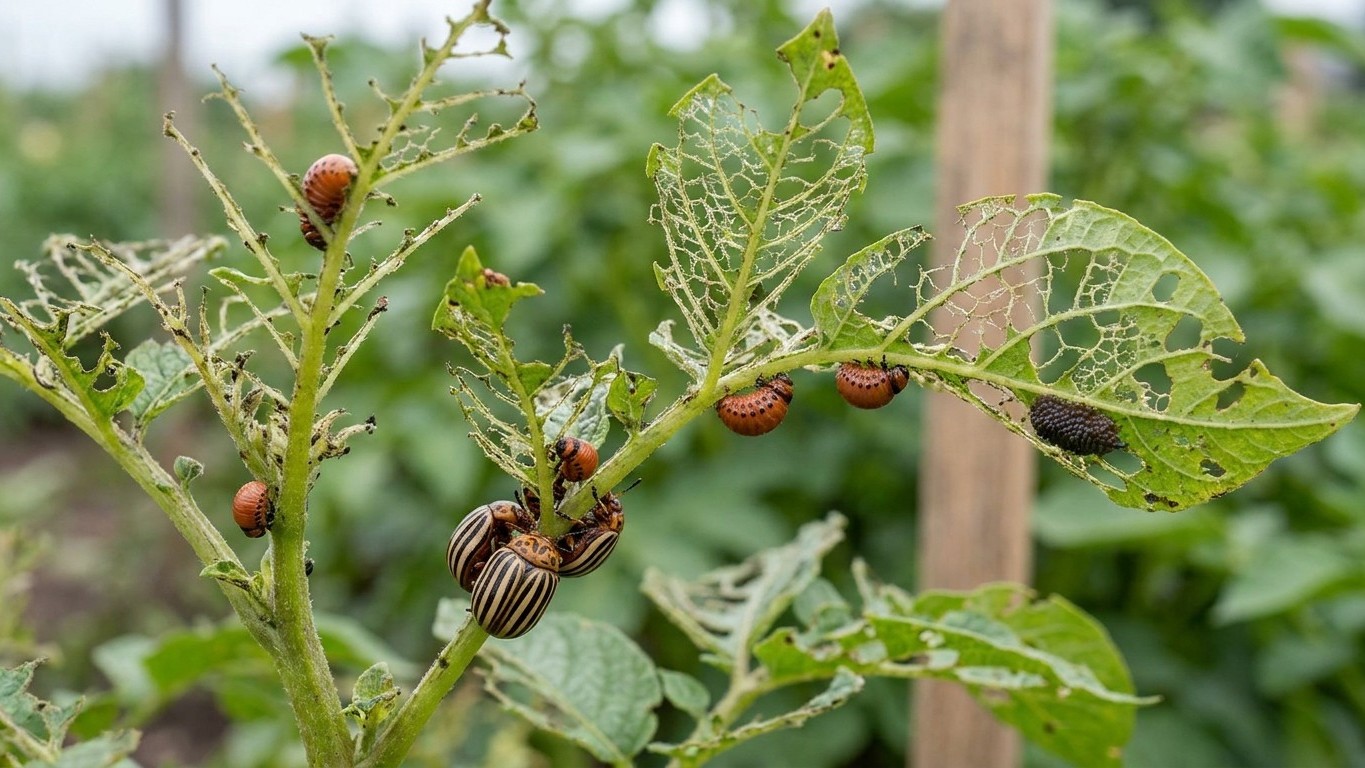

Skeletonized leaves, ragged holes that spread fast, and clusters of orange-red larvae feeding right alongside black-and-yellow striped adults are the giveaway. The Colorado potato beetle (Leptinotarsa decemlineata) targets potato and eggplant foliage almost exclusively, and it feeds in mixed-age groups, so you’ll often find egg masses, small larvae, full-grown larvae, and adults all on the same plant at once. That combination, more than any single mark, is what separates its damage from every other pest working the same row.
What the damage looks like

Step back from the row first. A potato or eggplant patch under attack looks patchy and tired before it looks destroyed: some plants still green and upright, others already thinned out, a few reduced to bare, forked stems poking up with almost nothing left on them. That uneven pattern, healthy plants next to stripped ones, is typical of this beetle because it colonizes a few plants and then works outward as the population grows.
Move in closer and the picture sharpens. Leaves show irregular chewing that starts at the edges and works inward, then larger sections eaten down to just the network of veins, giving the foliage a lacy, see-through look. This is the “skeletonizing” that gardeners and extension bulletins both describe, and it’s the single most reliable visual sign of this pest. You’ll also spot the culprits doing it: hard-shelled adults about the size of a pencil eraser, cream to yellow with bold black longitudinal stripes on the wing covers, and separately, humpbacked larvae in shades of orange-red with two rows of black spots along each side, ranging from tiny to plump depending on how long they’ve been feeding.
On the plant itself, the damage concentrates on new growth and upper foliage first, then spreads down the plant as populations build. Older, larger larvae do the heaviest feeding of any stage, so a plant that looked lightly nibbled a few days earlier can lose most of its canopy within a short stretch once those larvae mature. On young potato or eggplant transplants, that kind of defoliation can stunt or kill the plant outright. On established, flowering potatoes, stripped foliage cuts short the window the plant has to bulk up tubers underground, which shows up later as a lighter harvest rather than as visible plant death.
One trait worth knowing going in: this species has a long history of becoming difficult to manage with repeated insecticide use, a fact well documented by university entomology programs. That’s a separate issue from identification, but it explains why so much guidance leans on scouting, timing, and biological control rather than treating the beetle as a one-spray problem.
What it is confused with
Several other pests chew potato-family or eggplant leaves in ways that look similar from a few feet away, and mixing them up sends gardeners toward a control approach that does nothing for the actual insect on the plant.
| Could be confused with | How to tell it apart | Why the mix-up matters |
|---|---|---|
| Three-lined potato beetle (Lema daturaphila) | Smaller adult with three dark stripes running lengthwise on a paler background; larvae carry a dark, sticky covering of their own waste on their backs instead of showing bare orange-red skin with spotted rows. | Similar host plants and similar-looking chewing, but a different biology and timing, so treatments scouted and timed for Colorado potato beetle stages can miss this species’ active window entirely. |
| Flea beetles (Epitrix species) | Adults are tiny, shiny, and jump like fleas when disturbed; damage is a scatter of small round or shot-hole punctures rather than large skeletonized patches. | Gardeners who see holes and assume Colorado potato beetle often wait for larvae that never show up, missing the actual flea beetle window and letting damage continue. |
| False potato beetle (Leptinotarsa juncta) | Nearly identical stripe pattern to the true Colorado potato beetle, but it feeds mainly on horsenettle and related weeds rather than cultivated potato and eggplant, and rarely reaches damaging numbers on garden crops. | Treating every striped beetle on a nearby weed patch as a garden threat leads to unnecessary spraying of plants that aren’t actually at risk. |
| Blister beetles (several genera) | Longer, narrower, softer-bodied than Colorado potato beetle adults, often black, gray, or striped in different patterns, and found in tight feeding groups on the same host plants. | This is the mix-up that causes real harm: blister beetles release a chemical (cantharidin) that blisters skin on contact and is dangerous to livestock if eaten in hay. Hand-picking them the way you would Colorado potato beetle, bare-handed, can cause a painful skin reaction. |
The practical takeaway is to slow down before reaching for any control measure. Confirming the mixed-stage presence, eggs, larvae, and striped adults together, on potato or eggplant specifically, rules out most of these look-alikes on its own.
Where to look to confirm
Confirming this beetle means checking specific plant locations rather than scanning the whole garden at once. Start on the undersides of leaves, particularly toward the top third of the plant where growth is newest. Egg masses show up there as tight clusters of oval, bright yellow-orange eggs standing on end, glued to the leaf surface. Finding these is often the earliest sign, well before any visible chewing shows up on top of the leaf.
From there, work downward and outward. Small larvae tend to stay close to where they hatched, feeding in tight groups on the same leaf or an adjacent one. As they grow through their later stages, they spread across more of the plant and range lower into the canopy, which is where the heaviest skeletonizing damage accumulates. Adults move more freely across the whole plant and between neighboring plants, so finding a single striped adult on a healthy-looking leaf doesn’t confirm an active infestation the way finding eggs or larvae does.
Timing your check matters less for this species than for some other garden pests, since larvae feed steadily through the day rather than mainly at night. That said, early morning is a practical window: beetles and larvae are less active in cooler temperatures, which makes them easier to count accurately without them dropping off the leaf or scattering as you approach. Warm afternoons are when adults are most likely to be flying between plants, which is useful if you’re trying to confirm they’re present at all in a new area of the garden.
Don’t overlook the soil right at the base of stressed plants. Mature larvae drop to the ground to pupate just below the surface, so a plant that suddenly seems to have fewer larvae feeding on it hasn’t necessarily recovered, it may simply be between generations. Digging a small amount of soil at the stem base can reveal pupae when foliage checks come up inconclusive.
Exactly how many eggs, larvae, or adults justify taking action is not a fixed number that applies everywhere. Action levels, emergence timing, and degree-day thresholds for this species are set and updated by each state’s university extension service, based on local climate and crop calendars. Confirm identification using the plant-part checks above, then use your own state’s guidance to decide when the population crosses into a level worth managing.
What to do once you are sure
Once the mixed-stage feeding pattern, striped adults, spotted orange-red larvae, and yellow-orange egg clusters, confirms this beetle rather than a look-alike, timing becomes the next question. The life cycle of this species runs through several generations in a single season in many regions, and knowing which stage you’re looking at points to how much feeding pressure is still ahead. This site’s Colorado potato beetle life cycle page breaks down egg, larval, pupal, and adult timing so you can judge whether you’re catching an early wave or a late one.
Biological control matters more for this species than for many garden pests, because several natural enemies genuinely suppress populations when they’re allowed to operate. The spined soldier bug (Podisus maculiventris) preys directly on eggs and small larvae, and populations of lady beetles and lacewings do the same when they’re present in the garden. Parasitic tachinid flies, specifically Myiopharus doryphorae and Myiopharus aberrans, lay eggs on larvae and adults and can meaningfully reduce numbers in some regions and seasons. Ground beetles patrolling the soil surface also take a toll on pupae before they emerge as adults.
Protecting these predators and parasitoids comes down to a few consistent habits:
- Avoid broad-spectrum insecticide applications that kill natural enemies along with the target pest.
- Leave some flowering plants nearby, since adult parasitic flies and many predatory insects need nectar and pollen sources to sustain themselves between hunting.
- Rotate potato and eggplant plantings away from the previous year’s location where practical, since adults overwinter in soil near where they fed.
- Hand-remove egg masses and early larval clusters when numbers are still low, which reduces pressure without disturbing the beetles’ predators at all.
For the specific methods that hold up against this beetle’s well-documented resistance to many insecticides, including how to sequence hand removal, barriers, and biological options, this site’s Colorado potato beetle control page lays out what actually works and in what order. And because emergence dates, degree-day thresholds, and legal product options differ by state, check this site’s page for your own territory, where the relevant university extension service is named directly, before deciding on a treatment window.
Common questions
Does Colorado potato beetle damage kill the plant, or just reduce yield?
It depends on the plant’s age and how much foliage is lost. Young transplants stripped of most of their leaves can die outright, since they have little stored energy to regrow from. Mature, flowering potato plants usually survive heavy feeding but produce smaller tubers, because losing leaf area cuts short the period the plant spends building up the crop underground.
Can this beetle damage tomatoes as well as potatoes and eggplant?
It occasionally feeds lightly on tomato foliage since tomatoes are in the same plant family, but tomatoes are not a preferred host and rarely show significant damage. Potato and eggplant are the crops that consistently sustain feeding pressure from this species.
Why do the leaves look fine one week and stripped the next?
Because the largest, oldest larvae do most of the actual defoliation, and they reach that stage only after feeding through several smaller growth stages first. Early feeding by small larvae is easy to miss since it’s light and scattered; damage becomes obvious once those larvae mature and start consuming much larger amounts of leaf tissue in a short window.
If I see striped beetles but no larvae, is it still this pest?
Possibly, but confirm before assuming. Adults move between plants and can show up before laying eggs, or after a generation has already finished feeding elsewhere. Check leaf undersides for egg clusters and search the plant and surrounding soil for larvae or pupae before deciding the population is active on that particular plant.