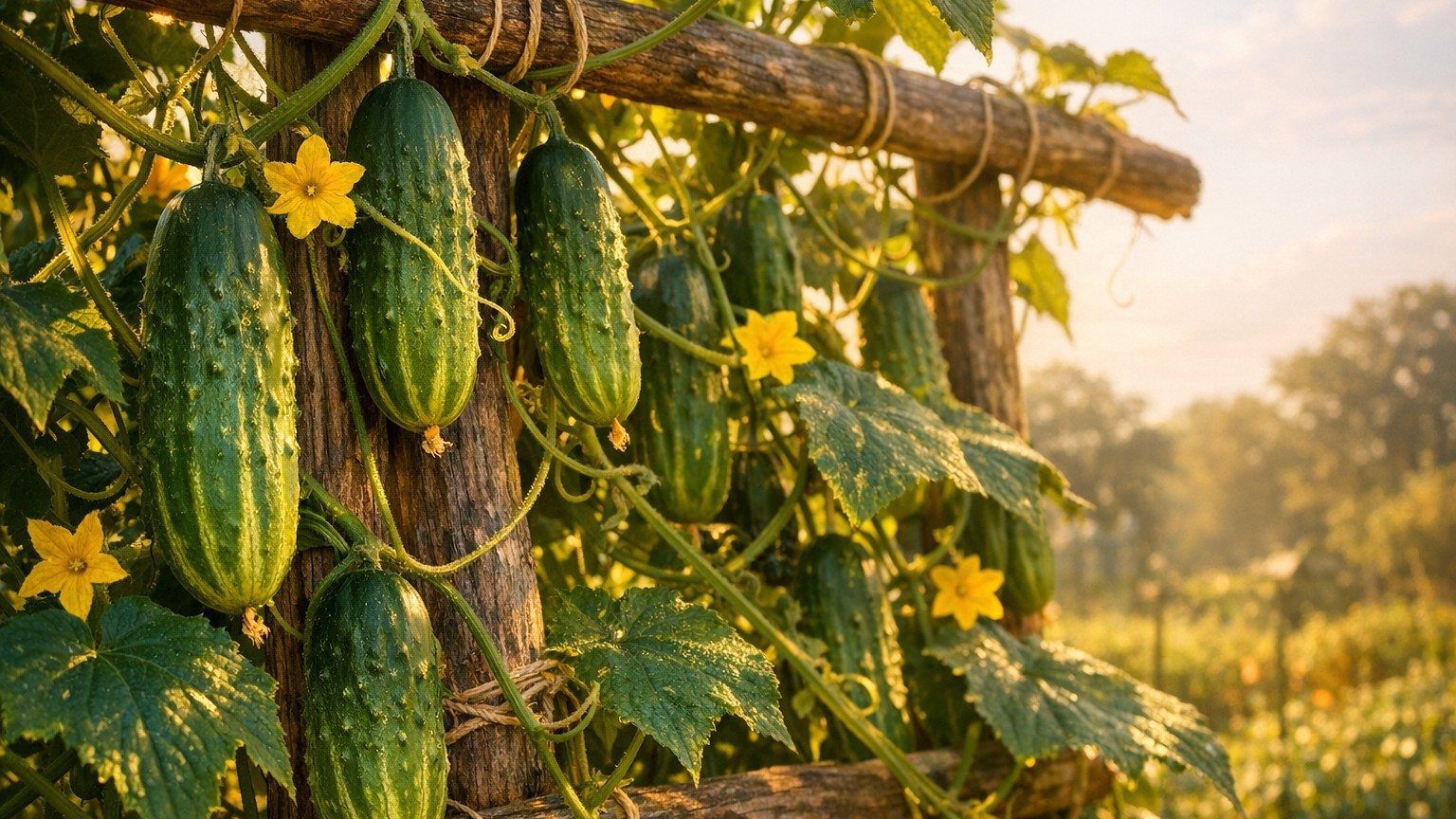

Prince Edward Island’s short, cool growing season and near-total absence of real summer heat point growers toward fast-maturing pickling cucumbers and shorter-season slicers, grown as bush types where space or season is tight. Long-vining, heat-hungry burpless and English types are a gamble outdoors here unless given extra protection.
The short answer for Prince Edward Island
Start with the numbers that actually run the show. Environment and Climate Change Canada puts the mean last spring frost at Charlottetown A on May 16 and the mean first fall frost on October 17. That’s roughly 154 days between the two averages, and it sounds like a generous window. But both dates are means, not safe cutoffs: in one year out of two, frost shows up later than May 16, and in one year out of two, the first fall frost also arrives later than October 17. The season can run shorter or longer than that 154-day midpoint depending on the year, which matters more for a frost-tender crop like cucumbers than for almost anything else in the garden.
The second number that decides everything: 0.0 days a year average above 90°F at the reference station. Cucumbers size up fastest with sustained heat, and PEI summers simply don’t deliver much of it. That single fact rules out relying on long-maturing types bred for hot, extended summers, and it explains why bush and pickling types, which were bred to size up fast in a shorter window, tend to outperform sprawling vine types here.
Sorting by type, not by name
What the numbers do support is a decision by type:
| Type | Fit for PEI | Why |
|---|---|---|
| Pickling cucumbers | Strong fit | Bred to mature quickly, tolerant of a shorter, cooler season |
| Bush habit (any use) | Strong fit | Compact canopy fills in faster, useful under row cover or in a cold frame |
| Shorter-season slicers | Workable fit | Can finish within the average frost-free window if started right |
| Long-vining slicers | Risky | Needs more heat units and season length than 0 days above 90°F reliably provides |
| Burpless / English types | Risky outdoors | Bred for sustained heat and a long season; usually need a greenhouse or tunnel here |
For the actual cultivar trialled and recommended in a given county, that call belongs to Prince Edward Island’s own extension service, not to a province-wide page like this one.
What will not work here

Long-maturing vining slicers and greenhouse-bred English cucumbers are the clearest failure case. They’re built for a season with real heat and plenty of it, and a summer with zero days at or above 90°F simply won’t push them to finish outdoors on a reliable timeline. Growers who plant them in the open garden are usually racing the October 17 mean frost date with a crop that still needs weeks of warmth it isn’t getting.
Tight spacing on the ground is the second trap. PEI runs a genuinely humid maritime summer, with about 10.8 inches of rain across June, July and August alone (June 3.89 inches, July 3.15, August 3.77). Vines sprawled close together with poor airflow hold that moisture on the leaf surface far longer, and powdery and downy mildew move fast in exactly that kind of dampness. Trellising, or at minimum wider spacing than a seed packet written for a drier climate suggests, matters more here than in a hot, dry state.
The instinct to water on a fixed weekly schedule, borrowed from advice written for hot, dry regions, also misreads this climate. PEI’s problem most summers isn’t drought stress, it’s the opposite: rain totaling nearly 4 inches in a single month on top of a gardener’s own watering can waterlog cool clay soils, rot seed before it germinates, and encourage the same fungal issues that crowded spacing invites. Watch the soil, not the calendar.
Finally, seeding cucumbers directly into the ground the moment the calendar hits May 16 is a common misstep. That date is a mean, and cucumbers are among the least frost-tolerant plants in a home garden. Because frost falls later than May 16 in roughly half the years on record, direct-seeding right on that date carries a real chance of losing the planting to a frost that, statistically, was always about as likely as not.
What changes across Prince Edward Island
The zone figure for Prince Edward Island is Canadian hardiness zone 5b, measured at the Charlottetown A reference station. That number matters for a reason worth flagging clearly: it’s the Canadian system, built from seven climate variables, not the single-variable USDA system used elsewhere on this site, and Natural Resources Canada itself warns the two don’t convert cleanly. Treat the 5b figure as describing Charlottetown’s own climate station, not the whole province.
Prince Edward Island is a small province, but it isn’t one climate. A reading taken at a coastal station near open water behaves differently from a garden set back from the shore, at slightly higher elevation, or exposed to wind funneling across open farmland. Coastal moderation tends to soften both the spring warm-up and the fall cool-down near the water; inland and higher ground typically lag behind on spring warming and cool off sooner in autumn. Since the province’s only sourced frost dates and heat figures come from one Charlottetown station, a reader gardening well away from that station should expect their own effective frost-free window to run somewhat shorter than the provincial mean, particularly at the fall end.
What it can say is that a single zone number for the province would overstate how uniform PEI’s growing conditions really are. The province’s own hardiness zone map, published by Natural Resources Canada, is where a reader can see the zone assigned to their specific municipality rather than borrowing Charlottetown’s.
Where to check this for your own county
Prince Edward Island’s agriculture division publishes provincial guidance at princeedwardisland.ca/en/topic/agriculture, and that’s the right next stop for anyone trying to move from provincial numbers to something specific to their own soil.
Two things are worth pulling from that resource specifically. First, any local planting calendar the province or a county-level program has issued, which will reflect actual frost data closer to the reader’s own farm or backyard than the single Charlottetown station. Second, records of which cucumber types and cultivars have actually been trialled and recommended in the reader’s own county. That’s the piece this provincial-level page cannot responsibly provide, since naming a specific variety without a sourced trial result behind it would be a guess dressed up as advice.
The general rule holds regardless of where in the province someone gardens: a county-level recommendation, tested against local soil and local frost patterns, will beat a province-wide one every time. Anyone serious about squeezing the most out of a short cucumber season here should start with the provincial numbers, then check their own garden.
Checking this against your own garden
Every date and average describes a reference station, not a specific backyard, so the most reliable information available to any PEI gardener is what’s actually happening on their own plot.
Soil warmth by feel is the first and most useful check. Push a hand a few inches into the bed where cucumbers are meant to go. If the soil still feels cold and heavy rather than mild, seed sown there will sit and rot rather than germinate, no matter what the calendar says about the mean frost date having passed. Cucumber seed wants soil that’s genuinely warmed through, not just air that’s warmed up on a sunny afternoon.
The first flush of male flowers is the second signal. Cucumbers typically produce male blooms before the female flowers that actually set fruit, and how quickly that first flush shows up says something about how much accumulated warmth the plant has actually banked in its own microclimate, regardless of what a regional heat average suggests.
The appearance of the first true leaves, the ones that follow the rounded seed leaves and actually look like miniature cucumber foliage, marks the point where the plant has moved past its most fragile stage. A garden that reaches that stage well ahead of, or well behind, the pace a neighbor a few miles away reports is telling its owner something real about a warmer or cooler pocket that no provincial average could ever capture.