
Melons can be grown outdoors in Prince Edward Island, but the province sits at the cool edge of what the crop tolerates. Success depends less on the calendar date than on soil warmth, disease-resistant types, and techniques that trap heat in a short, often damp season. Expect a narrow window and a hands-on approach rather than a set-and-forget planting.
When the soil is warm enough in Prince Edward Island
The average last spring frost at Charlottetown A, Environment and Climate Change Canada’s reference station for the province, falls on May 16 (Canadian Climate Normals, 1981-2010). That date gets quoted constantly, but it’s a mean, not a guarantee. In one year out of two, frost arrives after May 16, sometimes well after. Treat it as the midpoint of a risk window, not a green light for planting.
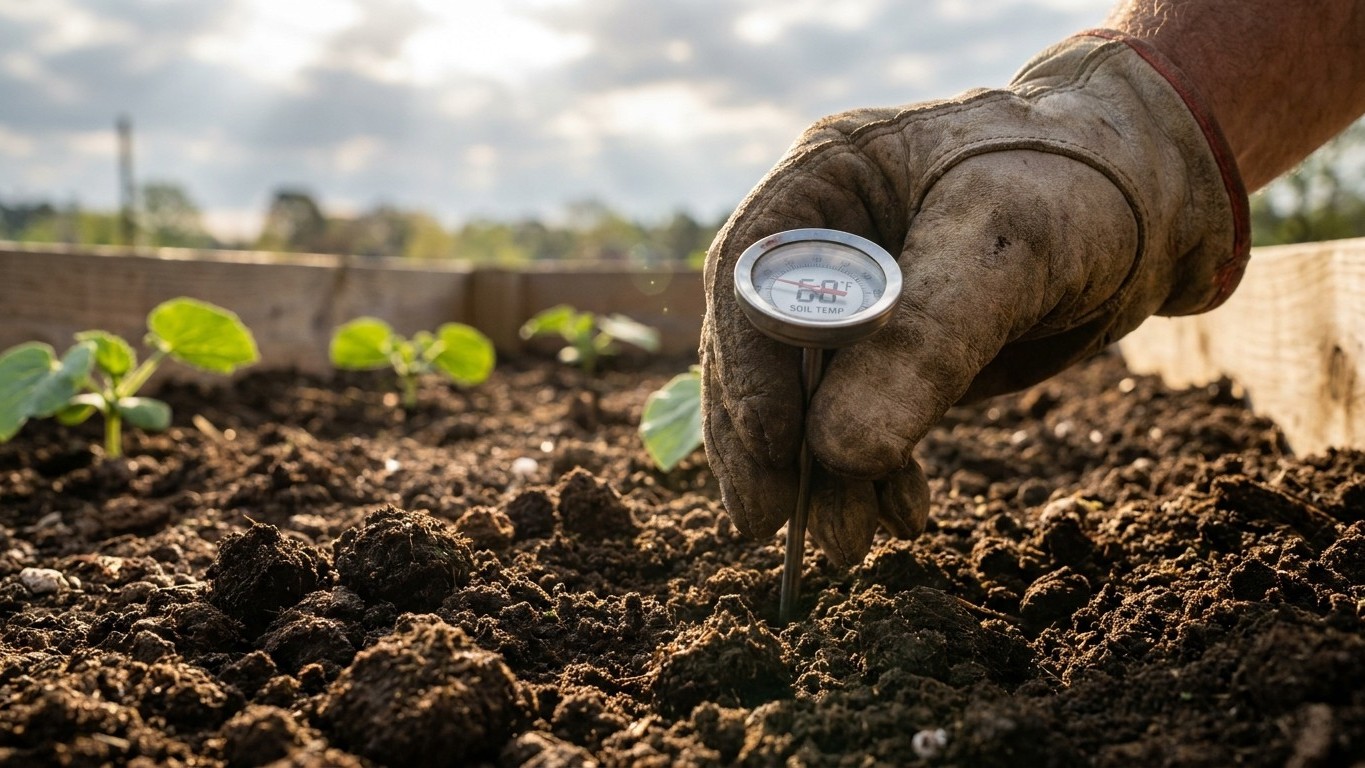
Frost dates also answer the wrong question for melons. What actually matters is soil temperature, and soil lags behind air temperature by weeks. A patch of ground can sit stubbornly cold and wet long after the last frost has passed, especially on the heavier clay-loam soils common across parts of the Island. Melon seed sown into cold soil either rots or germinates so slowly that any head start is lost. The practical move is to wait until the soil itself feels consistently warm through the day and night, not just to count days from the frost date on a chart.
Why the frost date is a proxy, not a rule
Gardeners often plant melons the week after the “average” frost date and assume they’re safe. They’re not. Because May 16 is an average drawn from three decades of records, roughly half of those years saw frost strike later. Prince Edward Island also falls into Canadian hardiness zone 5b at the reference city used for this data (Natural Resources Canada, Plant Hardiness Site, 1991-2020 normals), a system built on seven climate variables and not comparable to the USDA zones used elsewhere on this site. It describes the reference location only; coastal pockets, elevated inland ground, and sheltered south-facing gardens can all run warmer or colder than the provincial reference station suggests.
Given that spread, most Island gardeners lean on warming techniques rather than an early sowing date: black plastic mulch to raise soil temperature, floating row cover to buffer cool nights, and a sheltered, south-facing bed to catch extra sun. None of that changes the biology, melons still want reliably warm soil, but it buys days in a province that doesn’t have many to spare.
How long the season lasts here
Run the two frost dates from Charlottetown A together and the frost-free window comes out to 154 days, from the average last spring frost on May 16 to the average first fall frost on October 17. On paper, that’s not a bad stretch. In practice, a meaningful chunk of it gets eaten up waiting for soil to warm past the point where melon roots will actually grow, which pushes the real planting window later than the raw frost-free count implies.
That compressed reality changes the strategy. In regions with genuinely long, hot seasons, gardeners can often get away with a second sowing later in summer as insurance or for a staggered harvest. Prince Edward Island’s window doesn’t leave that kind of margin. The first sowing, timed to warm soil rather than the calendar, is usually the only shot at a mature crop before the October frost risk sets in.
That reality also tips the scale toward starting plants indoors and transplanting rather than direct-seeding outdoors. Melons resent root disturbance, so a transplant has to be raised in a container that lets the whole root ball go into the ground undisturbed, and it has to go out promptly once conditions allow rather than sitting and becoming rootbound. Anyone weighing whether to direct-seed or transplant, and how to stagger sowings when the season allows it, should work through the site’s succession sowing guide before committing a whole bed to one planting date.
Heat and water in Prince Edward Island
This is the number that reframes everything else: the reference station at Charlottetown records an average of 0.0 days a year above 90°F (ECCC Canadian Climate Normals, 1981-2010). Essentially, the Island doesn’t get genuinely hot summer heat. Melons are a crop that ripens on accumulated warmth over the whole season, not on the calendar, and a territory with zero days above 90°F is one where that accumulated warmth simply isn’t going to show up on its own.
That single fact should override any instinct to garden here the way someone would in a hot, dry region. In a warm climate with little summer rain, the conversation is about irrigation scheduling and how the final weeks of dry heat concentrate sugar in the fruit. None of that applies on Prince Edward Island. Summer rainfall averages about 10.8 inches across June, July and August (June 3.89 inches, July 3.15 inches, August 3.77 inches, per ECCC Canadian Climate Normals, 1981-2010), with July as the relatively driest month. That’s a meaningful amount of moisture landing through the growing season, on top of already limited heat.
The combination of low heat accumulation and steady summer rain points to a different set of risks entirely: powdery and downy mildew, slower ripening, and fruit that struggles to size up and sweeten before the season closes. Airflow around plants, avoiding overhead watering late in the day, and keeping foliage from staying wet overnight matter more here than any irrigation schedule. Where a hot, dry province is fighting drought stress, Prince Edward Island is fighting dampness and a short supply of warm days. Rainfall figures also never tell the whole story on their own; how quickly a given soil drains it, and how much extra evaporation the (rare) hot day drives, both change how the same 10.8 inches actually behaves in a specific garden.
Which melons suit Prince Edward Island
Given a compressed heat budget and a habitually damp summer, the types that make sense in this province share a couple of traits: they mature quickly relative to other melons, and they carry some resistance to the fungal diseases that thrive in cool, humid air. Small-fruited, early-maturing types generally have an easier path to a finished harvest here than large, long-season types bred for hot inland climates. Disease resistance, particularly to powdery and downy mildew, deserves to be the first filter applied, ahead of flavor or size, simply because a plant that succumbs to mildew in August never gets the chance to ripen anything.
Raising plants off the ground with airflow underneath, giving roots even, consistent moisture rather than let them alternate between soggy and dry, and using black plastic or a similar warming mulch to push soil temperature up all support whichever type gets chosen. None of that substitutes for picking a type suited to a short, cool, wet season in the first place.
This page won’t name a specific variety, and that’s a deliberate choice rather than an omission. Provincial and county trial results shift from year to year and from soil to soil, and a variety that performs well in a trial plot on the mainland or in a seed catalog written for a much hotter zone may simply fail here. The Prince Edward Island Department of Agriculture (princeedwardisland.ca/en/topic/agriculture) tracks what’s actually been trialled and performed under these specific conditions, and that local record is worth more than any name printed on a seed packet designed for a different climate. Anyone serious about a melon harvest on the Island should start there, then match the type to the season length and disease pressure described above, and only then choose from among the options that extension has actually tested in this ground.