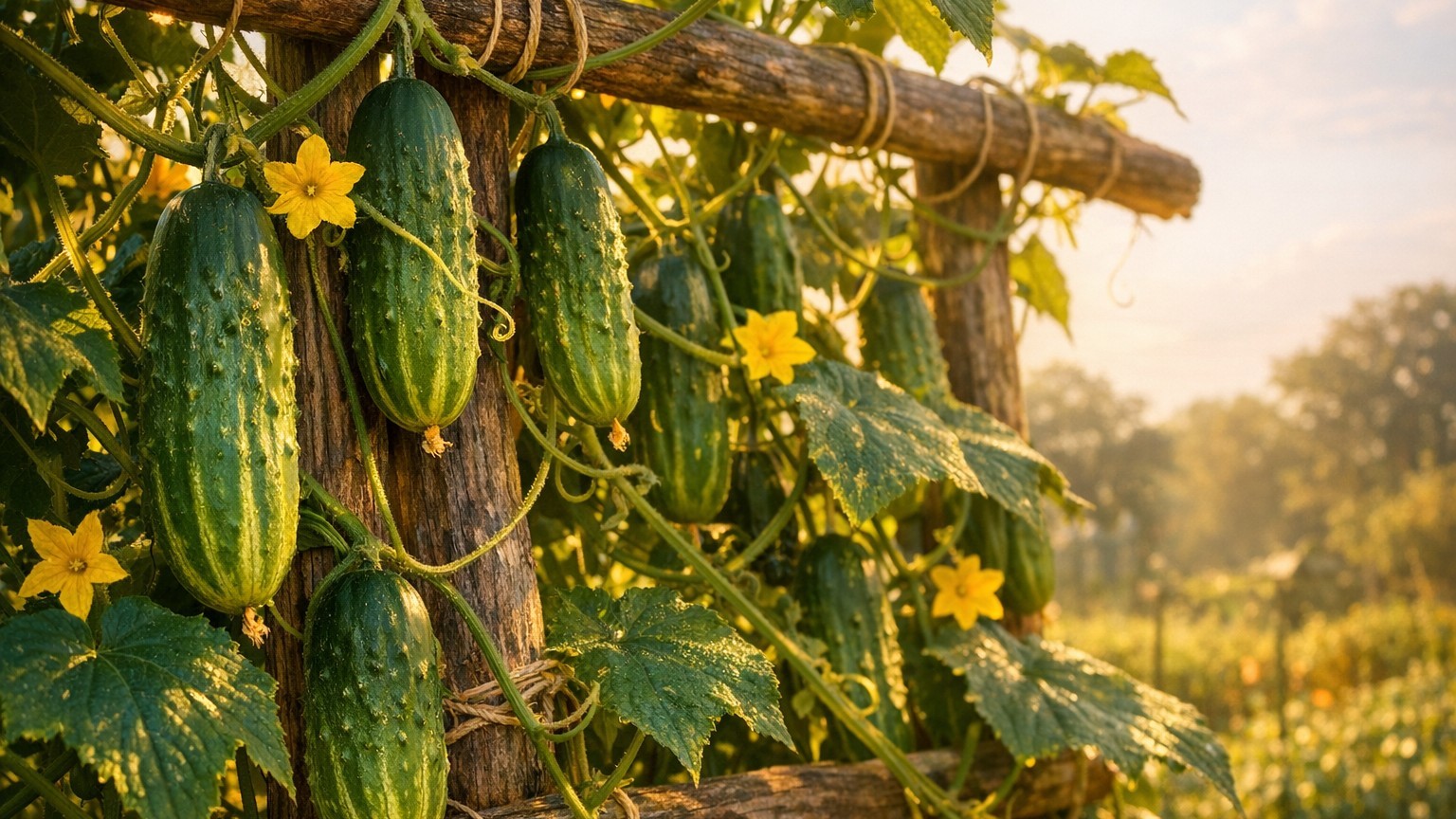

For a Saskatchewan garden, the safest cucumber bet is a fast-maturing bush or pickling type, especially a parthenocarpic one that sets fruit without help from pollinators. The province’s mean frost-free window runs only from May 18 to September 18, and summers rarely see a day above 90F. Long-season slicing or greenhouse-style cucumbers routinely run out of time.
The short answer for Saskatchewan
Start with the math, because it’s what drives everything else. A mean last spring frost of May 18 and a mean first fall frost of September 18 leaves about 123 days of frost-free growing at the Saskatoon reference station. That’s the number every cucumber decision in this province has to fit inside, and it’s tighter than what a lot of seed catalog descriptions assume when they were written for longer, hotter growing regions.
Bush and pickling types tend to size up faster than long vining slicers, which is the main reason they fit better here. Parthenocarpic and gynoecious types add a second advantage: cold early-June nights in a zone 3a climate keep pollinator activity low, and standard varieties that depend on bees for fruit set can stall for a week or two waiting on pollination that just isn’t showing up yet. A cucumber that sets fruit on its own skips that delay entirely.
With an average of zero days a year reaching 90F, heat-loving types bred for a long, hot stretch rarely get the warmth spike they need to speed up. Trellising helps regardless of type, since it lifts fruit into warmer air above the soil and off ground that stays cool and sometimes damp through the season.
| Type | Fit for a zone 3a season | Pollination need | Support |
|---|---|---|---|
| Bush pickling | Good, fast to mature | Standard or parthenocarpic | Minimal |
| Standard vining slicer | Marginal, longer maturity | Needs pollinators | Trellis recommended |
| Parthenocarpic / gynoecious | Best fit for a cool, short season | None required | Trellis or row cover |
| Burpless / English long | Poor fit, bred for extended warm summers | Often needs isolation from other types | High tunnel or greenhouse |
None of this replaces a name. The type is the decision this page can make responsibly; the specific variety trialled and proven in a given county is a decision for the province’s own agriculture service, further down this page.
What will not work here
Long-maturing slicing or specialty cucumbers bred for extended, warm summers are the clearest mismatch. With an average of zero days a year at or above 90F, these types never get the heat units to size up on schedule, and by the time they’d normally start producing heavily, the mean September 18 frost is already back on the calendar.
Treating May 18 as a safe planting date is a second, quieter failure. It’s a mean, which means in roughly half of all years the last frost falls later than that date. Direct-seeded cucumbers, which are frost-tender from the moment they germinate, put in the ground right on the average date get caught in the years frost runs late.
Counting on summer rainfall to cover irrigation is a third trap. Saskatoon’s summer normal is about 6.6 inches across June, July and August, and August itself averages only 1.68 inches, the driest of the three. Cucumbers need steady moisture to size up without turning bitter, and a dry August stretch with no supplemental watering shows up fast as misshapen or bitter fruit.
Sprawling vining varieties left to spread on bare ground waste some of a season that’s already short. Trellising raises fruit into warmer air and off cool soil, which matters more here than in a longer, hotter zone where a few extra warm days aren’t the difference between a ripe cucumber and a green one still on the vine at frost.
Finally, planning a rolling harvest with cucumbers sown every two or three weeks through summer, the way a gardener in a longer season might, usually backfires. With this tight a window, most Saskatchewan gardens get one solid, well-timed crop rather than a string of staggered ones.
What changes across Saskatchewan
The zone 3a figure and the frost dates above both come from a single reference station near Saskatoon. Saskatchewan is not one climate, and the Canadian hardiness system, built on seven weather variables rather than the single minimum-temperature measure the USDA uses, can shift meaningfully from one part of a province to another.
There’s no single zone number that honestly describes the whole province, and this page won’t pretend otherwise. A garden north of Saskatoon, or one at higher elevation, likely sees a shorter frost-free window than the mean dates given here, both a later spring frost and an earlier fall one, which squeezes an already tight cucumber season further still.
What to do with that is straightforward: don’t guess a personal zone from a provincial average. Natural Resources Canada’s Plant Hardiness site lets a gardener look up the zone for their own municipality, and that number, not the Saskatoon reference figure used throughout this page, should guide decisions about which cucumber type to risk and how much frost protection to plan for at both ends of the season.
The same caution applies to rainfall. The summer figures cited here come from one station too, and a rain shadow, a slope, or even a difference in soil that holds or sheds moisture can make actual watering needs run higher or lower than the provincial normal suggests.
Where to check this for your own county
Saskatchewan’s own agriculture service is the right next stop, and it’s reachable through the province’s agribusiness, farmers and ranchers page. That’s a state-level resource, in the same sense as everything above it on this page: useful for the shape of the decision, not a substitute for what applies in a specific rural municipality.
Two things are worth looking for once there. First, a local planting calendar adjusted for a specific district rather than the Saskatoon-based averages used here, since actual frost dates can run a week or more different depending on location within the province. Second, any list of cucumber varieties that have actually been trialled in the reader’s own region, which is the closest thing to a real answer to “which variety” that exists for a place this size.
A county or district-level recommendation will always beat a provincial one, for the simple reason that it’s built on conditions closer to the actual garden in question. This page works at the scale of the whole province, using one reference station’s frost dates and rainfall normals to describe general fit. That’s useful for choosing a type of cucumber and ruling out ones that clearly won’t work, but it isn’t the same as knowing what’s grown well two or three seasons running on a specific block of land.
Checking this against your own garden
None of the numbers above beat what a gardener can observe directly, and three signs matter more than any date on a calendar.
Soil warmth by feel is the first. Cucumber seed sits and rots in cold soil rather than germinating, so pushing a bare hand a couple of inches into the planting row and feeling for real warmth, not just “not frozen,” tells more about readiness than the mean frost date does. Cold, damp soil that still feels chilly in late May is a sign to wait, regardless of what the calendar says.
The first flush of male flowers is the second. Cucumbers open male blooms before female ones, and seeing those bright yellow flowers appear is an early signal the plant is maturing, though it isn’t yet producing fruit. Female flowers, easy to spot by the tiny cucumber-shaped swelling behind the petals, are the ones that actually turn into a harvest once pollinated or, on a parthenocarpic type, on their own.
First true leaves are the third. The rounded seed leaves that appear first aren’t the plant’s real foliage; the jagged, cucumber-shaped leaves that follow are, and their appearance signals the seedling is established enough to handle thinning, transplant shock, or a first light feeding. A garden where true leaves show up noticeably earlier or later than a neighbor’s, even a few blocks away, is telling its owner something specific about its own microclimate that no provincial average ever will.